



view more
Credit: Andreas Oelker; icon illustrations by Annika Brandtner, CC-BY 4.0 (
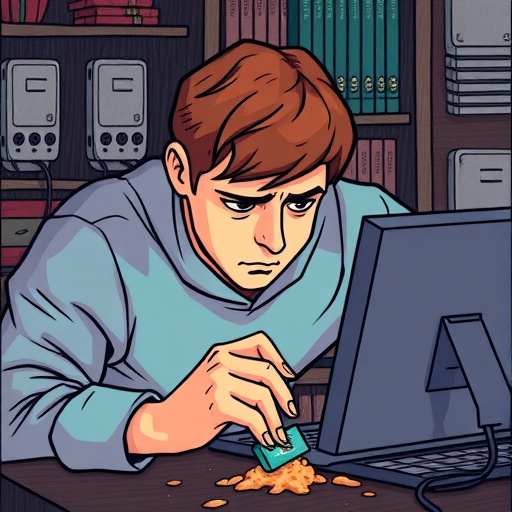
People described as ‘problematic’ Internet users report higher stress, worse mood, and greater neglect of other activities than those who surf the web sparingly, according to a study published July 29, 2026 in the open access journal PLOS One by Silke M. Müller from the University Hospital Essen, Germany, and colleagues. These users also reported a stronger temptation to return to the Internet.
Problematic Internet usage (PUI) is a pathology defined by using online applications (i.e., gaming, gambling, pornography use, social network use, and shopping online) excessively and to the point of functional impairment or distress. Researchers theorize that individuals may seek out the Internet to satiate stress or a bad mood, forming habits that evolve into cycles. The severity of PUI can vary, with the most extreme cases causing neglect in other areas of life.
Müller and colleagues wondered whether daily stress, mood and temptation could be used to predict a person’s daily internet usage, and further, how these factors in turn affect daily pleasure, relief and neglect of other activities.
The researchers tested this theory with 900 German adults who reported engaging in gaming, pornography use, social network use, or online shopping at least once in the last year. Depending on the degree to which they engaged in these behaviors, their Internet use was classified as pathological, risky, or non-problematic.
After diagnostic interviews, the participants completed an assessment every evening for 14 days. They reported their mood and stress levels, temptation to engage in PUI, and total Internet usage, as well as how much pleasure was derived from Internet usage and whether any other activities were neglected as a result.
Results revealed that more severe PUI is associated with worse mood, more stress, longer Internet use times and greater neglect of other areas of life. Consistent with existing theories, temptation was the main driver for continued Internet use, with feelings of pleasure and relief emerging as reinforcing factors. On the whole, the data and analysis indicated that common theoretical models of problematic Internet usage appear in everyday life.
Andreas Oelker adds: “Our study shows that the feeling of temptation is the central mechanism linking emotional states with problematic Internet use in everyday life. More than actual stress or mood alone, it is the momentary urge to go online that determines whether people engage in online activities and experience both rewarding and harmful consequences.”
“The ambulatory assessment allowed us to examine psychological processes in daily life. Understanding why individuals at risk of problematic internet use go online at particular moments is essential for developing better prevention and treatment strategies. Our findings suggest that helping people recognize and manage moments of temptation may be more effective than focusing on stress or mood alone.”
In your coverage, please use this URL to provide access to the freely available article in PLOS One:
Citation: Oelker A, Knorr A, Brand M, Müller SM, on behalf of the FOR2974 Consortium (2026) Temptation as a key driver between affective states and usage outcomes of problematic usage of the Internet: A 14-day ambulatory assessment study. PLoS One 21(7): e0352776.
Author countries: Germany.
Funding: The following funding supported this study: Deutsche Forschungsgemeinschaft, 411232260, awarded to M.B. We also acknowledge support by the Open Access Publication Fund of the University of Duisburg-Essen.
Journal
PLOS One
Method of Research
Survey
Subject of Research
Not applicable
Article Title
Temptation as a key driver between affective states and usage outcomes of problematic usage of the Internet: A 14-day ambulatory assessment study
Article Publication Date
29-Jul-2026
COI Statement
I have read the journal’s policy and the authors of this manuscript have the following competing interests: MB and SMM receive funding from the Deutsche Forschungsgemeinschaft (DFG, German Research Foundation). MB also receives funding from the EU, and the German Federal Ministry of Education and Research. The authors report no financial relationships with commercial interests related to this manuscript. This does not alter our adherence to PLOS ONE policies on sharing data and materials.
Hanna Abdallah
PLOS
onepress@plos.org
Journal
PLOS One
Method of Research
Survey
Subject of Research
Not applicable
Article Title
Temptation as a key driver between affective states and usage outcomes of problematic usage of the Internet: A 14-day ambulatory assessment study
Article Publication Date
29-Jul-2026
COI Statement
I have read the journal’s policy and the authors of this manuscript have the following competing interests: MB and SMM receive funding from the Deutsche Forschungsgemeinschaft (DFG, German Research Foundation). MB also receives funding from the EU, and the German Federal Ministry of Education and Research. The authors report no financial relationships with commercial interests related to this manuscript. This does not alter our adherence to PLOS ONE policies on sharing data and materials.
Cite Scienmag News
Denise Maddox. (July 29, 2026). Internet users are crabbier, more stressed, and more tempted than the rest of us. Scienmag. https://scienmag.com/internet-users-are-crabbier-more-stressed-and-more-tempted-than-the-rest-of-us/
Denise Maddox. "Internet users are crabbier, more stressed, and more tempted than the rest of us." Scienmag, 29 July 2026, https://scienmag.com/internet-users-are-crabbier-more-stressed-and-more-tempted-than-the-rest-of-us/. Accessed 3 September 2026.
Denise Maddox. "Internet users are crabbier, more stressed, and more tempted than the rest of us." Scienmag. July 29, 2026. https://scienmag.com/internet-users-are-crabbier-more-stressed-and-more-tempted-than-the-rest-of-us/

