

Wednesday, July 29, 2026
Science
No Result
View All Result
  • Login
  • HOME
  • SCIENCE NEWS
  • CONTACT US
  • HOME
  • SCIENCE NEWS
  • CONTACT US
No Result
View All Result
Scienmag
No Result
View All Result
Home Science News Medicine

Rational Design of Disordered Proteins Enables Sequence-Function Investigation

July 29, 2026
in Medicine, Technology and Engineering
Reading Time: 2 mins read
0
Rational Design of Disordered Proteins Enables Sequence-Function Investigation

Rational Design of Disordered Proteins Enables Sequence-Function Investigation

65
SHARES
587
VIEWS
Share on FacebookShare on Twitter
ADVERTISEMENT

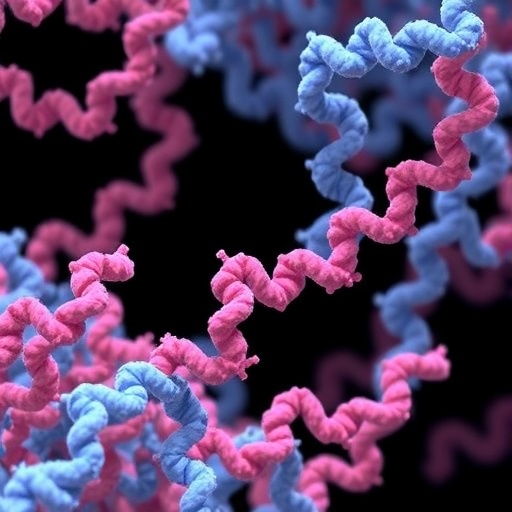
Intrinsically disordered proteins (IDRs)—segments that do not adopt a single stable 3D structure—are common across life and perform crucial cellular jobs. Yet while scientists can now design folded proteins with increasing precision, designing IDRs that reliably produce desired behaviors has remained far harder. A new study in Nature reports a computational strategy aimed at closing this gap.

The research introduces GOOSE (Generate disOrdered prOteins Specifying propErties), a framework built to rationally design IDR sequences and predict how they will behave as ensembles rather than fixed structures. Instead of treating disorder as a failure of structure, GOOSE explicitly links sequence features to the distribution of conformations that proteins sample over time in cellular contexts.

A central advance is throughput: the platform enables the generation and testing of thousands of candidate IDR sequences. By systematically varying sequence properties and analyzing the resulting structural ensembles, the team identifies sequence-to-function relationships that were previously difficult to uncover experimentally at scale.

GOOSE also supports “ensemble engineering,” where designers tune the balance of conformations so that an IDR responds to physical or environmental changes. In one set of experiments, the authors designed IDRs that react to structural shifts associated with decreased cell volume, suggesting a route to build disordered sensors that couple biophysical stress to reproducible molecular outcomes.

Beyond responsiveness, the framework can produce scaffold-like IDRs that self-assemble. These scaffolds can recruit specific clients, effectively turning an intrinsically disordered region into a programmable recruitment platform. This offers a computational path toward controlling multicomponent organization without relying on rigid tertiary architecture.

The study further demonstrates that IDRs can be designed for protective roles in harsh conditions. Using GOOSE, the authors create novel disordered sequences intended to shield cells from desiccation-related damage—an ability that disorder is known to support in nature, but that has been challenging to replicate by design.

Overall, the work reframes IDR design as a sequence-driven, ensemble-based problem that is solvable with sufficiently general computational tools. By combining rational design with large-scale sequence exploration, GOOSE turns disordered proteins into a tractable engineering target and a platform for probing how sequence encodes function in dynamic molecular systems.

The article’s DOI is https://doi.org/10.1038/s41586-026-10849-1.

Subject of Research: Rational design of intrinsically disordered proteins (IDRs)

Article Title: Rational design of disordered proteins for sequence–function investigation.

Article References: Hunter, K., Brandt, T., Guadalupe, K. et al. Rational design of disordered proteins for sequence–function investigation. Nature (2026). https://doi.org/10.1038/s41586-026-10849-1

DOI: https://doi.org/10.1038/s41586-026-10849-1

Keywords: intrinsically disordered proteins, IDR design, protein ensembles, sequence–function mapping, computational protein design, GOOSE, self-assembly, cellular volume sensing, desiccation protection

Tags: Computational protein engineeringdisorder in cellular functionsdisorder-to-function relationshipensemble-based protein designenvironment-responsive IDRsGOOSE framework for IDRshigh-throughput IDR testingIDR sequence designintrinsically disordered proteinsrational design of disordered proteinssequence-ensemble relationshipsstructure prediction for IDRs
Share26Tweet16
Previous Post

Zhurong Observations Reveal Primary Evaporite Deposits in Mars Utopia Planitia

Next Post

Researchers Uncover Nonlinear Mechanism Driving Northern Hemisphere Lake Ice Loss

Related Posts

Taufer Leads NSF-Funded $9 Million Team to Accelerate AI-Driven Discovery
Technology and Engineering

Taufer Leads NSF-Funded $9 Million Team to Accelerate AI-Driven Discovery

July 29, 2026
AI Tool Acts Like a Molecular Shrink Ray, Redesigns Proteins Reliably
Medicine

AI Tool Acts Like a Molecular Shrink Ray, Redesigns Proteins Reliably

July 29, 2026
Short ACE2 Isoform Increases in Adipose Tissue of Women With Obesity
Medicine

Short ACE2 Isoform Increases in Adipose Tissue of Women With Obesity

July 29, 2026
Mitochondria plaques in Alzheimer’s linked to buildup and lysosomal dysfunction
Medicine

Mitochondria plaques in Alzheimer’s linked to buildup and lysosomal dysfunction

July 29, 2026
Conformations of Neuronal Na+, K+-ATPase Isoforms and a Disease-Causing Variant
Medicine

Conformations of Neuronal Na+, K+-ATPase Isoforms and a Disease-Causing Variant

July 29, 2026
Process Mapping Informs Design Strategies to Curb Inappropriate HFNC Use
Technology and Engineering

Process Mapping Informs Design Strategies to Curb Inappropriate HFNC Use

July 29, 2026
Next Post
Researchers Uncover Nonlinear Mechanism Driving Northern Hemisphere Lake Ice Loss

Researchers Uncover Nonlinear Mechanism Driving Northern Hemisphere Lake Ice Loss

  • Mothers who receive childcare support from maternal grandparents show more

    Mothers who receive childcare support from maternal grandparents show more parental warmth, finds NTU Singapore study

    27656 shares
    Share 11059 Tweet 6912
  • University of Seville Breaks 120-Year-Old Mystery, Revises a Key Einstein Concept

    1061 shares
    Share 424 Tweet 265
  • Bee body mass, pathogens and local climate influence heat tolerance

    682 shares
    Share 273 Tweet 171
  • Researchers record first-ever images and data of a shark experiencing a boat strike

    546 shares
    Share 218 Tweet 137
  • Groundbreaking Clinical Trial Reveals Lubiprostone Enhances Kidney Function

    531 shares
    Share 212 Tweet 133
Science

Embark on a thrilling journey of discovery with Scienmag.com—your ultimate source for cutting-edge breakthroughs. Immerse yourself in a world where curiosity knows no limits and tomorrow’s possibilities become today’s reality!

RECENT NEWS

  • Comment on: ‘Modelled impact of a multi-cancer early detection screening programme on cancer treatment in England
  • Black hole “blast” reaches 300,000 light years
  • Taufer Leads NSF-Funded $9 Million Team to Accelerate AI-Driven Discovery
  • Massey researchers uncover pathway that could transform glioblastoma treatment options

Categories

  • Agriculture
  • Anthropology
  • Archaeology
  • Athmospheric
  • Biology
  • Biotechnology
  • Blog
  • Bussines
  • Cancer
  • Chemistry
  • Climate
  • Earth Science
  • Editorial Policy
  • Marine
  • Mathematics
  • Medicine
  • Pediatry
  • Policy
  • Psychology & Psychiatry
  • Science Education
  • Social Science
  • Space
  • Technology and Engineering

Subscribe to Blog via Email

Enter your email address to subscribe to this blog and receive notifications of new posts by email.

Join 5,147 other subscribers

© 2025 Scienmag - Science Magazine

Welcome Back!

Login to your account below

Forgotten Password?

Retrieve your password

Please enter your username or email address to reset your password.

Log In
No Result
View All Result
  • HOME
  • SCIENCE NEWS
  • CONTACT US

© 2025 Scienmag - Science Magazine

Discover more from Science

Subscribe now to keep reading and get access to the full archive.

Continue reading
