

Tuesday, July 28, 2026
Science
No Result
View All Result
  • Login
  • HOME
  • SCIENCE NEWS
  • CONTACT US
  • HOME
  • SCIENCE NEWS
  • CONTACT US
No Result
View All Result
Scienmag
No Result
View All Result
Home Science News Earth Science

Earliest Mediterranean long-distance sea routes lasted for at least a millennium

July 28, 2026
in Earth Science
Reading Time: 2 mins read
0
Earliest Mediterranean long-distance sea routes lasted for at least a millennium

Earliest Mediterranean long-distance sea routes lasted for at least a millennium

65
SHARES
587
VIEWS
Share on FacebookShare on Twitter
ADVERTISEMENT

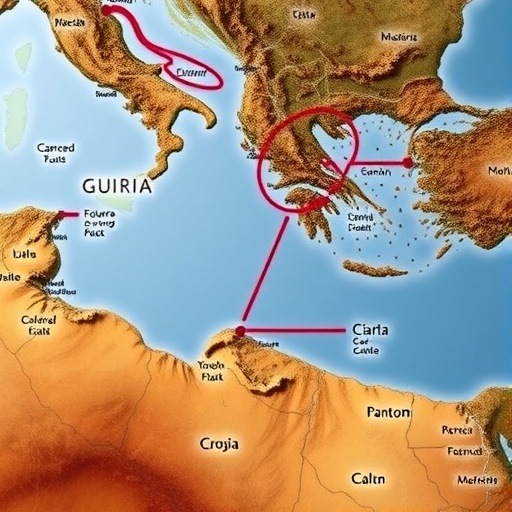
Remote Mediterranean islands were settled long before agriculture—challenging a key assumption about the limits of Europe’s last hunter-gatherers at sea. A new study released today argues that these communities were not merely coastal wanderers. Instead, they repeatedly crossed open water over distances of at least 100 kilometers, likely linking Sicily and Malta for centuries.

The work, published in PNAS Nexus (28 July 2026), focuses on Malta’s long Mesolithic timeline, reporting evidence of continuous human presence from at least 8,400 to 7,400 years ago. That span is significant because it implies not just a single arrival, but sustained occupation.

Researchers say Malta’s ecology would not have supported a large, self-sustaining hunter-gatherer population once the islands were cut off from Sicily by rising seas about 14,000 years ago. Without access to a broader resource base, the island’s carrying capacity would remain too limited for a population to persist in isolation over a millennium.

To test this, the team combined modern ethnographic population patterns with palaeoclimate reconstructions and sea-level modeling. Their approach uses climate-linked relationships between environment and hunter-gatherer group size to estimate what populations Malta could have supported after isolation.

The results suggest Malta’s post-isolation population ceiling was very small, with maximum plausible figures around 170–144 individuals, and more conservative estimates likely far lower. Even if those individuals existed simultaneously, long-term survival across generations would require hundreds of reproductive-age adults, not a sparse island population.

The analysis therefore points toward a persistent problem: such small numbers would increase inbreeding risk and demographic collapse. The only solution, the authors argue, is regular genetic and social renewal through connections to other regions.

Those connections, they propose, depended on a seagoing network capable of repeated voyages. The study describes this as a major transition in human history, when maritime frontiers shifted from barriers to bridges—Mesolithic voyaging enabling new connections across islands and coastlines.

“In the Mediterranean, single-stage, long-distance open-water sea voyaging is first documented in the Mesolithic,” the paper’s senior author notes, adding that Malta’s record likely reflects an established network rather than an accidental landing.

Subject of Research: Mesolithic hunter-gatherer long-distance sea voyaging and population survival on Malta
Article Title: Not provided in the supplied text
News Publication Date: 28-Jul-2026
Web References: https://academic.oup.com/pnasnexus/article/5/7/pgag234/8741796?searchresult=1
References: Not provided beyond the web reference
Image Credits: Not provided in the supplied text

Keywords: Mesolithic; hunter-gatherers; Malta; Sicily; long-distance seafaring; PNAS Nexus; palaeoclimate modeling; sea-level change; social networks; archaeology

Tags: ancient sea crossing evidencehunter-gatherer maritime adaptationlong-distance sea travel in prehistoryMaltese island settlementmaritime archaeology in the MediterraneanMediterranean sea routesMesolithic period in Europeopen water crossingspalaeoclimate and sea-level modelingprehistoric human migrationprehistoric maritime navigationsea-level rise and island habitation
Share26Tweet16
Previous Post

National Academy of Inventors and USPTO launch five-year initiative to boost U.S. innovation

Next Post

UT and Eastman Extend Research Partnership Through 2032

Related Posts

Century-Long Data Shows Complex Ice-Cover Trends in the Laurentian Great Lakes
Earth Science

Century-Long Data Shows Complex Ice-Cover Trends in the Laurentian Great Lakes

July 28, 2026
Ecosystem Engineers Boosted Marine Biodiversity Across the Entire Phanerozoic
Earth Science

Ecosystem Engineers Boosted Marine Biodiversity Across the Entire Phanerozoic

July 28, 2026
Genetic Engineering in Rice After 50 Years Could Deliver Major Gains
Earth Science

Genetic Engineering in Rice After 50 Years Could Deliver Major Gains

July 28, 2026
Asteroid Impact Created Dust Cloud Insulating Earth, Frying Cretaceous Dinosaurs
Earth Science

Asteroid Impact Created Dust Cloud Insulating Earth, Frying Cretaceous Dinosaurs

July 28, 2026
Soil viral DNA and RNA recovery depend on sample preparation method
Earth Science

Soil viral DNA and RNA recovery depend on sample preparation method

July 28, 2026
Predictable Coastal Flooding Hits Shorelines at Regular Hours
Earth Science

Predictable Coastal Flooding Hits Shorelines at Regular Hours

July 28, 2026
Next Post
UT and Eastman Extend Research Partnership Through 2032

UT and Eastman Extend Research Partnership Through 2032

  • Mothers who receive childcare support from maternal grandparents show more

    Mothers who receive childcare support from maternal grandparents show more parental warmth, finds NTU Singapore study

    27656 shares
    Share 11059 Tweet 6912
  • University of Seville Breaks 120-Year-Old Mystery, Revises a Key Einstein Concept

    1061 shares
    Share 424 Tweet 265
  • Bee body mass, pathogens and local climate influence heat tolerance

    682 shares
    Share 273 Tweet 171
  • Researchers record first-ever images and data of a shark experiencing a boat strike

    546 shares
    Share 218 Tweet 137
  • Groundbreaking Clinical Trial Reveals Lubiprostone Enhances Kidney Function

    531 shares
    Share 212 Tweet 133
Science

Embark on a thrilling journey of discovery with Scienmag.com—your ultimate source for cutting-edge breakthroughs. Immerse yourself in a world where curiosity knows no limits and tomorrow’s possibilities become today’s reality!

RECENT NEWS

  • Bioiontronics Promises New Advances in Bioelectronic Devices
  • Willingness to Pay for Quality-Adjusted Life Years Among Older Adults in Iran
  • Postmarketing VigiBase analysis links GLP-1 therapies to neuropsychiatric adverse events
  • Core2Edge Glioblastoma Model Tracks Infiltration and Transcriptional Heterogeneity

Categories

  • Agriculture
  • Anthropology
  • Archaeology
  • Athmospheric
  • Biology
  • Biotechnology
  • Blog
  • Bussines
  • Cancer
  • Chemistry
  • Climate
  • Earth Science
  • Editorial Policy
  • Marine
  • Mathematics
  • Medicine
  • Pediatry
  • Policy
  • Psychology & Psychiatry
  • Science Education
  • Social Science
  • Space
  • Technology and Engineering

Subscribe to Blog via Email

Enter your email address to subscribe to this blog and receive notifications of new posts by email.

Join 5,146 other subscribers

© 2025 Scienmag - Science Magazine

Welcome Back!

Login to your account below

Forgotten Password?

Retrieve your password

Please enter your username or email address to reset your password.

Log In
No Result
View All Result
  • HOME
  • SCIENCE NEWS
  • CONTACT US

© 2025 Scienmag - Science Magazine

Discover more from Science

Subscribe now to keep reading and get access to the full archive.

Continue reading
