


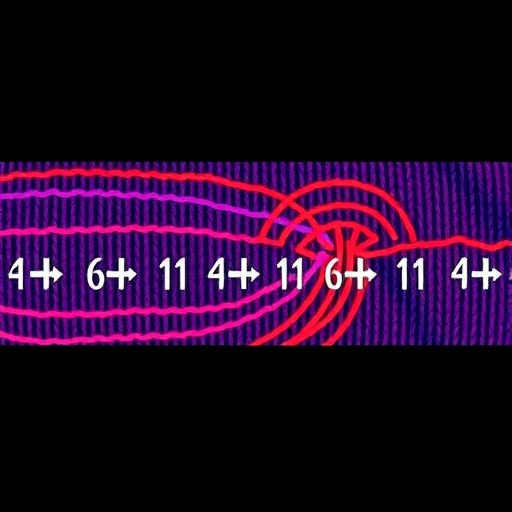
A team of researchers has unveiled a path toward truly interactive clothing by knitting radio-frequency identification (RFID) functionality directly into yarn. Instead of treating smart textiles as separate add-ons, the work integrates RFID-responsive material strands during fabric formation, enabling garments to sense movement and support identification without relying on bulky electronics. The result points to a new class of wearables where “threads” can behave like distributed sensors.
The study, published in npj Flexible Electronics, describes knitted RFID yarns engineered to operate as thin, flexible transducers across the textile plane. By embedding the RFID capability at the yarn level, the fabric can distribute electromagnetic interactions over many fibers, improving robustness during bending and stretching. This is especially important for motion-heavy applications where conventional sensor sheets can crack or delaminate.
A core technical idea is that the knitted architecture changes how signals propagate through the fabric. As the wearer moves, mechanical deformation alters the micro-geometry of the knit, affecting the electrical and electromagnetic coupling that the RFID system relies on. That coupling shift can be read by an external interrogator, translating subtle posture and motion patterns into measurable changes.
Beyond sensing, the same RFID functionality can serve as a lightweight identification layer. In practical terms, a smart fabric could be scanned to determine whether a textile item is present, authenticated, or paired with a specific device profile—useful for inventory tracking, secure uniforms, or assistive contexts where identifying the wearer’s gear matters.
The researchers emphasize motion sensing as a key outcome. When fabric undergoes stretching, twisting, or bending, the yarn network responds in a way that can be captured by RFID interrogation. With appropriate signal processing, these responses can be mapped to motion signatures, turning everyday garment dynamics into data.
Fabric-based RFID is attractive because it scales with manufacturing: knitting naturally produces repeatable patterns over large areas. That scalability could lower barriers compared with weaving in discrete antenna patches or attaching rigid modules after the fact. It also opens room for garment designs that remain comfortable while still communicating wirelessly.
The work also highlights flexibility as a design constraint. RFID structures must maintain functionality through repeated deformation cycles. Knitted yarn integration is designed to keep the sensing and identification interfaces distributed, reducing the stress concentration common in planar, rigid devices.
Taken together, the research suggests a “smart fabric” roadmap where identification and sensing are not separate technologies but a unified woven function. If further validated for long-term durability, wash resistance, and real-world motion complexity, RFID yarns could become a viral new ingredient in next-generation wearable technology, enabling clothes that recognize, respond, and report without visible electronics.
Cite Scienmag News
Denise Maddox. (July 27, 2026). Knitted RFID Yarns Enable Smart Fabrics for Motion Sensing and Identification. Scienmag. https://scienmag.com/knitted-rfid-yarns-enable-smart-fabrics-for-motion-sensing-and-identification/
Denise Maddox. "Knitted RFID Yarns Enable Smart Fabrics for Motion Sensing and Identification." Scienmag, 27 July 2026, https://scienmag.com/knitted-rfid-yarns-enable-smart-fabrics-for-motion-sensing-and-identification/. Accessed 4 September 2026.
Denise Maddox. "Knitted RFID Yarns Enable Smart Fabrics for Motion Sensing and Identification." Scienmag. July 27, 2026. https://scienmag.com/knitted-rfid-yarns-enable-smart-fabrics-for-motion-sensing-and-identification/


