

Monday, July 27, 2026
Science
No Result
View All Result
  • Login
  • HOME
  • SCIENCE NEWS
  • CONTACT US
  • HOME
  • SCIENCE NEWS
  • CONTACT US
No Result
View All Result
Scienmag
No Result
View All Result
Home Science News Archaeology

Mapping Project Helps Shield Coastal World Heritage Sites From Climate Risks

July 27, 2026
in Archaeology
Reading Time: 2 mins read
0
Mapping Project Helps Shield Coastal World Heritage Sites From Climate
65
SHARES
587
VIEWS
Share on FacebookShare on Twitter
ADVERTISEMENT

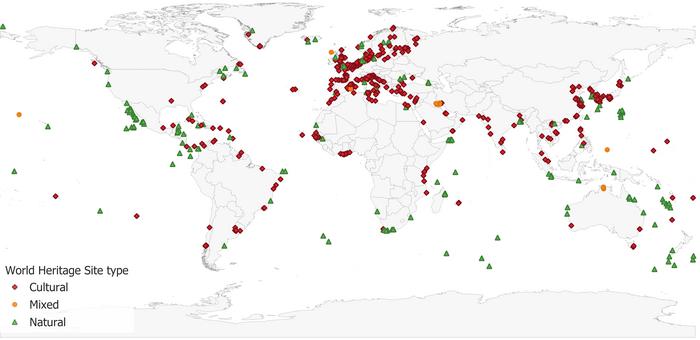
A new digital mapping project aims to protect coastal UNESCO World Heritage sites from intensifying sea-level rise, flooding, and coastal erosion. The effort delivers a first-of-its-kind, comprehensive spatial database focused on places that sit in low-lying coastal zones—less than 20 metres above sea level—where climate impacts are often hardest to quantify.

The Global Coastal Heritage (Glo-CoH) dataset was created by an international research team led by scientists from the University of East Anglia (UEA), Durham University, and the University of Cape Town. Motivated by urgent concerns about how coastal development and climate change threaten both cultural and natural treasures, the project turns historical records and satellite observations into usable digital boundaries.

Published in Scientific Data, the resource provides precise mapped outlines for every UNESCO World Heritage property of “Outstanding Universal Value” located along coastlines worldwide. The mapping is based on the UNESCO World Heritage list as of 2023, with an update planned through 2026 by the end of this year to keep the catalogue current.

In total, the dataset includes 1,250 individual heritage sites. These span cultural monuments, ecosystems of natural significance, geodiversity and rare species habitats, and mixed heritage locations that combine both cultural and natural values. Together, the mapped sites cover more than 235 million hectares, illustrating the geographic scale of what is at stake.

Until now, researchers have struggled to model hazard exposure accurately because detailed boundary maps were often unavailable. By supplying digitised spatial limits, Glo-CoH enables more reliable assessments of storm surge effects, coastal flooding, and erosion risks across local, regional, and global planning scales.

To build the maps, the team traced each site boundary using published site plans and cross-referenced them with Google Earth satellite imagery. This approach was supported by a structured quality-checking process that evaluated source-material quality, correct site identification, and digitisation precision.

The authors report that the mapping achieved high reliability: 92% of sites reached the top levels of digitisation accuracy. Such performance is designed to support real risk assessment rather than high-level approximation.

Researchers say the dataset is already being used to power follow-on studies, including a global sea-level risk analysis of coastal heritage sites and a climate-risk assessment for biodiversity at these locations, with an emphasis on thermal exposure affecting reef-building corals and mangroves.

The work was funded by Irish Aid, the British Academy, and the UK Natural Environment Research Council, and is published under the title “Mapping the global distribution of coastal World Heritage Sites: Glo-CoH, a new Global Coastal Heritage dataset.” As sea levels continue to rise, the team argues that accessible, high-precision spatial data can help guide conservation decisions before irreversible loss occurs.

Subject of Research: Coastal UNESCO World Heritage risk mapping for sea-level rise, flooding, and erosion
Article Title: Mapping the global distribution of coastal World Heritage Sites: Glo-CoH, a new Global Coastal Heritage dataset
News Publication Date: 24-Jul-2026
Web References: https://www.nature.com/articles/s41597-026-07758-3 ; https://zivahub.uct.ac.za/articles/dataset/Global_Coastal_Heritage_Dataset_Glo-CoH_/28547267
References: 10.1038/s41597-026-07758-3
Image Credits: David Bescoby
Keywords: Global Coastal Heritage, Glo-CoH, UNESCO World Heritage, coastal hazards, sea-level rise, storm surge, digitised boundaries, climate risk, conservation planning, Scientific Data

Tags: climate change impact on cultural heritageclimate resilience for cultural sitescoastal UNESCO World Heritage sitesdigital mapping of heritage sitesglobal coastal heritage databaseinternational collaboration for heritage conservationlow-lying coastal zone risk assessmentpreserving natural and cultural treasures from climate threatssatellite observation for heritage protectionsea-level rise and coastal erosionspatial analysis of coastal heritageUNESCO World Heritage site climate vulnerability
Share26Tweet16
Previous Post

Biochar Makes Green Roofs Potent Methane Sinks

Next Post

Unwritten social rules, not government oversight, sustain forests for the future

Related Posts

Genetically distinct Nicaraguan avocados reveal South American transport thousands of
Archaeology

Genetically distinct Nicaraguan avocados reveal South American transport thousands of years ago

July 26, 2026
Ceramic Vessels Show Social Inequality Was Baked into 19th-Century Brazil
Archaeology

Ceramic Vessels Show Social Inequality Was Baked into 19th-Century Brazil

July 26, 2026
Study Quantifies Damage to Historic Sites Across Syria
Archaeology

Study Quantifies Damage to Historic Sites Across Syria

July 26, 2026
Silkworm Farming in Southern Central Asia Preceded the Silk Road
Archaeology

Silkworm Farming in Southern Central Asia Preceded the Silk Road

July 26, 2026
Ancient Egyptian princesses from 4,000 years ago were skilled archers,
Archaeology

Ancient Egyptian princesses from 4,000 years ago were skilled archers, study finds

July 17, 2026
Precolonial Brazilian Cerrado Villages Grew Maize-Based Polyculture for Centuries
Archaeology

Precolonial Brazilian Cerrado Villages Grew Maize-Based Polyculture for Centuries

July 15, 2026
Next Post
Unwritten social rules, not government oversight, sustain forests for the future

Unwritten social rules, not government oversight, sustain forests for the future

  • Mothers who receive childcare support from maternal grandparents show more

    Mothers who receive childcare support from maternal grandparents show more parental warmth, finds NTU Singapore study

    27656 shares
    Share 11059 Tweet 6912
  • University of Seville Breaks 120-Year-Old Mystery, Revises a Key Einstein Concept

    1061 shares
    Share 424 Tweet 265
  • Bee body mass, pathogens and local climate influence heat tolerance

    682 shares
    Share 273 Tweet 171
  • Researchers record first-ever images and data of a shark experiencing a boat strike

    546 shares
    Share 218 Tweet 137
  • Groundbreaking Clinical Trial Reveals Lubiprostone Enhances Kidney Function

    531 shares
    Share 212 Tweet 133
Science

Embark on a thrilling journey of discovery with Scienmag.com—your ultimate source for cutting-edge breakthroughs. Immerse yourself in a world where curiosity knows no limits and tomorrow’s possibilities become today’s reality!

RECENT NEWS

  • Study Finds Falls Risk Perception Influenced by Multiple Factors in Elderly Hip Fracture Patients
  • GC-MS Method Developed and Validated to Measure Ethylene and Diethylene Glycols
  • Neural Network Models Free Recall, Revealing Multiple Memory Strategies
  • Lipid-Shelled Nanobubble Ultrasound Agents: Formulation and Activation Study

Categories

  • Agriculture
  • Anthropology
  • Archaeology
  • Athmospheric
  • Biology
  • Biotechnology
  • Blog
  • Bussines
  • Cancer
  • Chemistry
  • Climate
  • Earth Science
  • Editorial Policy
  • Marine
  • Mathematics
  • Medicine
  • Pediatry
  • Policy
  • Psychology & Psychiatry
  • Science Education
  • Social Science
  • Space
  • Technology and Engineering

Subscribe to Blog via Email

Enter your email address to subscribe to this blog and receive notifications of new posts by email.

Join 5,146 other subscribers

© 2025 Scienmag - Science Magazine

Welcome Back!

Login to your account below

Forgotten Password?

Retrieve your password

Please enter your username or email address to reset your password.

Log In
No Result
View All Result
  • HOME
  • SCIENCE NEWS
  • CONTACT US

© 2025 Scienmag - Science Magazine

Discover more from Science

Subscribe now to keep reading and get access to the full archive.

Continue reading
