


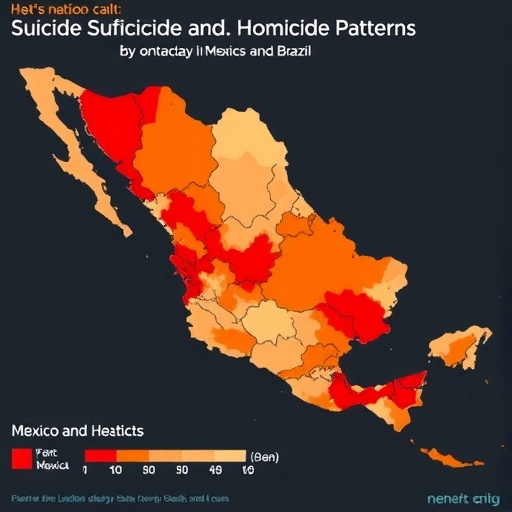
A new study warns that everyday heat may be quietly reshaping public-health risks for both self-harm and interpersonal violence in parts of Latin America. Researchers examined how ambient mean temperature—an environmental exposure often overlooked in violence prevention—relates to suicide and homicide mortality across Mexico and Brazil, two countries facing persistently high burdens.
Using 1,243,596 mortality records drawn from two national mortality information systems, the team linked deaths occurring between 2000 and 2019 with contemporaneous daily weather measurements. To isolate short-term temperature effects from longer-term trends and seasonality, they applied a time-stratified case-crossover framework.
The statistical core combined conditional logistic regression with a distributed lag nonlinear model, allowing temperature effects to vary over subsequent days rather than assuming an immediate or fixed risk window. This design helps control for stable individual and area-level characteristics, shifting attention to how risk changes when temperature fluctuates day by day.
Across pooled results, each 1°C increase in ambient mean temperature corresponded to a 2.17% rise in homicide mortality in Brazil and Mexico during lag 0–5 days (95% CI 1.72–2.63%), and a 1.80% increase overall for homicide (95% CI 1.33–2.27%). For suicide, the temperature-associated increases were even steeper: 2.78% (95% CI 2.18–3.39%) and 3.75% (95% CI 3.05–4.46%), respectively.
Importantly, the heat–violence relationship was not uniform. It appeared stronger among males, among mixed-race individuals in Brazil, and during weekends, suggesting that social routines and vulnerability may modulate biological or behavioral responses to heat. Seasonally, impacts concentrated in summer–autumn.
The study also reports meaningful effect modification by socioeconomic context, implying that underlying structural conditions can amplify or buffer temperature-related risk. This finding supports the idea that heat exposure interacts with social stressors rather than acting in isolation.
By comparing observed temperatures with state-specific median thresholds, the authors estimated population-attributable proportions. Throughout the study period, temperature above these medians was linked to 10.19% of suicides and 9.43% of homicides in Brazil, and 12.97% of suicides and 12.56% of homicides in Mexico.
Overall, the results suggest that prevention strategies should extend beyond peak heat waves. “Heat adaptation” that operates across much of the year—targeting exposure reduction, cooling access, and risk-aware public messaging—may help mitigate both self-harm and interpersonal violence in tropical developing settings.
Cite Scienmag News
Glenn Wilkins. (July 17, 2026). Heat’s Nationwide Toll: Suicide and Homicide Patterns in Mexico and Brazil. Scienmag. https://scienmag.com/heats-nationwide-toll-suicide-and-homicide-patterns-in-mexico-and-brazil/
Glenn Wilkins. "Heat’s Nationwide Toll: Suicide and Homicide Patterns in Mexico and Brazil." Scienmag, 17 July 2026, https://scienmag.com/heats-nationwide-toll-suicide-and-homicide-patterns-in-mexico-and-brazil/. Accessed 3 September 2026.
Glenn Wilkins. "Heat’s Nationwide Toll: Suicide and Homicide Patterns in Mexico and Brazil." Scienmag. July 17, 2026. https://scienmag.com/heats-nationwide-toll-suicide-and-homicide-patterns-in-mexico-and-brazil/


