

Friday, July 17, 2026
Science
No Result
View All Result
  • Login
  • HOME
  • SCIENCE NEWS
  • CONTACT US
  • HOME
  • SCIENCE NEWS
  • CONTACT US
No Result
View All Result
Scienmag
No Result
View All Result
Home Science News Chemistry

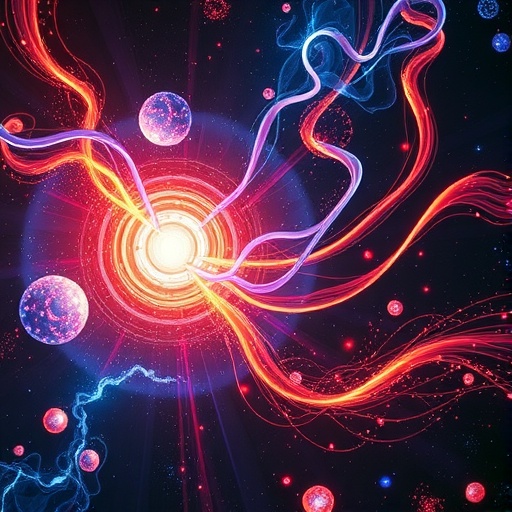
Entropy Gravity Theory Provides New Clues to Reconcile Gravity With Thermodynamics’ Second Law

July 17, 2026
in Chemistry
Reading Time: 2 mins read
0
Entropy Gravity Theory Provides New Clues to Reconcile Gravity With Thermodynamics’ Second Law

Entropy Gravity Theory Provides New Clues to Reconcile Gravity With Thermodynamics’ Second Law

65
SHARES
587
VIEWS
Share on FacebookShare on Twitter
ADVERTISEMENT

A new theoretical study from Queen Mary University of London examines a problem at the heart of cosmology: how the Universe can become more structured and complex over time without violating the second law of thermodynamics. The second law, often summarized as entropy tending to increase in isolated systems, appears to predict a march toward greater disorder—yet the cosmos clearly does the opposite in many respects, building galaxies, stars, planets, and eventually life.

In the work, Professor Ginestra Bianconi approaches the tension using Gravity from Entropy (GfE), a quantum-gravity framework that treats gravity as emerging from microscopic statistical properties of spacetime. Rather than taking spacetime geometry as merely a stage on which physics happens, GfE links geometric dynamics to entropy-like quantities defined through information-theoretic measures.

At the mathematical core of the theory is the Quantum Geometric Relative Entropy (QGRE), constructed as an entropy measure between the “true” spacetime metric and a metric induced by matter fields and curvature. In low-energy and weak-curvature regimes, the resulting field equations reproduce General Relativity, ensuring compatibility with known gravitational physics. However, when one moves beyond that limit, the theory departs from Einstein’s equations and naturally allows a dynamical dark-energy contribution.

The paper studies these ideas in Friedmann–Robertson–Walker cosmologies, the standard description of an expanding, homogeneous, and isotropic universe. The authors show that the local geometric degrees of freedom satisfy a form of the first law of thermodynamics, with the emergent dark-energy term behaving like an internal energy contribution.

A key result concerns how entropy is tracked. While the total entropy of the Universe increases as the cosmos expands, the entropy per unit volume—identified with the local QGRE—decreases over time. This distinct behavior provides a new lens for thinking about how localized complexity can arise even as global thermodynamic irreversibility continues.

The analysis also highlights the role of the physical volume element determined by the metric measure. As the Universe expands, that volume grows, helping explain why total entropy rises even while the local entropy density falls. Effective temperature and pressure quantities emerge consistently within the GfE thermodynamic picture.

Although still early and theoretical, the study suggests that gravity and spacetime may possess an intrinsic informational and thermal character. By offering a route to reconcile thermodynamic irreversibility with the emergence of structured cosmic outcomes, it could help connect general relativity, thermodynamics, quantum theory, and cosmology.

Overall, the findings motivate further exploration of how an entropic origin of gravity can address deep questions about complexity—potentially reaching all the way to the conditions that make life possible.

Keywords:
Newtonian gravity, Gravitational fields, Gravitational waves, Quantum gravity, Gravitation, Classical mechanics, Mechanics, Applied mathematics, Mathematical principles, Mathematical logic, Mathematical analysis

Subject of Research: Thermodynamics of the Gravity from Entropy (GfE) theory in cosmology
Article Title: Thermodynamics of the gravity from entropy theory
Web References: http://dx.doi.org/10.1103/26kn-thgp
References: Physical Review (as stated in the article page)
Image Credits: Queen Mary University of London

Tags: Cosmology and thermodynamicsdark energy in modified gravityEinstein's equations and beyondemergent gravity modelsentropy and structure formationentropy in spacetimeentropy-driven cosmological modelsinformation-theoretic measures in physicsquantum geometric entropyquantum gravity theoriesreconciliation of gravity with second lawuniverse evolution and complexity
Share26Tweet16
Previous Post

Study Finds No Link Between Acetaminophen Use in Pregnancy and Birth Outcomes

Next Post

IRP1/ARID3A complex identified as a new epigenetic driver of pancreatic cancer chemoresistance

Related Posts

Chemical Functionalization Enables High-Performance Structural Nanocomposites Using Helical Carbon Nanotubes
Chemistry

Chemical Functionalization Enables High-Performance Structural Nanocomposites Using Helical Carbon Nanotubes

July 17, 2026
New Layered Crystal Enables High-Efficiency Thermoelectric Energy Conversion
Chemistry

New Layered Crystal Enables High-Efficiency Thermoelectric Energy Conversion

July 17, 2026
Phosphorus Promotes Synergistic Activity in Evolving NiFe Phosphides for Better Water Oxidation
Chemistry

Phosphorus Promotes Synergistic Activity in Evolving NiFe Phosphides for Better Water Oxidation

July 17, 2026
New Laser Technology Aims to Detect Deadly Fake Alcohol
Chemistry

New Laser Technology Aims to Detect Deadly Fake Alcohol

July 17, 2026
Surfactant-Free Hydrothermal Synthesis Creates Size-Tunable Monodisperse CeO2 CMP Abrasives
Chemistry

Surfactant-Free Hydrothermal Synthesis Creates Size-Tunable Monodisperse CeO2 CMP Abrasives

July 17, 2026
Data-Driven Framework Cuts Distillation Optimization Time Significantly
Chemistry

Data-Driven Framework Cuts Distillation Optimization Time Significantly

July 16, 2026
Next Post
IRP1/ARID3A complex identified as a new epigenetic driver of pancreatic cancer chemoresistance

IRP1/ARID3A complex identified as a new epigenetic driver of pancreatic cancer chemoresistance

  • Mothers who receive childcare support from maternal grandparents show more

    Mothers who receive childcare support from maternal grandparents show more parental warmth, finds NTU Singapore study

    27656 shares
    Share 11059 Tweet 6912
  • University of Seville Breaks 120-Year-Old Mystery, Revises a Key Einstein Concept

    1061 shares
    Share 424 Tweet 265
  • Bee body mass, pathogens and local climate influence heat tolerance

    682 shares
    Share 273 Tweet 171
  • Researchers record first-ever images and data of a shark experiencing a boat strike

    546 shares
    Share 218 Tweet 137
  • Groundbreaking Clinical Trial Reveals Lubiprostone Enhances Kidney Function

    531 shares
    Share 212 Tweet 133
Science

Embark on a thrilling journey of discovery with Scienmag.com—your ultimate source for cutting-edge breakthroughs. Immerse yourself in a world where curiosity knows no limits and tomorrow’s possibilities become today’s reality!

RECENT NEWS

  • Map Reveals Whether Neighborhoods Face Climate-Driven Gentrification Risk
  • All-optical computing advances toward 100-GHz clock speeds
  • Renal Resistive Index–Guided Blood Pressure Titration in Sepsis: Randomized Trial
  • Machine Learning Predicts Bronchopulmonary Dysplasia Seven Days After Birth Using Respiratory Data

Categories

  • Agriculture
  • Anthropology
  • Archaeology
  • Athmospheric
  • Biology
  • Biotechnology
  • Blog
  • Bussines
  • Cancer
  • Chemistry
  • Climate
  • Earth Science
  • Editorial Policy
  • Marine
  • Mathematics
  • Medicine
  • Pediatry
  • Policy
  • Psychology & Psychiatry
  • Science Education
  • Social Science
  • Space
  • Technology and Engineering

Subscribe to Blog via Email

Enter your email address to subscribe to this blog and receive notifications of new posts by email.

Join 5,146 other subscribers

© 2025 Scienmag - Science Magazine

Welcome Back!

Login to your account below

Forgotten Password?

Retrieve your password

Please enter your username or email address to reset your password.

Log In
No Result
View All Result
  • HOME
  • SCIENCE NEWS
  • CONTACT US

© 2025 Scienmag - Science Magazine

Discover more from Science

Subscribe now to keep reading and get access to the full archive.

Continue reading
