


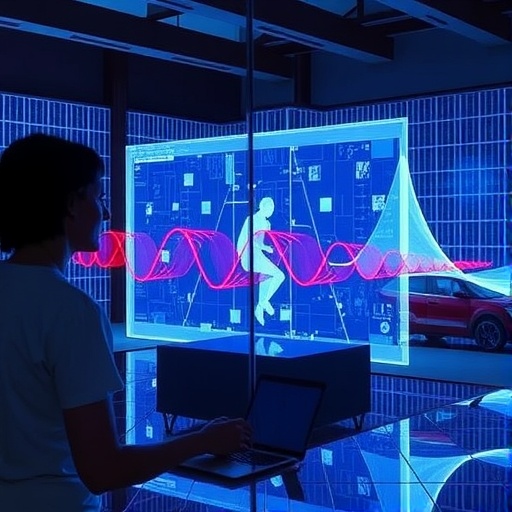
Three-dimensional communication may be moving closer to reality after researchers in South Korea demonstrated a holographic telepresence system that captures and replays the optical wavefront of a real scene in real time. The technology, developed by a team led by Professor YongKeun Park at the Korea Advanced Institute of Science and Technology (KAIST), is designed to transmit the physical information carried by light rather than simply generate a 3D-looking image from estimated shapes or depth maps. The researchers reported video-rate operation at approximately 28 frames per second and a median end-to-end latency of about 50 milliseconds, suggesting that wavefront-based communication could eventually become responsive enough for live interaction.
Most current 3D imaging systems reconstruct the appearance of an object using geometry. Cameras, depth sensors and computer vision algorithms estimate surfaces, distances and shapes, after which software renders a visual model for a display. These methods can produce convincing depth effects, but they do not reproduce the full physical behavior of light. Diffraction, phase and the way light focuses at different depths are often approximated or omitted. As a result, viewers may experience visual depth, but not necessarily the natural optical cues produced by the original scene.
The KAIST approach takes a fundamentally different route. Instead of first converting a scene into a geometric representation, the system measures its complex optical wavefront. A wavefront describes how light is distributed as it travels, including both its amplitude and phase. Amplitude is associated with the strength of the light, while phase records the relative timing of the wave’s oscillations. Together, these properties determine how light propagates, interferes, diffracts and focuses. If they can be measured accurately and reproduced, a remote viewer may see a three-dimensional scene through the same underlying optical information that existed at the source.
Capturing phase is one of the biggest obstacles in practical holography. Conventional cameras record intensity, or brightness, but do not directly reveal the phase of incoming light. Traditional digital holography commonly uses an interferometric reference beam to encode phase information. Although effective, such systems can require precise optical alignment and can be vulnerable to vibration and environmental disturbances. Those limitations make them difficult to operate outside carefully controlled laboratory conditions, particularly when high-speed acquisition and compact hardware are required for telepresence.
To avoid the need for a reference beam, the researchers introduced a pre-characterized geometric phase diffuser into the imaging system. The diffuser transforms the incoming wavefront into a deterministic speckle pattern. At first glance, the resulting intensity image appears random, but the pattern is not meaningless noise. Because the diffuser has been calibrated, the recorded speckle contains a predictable encoding of the original optical field. A computational model can then use that known relationship to recover the wavefront from a single intensity measurement, allowing both amplitude and phase information to be reconstructed without multiple exposures or interferometric detection.
Once the wavefront has been recovered, the system sends it to a spatial light modulator, an optical device capable of controlling the phase or amplitude of light across many individually addressed pixels. The modulator recreates the calculated wavefront, which is then optically replayed so that light propagates as if it were emerging from the original three-dimensional scene. This physical replay can produce depth-dependent focusing and volumetric refocusing, enabling different parts of the reconstructed scene to appear sharp at different distances. Such behavior is a key distinction between a genuine wavefront display and a conventional flat image with simulated depth.
In demonstrations, the system produced dynamic reconstructions at roughly 28 frames per second, while maintaining a median end-to-end latency of approximately 50 milliseconds. That combination is important for telepresence because delays or slow updates can make remote interaction feel disconnected. A system that captures, reconstructs and displays optical information quickly enough could support more natural communication, allowing users to move, gesture and change focus without the severe lag associated with many experimental holographic platforms.
The potential applications extend beyond futuristic video calls. Measurement-driven holography could support remote collaboration, scientific visualization, education, medical communication and industrial inspection. A specialist might eventually examine a remote object with more faithful depth cues, while students could observe a dynamic physical specimen from different focal distances. In telepresence, the technology could help transmit the visual presence of a person or object without relying entirely on a computer-generated model. Its central promise is to shift 3D communication from sending an interpretation of a scene to sending the measured structure of the light itself.
The prototype still faces significant challenges before it can become a consumer technology. The reported system uses monochromatic green laser illumination, and speckle noise limits image quality. Practical versions would need improved color reproduction, greater optical bandwidth, smaller components and higher-resolution displays. Additional advances in sensors, spatial light modulators, computational reconstruction and data compression will also be required. Nevertheless, the study demonstrates that single-shot, reference-free wavefront capture can operate at video rates, offering a possible foundation for future holographic communication systems in which remote presence is created not by drawing a 3D illusion, but by reconstructing the optical field that makes three-dimensional vision possible.
News Publication Date: 12-Jun-2026
Web References: https://doi.org/10.29026/oea.2026.260001
References: 10.29026/oea.2026.260001
Keywords
Holographic telepresence, wavefront capture, reference-free holography, optical phase, computational holography, spatial light modulation, 3D communication, applied optics, optoelectronics, holographic display
Cite Scienmag News
Bethany Barker. (August 7, 2026). New holographic telepresence system captures and replays 3D wavefronts in real time. Scienmag. https://scienmag.com/new-holographic-telepresence-system-captures-and-replays-3d-wavefronts-in-real-time/
Bethany Barker. "New holographic telepresence system captures and replays 3D wavefronts in real time." Scienmag, 7 August 2026, https://scienmag.com/new-holographic-telepresence-system-captures-and-replays-3d-wavefronts-in-real-time/. Accessed 3 September 2026.
Bethany Barker. "New holographic telepresence system captures and replays 3D wavefronts in real time." Scienmag. August 7, 2026. https://scienmag.com/new-holographic-telepresence-system-captures-and-replays-3d-wavefronts-in-real-time/


