

Friday, July 17, 2026
Science
No Result
View All Result
  • Login
  • HOME
  • SCIENCE NEWS
  • CONTACT US
  • HOME
  • SCIENCE NEWS
  • CONTACT US
No Result
View All Result
Scienmag
No Result
View All Result
Home Science News Space

Milky Way Source Found for Extremely High-Energy Particles

July 17, 2026
in Space
Reading Time: 2 mins read
0
Milky Way Source Found for Extremely High-Energy Particles

Milky Way Source Found for Extremely High-Energy Particles

65
SHARES
587
VIEWS
Share on FacebookShare on Twitter
ADVERTISEMENT

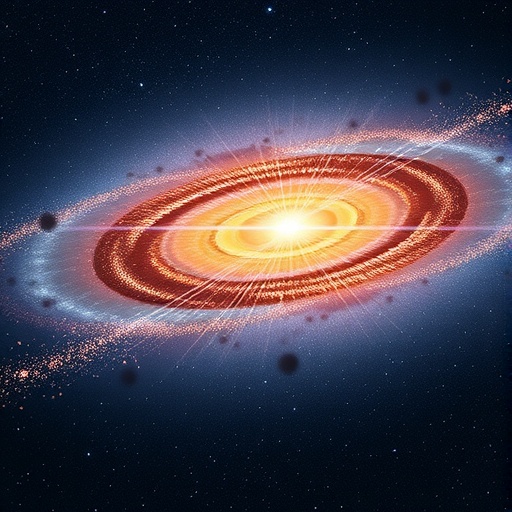
An international team led by Hiroshima University has identified what appears to be the Milky Way’s highest-energy “proton PeVatron,” pinpointing the cosmic accelerator behind a long-sought class of ultra-energetic particles. The target, LHAASO J1912+1014u, is confirmed through a combined, multi-instrument analysis rather than inference from a single observation.

Cosmic rays are mostly protons (with a smaller fraction of electrons) that traverse interstellar space at energies far beyond what human-made accelerators typically achieve. The extreme upper end of galactic cosmic-ray energies reaches or exceeds 10^15 electron volts—known as a peta-electron-volt (PeV). Finding a source capable of accelerating protons above this threshold is considered one of the most compelling problems in modern astrophysics.

The source was initially flagged by the Tibet AS gamma experiment and later by China’s Large High Altitude Air Shower Observatory (LHAASO). These observatories detected very high-energy gamma rays above 0.1 PeV, including emissions associated with LHAASO J1912+1014u. Because gamma rays often carry only about one-tenth the energy of their parent cosmic rays, such detections made the object a strong candidate for PeV proton acceleration.

However, proving a proton PeVatron is difficult. At PeV scales, cosmic-ray electrons can also generate gamma rays in related energy bands, and the angular resolution of current gamma-ray instruments can limit definitive separation between competing models. The breakthrough came by expanding the dataset beyond gamma rays alone.

Researchers incorporated observations from the Fermi Large Area Telescope (Fermi-LAT), the Nobeyama 45-m radio telescope in the FUGIN survey, and the Chandra X-ray Observatory. Together, these facilities cover a wide range of photon energies—from radio wavelengths through GeV and TeV gamma rays to X-rays—enabling detailed multiwavelength modeling of the physical processes at work.

The gamma-ray spectrum from LHAASO J1912+1014u shows a smooth extension from above 100 trillion electron volts down to about 400 million electron volts. This continuity makes an electron-acceleration-only explanation unlikely on energetic grounds. In addition, the GeV gamma-ray spatial pattern matches the distribution of interstellar gas traced by FUGIN radio data, reinforcing a hadronic scenario in which protons interact with matter to produce gamma rays.

Finally, Chandra data indicate weak diffuse X-ray emission, further narrowing the viable interpretations. By bundling “three arrows”—GeV gamma-ray measurements, radio-derived gas tracers, and X-ray constraints—the team argues that the most consistent explanation is that LHAASO J1912+1014u is actively accelerating protons into the PeV range.

These results were published in The Astrophysical Journal on July 16, 2026, and the authors note that dozens of PeVatron candidates remain in the Milky Way. Future work will apply similar multi-instrument strategies to systematically test other potential accelerators.

Subject of Research: Hadronic Scenario for Galactic PeVatron LHAASO J1912+1014u Supported by Fermi-LAT γ-ray Data and FUGIN CO Data
Article Title: Hadronic Scenario for Galactic PeVatron LHAASO J1912+1014u Supported by Fermi-LAT γ-ray Data and FUGIN CO Data
News Publication Date: 16-Jul-2026
Web References: http://dx.doi.org/10.3847/1538-4357/ae680d
References: The Astrophysical Journal (published July 16, 2026); DOI: 10.3847/1538-4357/ae680d
Image Credits: Adapted from Tsunefumi Mizuno, et al. The Astrophysical Journal. July 16, 2026

Keywords

Cosmic rays; PeVatron; LHAASO; Fermi-LAT; FUGIN; Chandra; gamma rays; hadronic interactions; interstellar gas; multiwavelength modeling

Tags: astrophysics of cosmic ray energy thresholdscosmic ray proton acceleration mechanismsdetection of high-energy gamma raysidentifying galactic cosmic ray sourceslarge high altitude air shower observatoryLHAASO J1912+1014u gamma-ray emissionsMilky Way galaxy cosmic ray sourcesmulti-instrument astrophysical observationsorigins of ultra-energetic cosmic raysPeV proton acceleratorsTibet AS gamma experiment findingsultra-high-energy particle acceleration
Share26Tweet16
Previous Post

Insilico Medicine Execs at CPIC Discuss AI Drug Discovery’s Tech and Clinical Breakthroughs

Next Post

Future warming leads to long-term global dissolved organic carbon losses

Related Posts

Sun’s Silver Content Exceeds Earlier Estimates, Study Finds
Space

Sun’s Silver Content Exceeds Earlier Estimates, Study Finds

July 17, 2026
Lehigh University Joins Global Consortium to Advance Commercial Space Research
Space

Lehigh University Joins Global Consortium to Advance Commercial Space Research

July 16, 2026
New Study Suggests Possible Atmosphere on Rocky Planet Near Nearby Star
Space

New Study Suggests Possible Atmosphere on Rocky Planet Near Nearby Star

July 16, 2026
Detected Rocky Exoplanet in Habitable Zone With Atmosphere
Space

Detected Rocky Exoplanet in Habitable Zone With Atmosphere

July 16, 2026
COSPAR 2026 Press Tour Visits Villa Galileo and INAF Arcetri Observatory
Space

COSPAR 2026 Press Tour Visits Villa Galileo and INAF Arcetri Observatory

July 16, 2026
Listening to Black Hole Ringing Reveals Path to Future Gravitational-Wave Astronomy
Space

Listening to Black Hole Ringing Reveals Path to Future Gravitational-Wave Astronomy

July 16, 2026
Next Post
Future warming leads to long-term global dissolved organic carbon losses

Future warming leads to long-term global dissolved organic carbon losses

  • Mothers who receive childcare support from maternal grandparents show more

    Mothers who receive childcare support from maternal grandparents show more parental warmth, finds NTU Singapore study

    27656 shares
    Share 11059 Tweet 6912
  • University of Seville Breaks 120-Year-Old Mystery, Revises a Key Einstein Concept

    1061 shares
    Share 424 Tweet 265
  • Bee body mass, pathogens and local climate influence heat tolerance

    682 shares
    Share 273 Tweet 171
  • Researchers record first-ever images and data of a shark experiencing a boat strike

    546 shares
    Share 218 Tweet 137
  • Groundbreaking Clinical Trial Reveals Lubiprostone Enhances Kidney Function

    531 shares
    Share 212 Tweet 133
Science

Embark on a thrilling journey of discovery with Scienmag.com—your ultimate source for cutting-edge breakthroughs. Immerse yourself in a world where curiosity knows no limits and tomorrow’s possibilities become today’s reality!

RECENT NEWS

  • Chemical Functionalization Enables High-Performance Structural Nanocomposites Using Helical Carbon Nanotubes
  • GLP-1 Shortage Deepens in Two States as Demand Remains High
  • Uncovering Causes Behind Southeast Asia’s Catastrophic Wildfires
  • Naloxone Now Widely Available in Retail Pharmacies After OTC Status Approval

Categories

  • Agriculture
  • Anthropology
  • Archaeology
  • Athmospheric
  • Biology
  • Biotechnology
  • Blog
  • Bussines
  • Cancer
  • Chemistry
  • Climate
  • Earth Science
  • Editorial Policy
  • Marine
  • Mathematics
  • Medicine
  • Pediatry
  • Policy
  • Psychology & Psychiatry
  • Science Education
  • Social Science
  • Space
  • Technology and Engineering

Subscribe to Blog via Email

Enter your email address to subscribe to this blog and receive notifications of new posts by email.

Join 5,146 other subscribers

© 2025 Scienmag - Science Magazine

Welcome Back!

Login to your account below

Forgotten Password?

Retrieve your password

Please enter your username or email address to reset your password.

Log In
No Result
View All Result
  • HOME
  • SCIENCE NEWS
  • CONTACT US

© 2025 Scienmag - Science Magazine

Discover more from Science

Subscribe now to keep reading and get access to the full archive.

Continue reading
