

Friday, August 7, 2026
Science
No Result
View All Result
  • Login
  • HOME
  • SCIENCE NEWS
  • CONTACT US
  • HOME
  • SCIENCE NEWS
  • CONTACT US
No Result
View All Result
Scienmag
No Result
View All Result
Home Science News Earth Science

Uncovering Causes Behind Southeast Asia’s Catastrophic Wildfires

July 17, 2026
in Earth Science
Reading Time: 2 mins read
0
Uncovering Causes Behind Southeast Asia’s Catastrophic Wildfires

Uncovering Causes Behind Southeast Asia’s Catastrophic Wildfires

65
SHARES
587
VIEWS
Share on FacebookShare on Twitter
ADVERTISEMENT

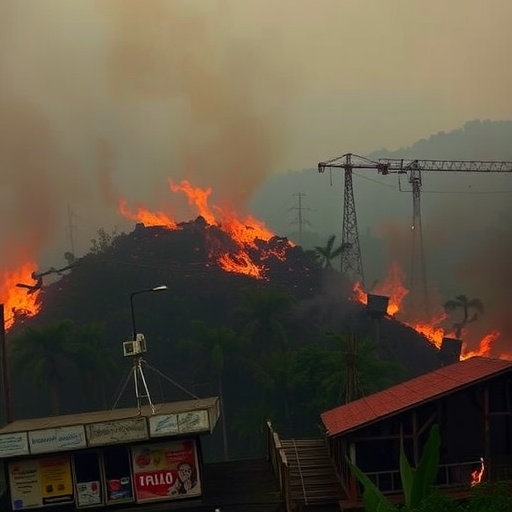
Wildfires in equatorial Southeast Asia can start small and rapidly evolve into region-wide disasters—but scientists have now mapped how that transformation happens. Focusing on the devastating 2015 fires, researchers traced the earliest detectable fire origins using satellite observations to better understand which ignition areas eventually grew into the largest events.

The study, published in Environmental Research Letters, responds to a key knowledge gap: even when fires burn millions of hectares, the earliest “where” and “why” behind their expansion are often poorly resolved. By reconstructing fire development across the region, the team estimated roughly 74,500–75,000 origin points organized into nearly 15,000 interconnected fire networks.

A central discovery is that large fires frequently do not have a single birthplace. Instead, about 84% of the analyzed fire networks contained multiple origin points, implying that many of the biggest catastrophes formed when several independent ignitions expanded and later merged into larger systems.

To reveal these patterns, the researchers applied network analysis to satellite-derived fire data, treating each ignition and its subsequent spread as links within a broader system. This framework allowed them to connect spatial wildfire behavior with environmental and human influences rather than relying on simplistic assumptions about single-source fires.

When the team examined drivers associated with ignition, natural landscape conditions and atmospheric dryness emerged as the strongest predictors of where fires began. The findings extend the idea that human activity is important, while also showing that ecological and climatic settings help determine which ignition opportunities become major outbreaks.

Lead author Adrian Dwiputra emphasizes that wildfire risk is “dynamic,” not only complex. In the study’s decomposition of fire behavior, human-linked signals were relatively stronger at origin points, whereas natural-linked signals became more influential during spread.

Coauthor Ping Yowargana highlights the climate relevance: atmospheric dryness is expected to increase with climate change. That shift could alter assumptions about tropical forest resilience to disturbances, especially if drier conditions limit recovery after ignitions.

The authors also report actionable implications for prevention. Because many large fires originate across multiple hotspots before merging, reducing expansion in high-origin-likelihood areas could lower the probability of future catastrophic wildfire networks.

For people managing fire-prone landscapes—alongside policymakers and modelers aiming to forecast fire risk and ecological impacts—this work provides a sharper map of ignition vulnerability across tropical terrain.

Subject of Research: Wildfire ignition origins and drivers in equatorial Southeast Asia (2015 fires)
Article Title: Connecting the dots: tracing the origins of 2015 equatorial Southeast Asian fires
News Publication Date: 13-Jul-2026
Web References: https://iopscience.iop.org/article/10.1088/1748-9326/ae81ca
References: Dwiputra, A., Yowargana, P., Lee, J.S.H., Teo, H.C., Tan, Z.D., Zeng, Y., Krasovskiy, A., & Koh, L.P. (2026). Environmental Research Letters. DOI: 10.1088/1748-9326/ae81ca
Keywords: wildfires, fire origins, satellite observations, network analysis, atmospheric dryness, tropical forests, fire risk, Southeast Asia, climate change, fire prevention

Tags: 2015 Southeast Asia firescatastrophic fire expansion mechanismsenvironmental and human fire driversfire ignition sources in Southeast Asiainterconnected wildfire systemsmulti-origin fire networksregional wildfire developmentsatellite fire origin mappingsatellite observations of wildfiresSoutheast Asia wildfire causeswildfire development and spreadwildfire network analysis
Share26Tweet16
Previous Post

Naloxone Now Widely Available in Retail Pharmacies After OTC Status Approval

Next Post

GLP-1 Shortage Deepens in Two States as Demand Remains High

Related Posts

Winter organic carbon export could feed zooplankton in the High Arctic
Earth Science

Winter organic carbon export could feed zooplankton in the High Arctic

August 7, 2026
Study Finds Heavy Iron Isotopes Enriched at Earth’s Core-Mantle Boundary
Earth Science

Study Finds Heavy Iron Isotopes Enriched at Earth’s Core-Mantle Boundary

August 7, 2026
Tropical–North Pacific Decadal Coupling Shapes Basin Variability and Marine Heatwaves
Earth Science

Tropical–North Pacific Decadal Coupling Shapes Basin Variability and Marine Heatwaves

August 7, 2026
Metagenomics Reveals How Iron-Rich Minerals Form in the Deep Biosphere
Earth Science

Metagenomics Reveals How Iron-Rich Minerals Form in the Deep Biosphere

August 6, 2026
Urban growth slows warming but increases heat exposure across growing Arabian cities
Earth Science

Urban growth slows warming but increases heat exposure across growing Arabian cities

August 6, 2026
Climate change increases severe snow droughts across western U.S., study finds
Earth Science

Climate change increases severe snow droughts across western U.S., study finds

August 6, 2026
Next Post
GLP-1 Shortage Deepens in Two States as Demand Remains High

GLP-1 Shortage Deepens in Two States as Demand Remains High

  • Mothers who receive childcare support from maternal grandparents show more

    Mothers who receive childcare support from maternal grandparents show more parental warmth, finds NTU Singapore study

    27656 shares
    Share 11059 Tweet 6912
  • University of Seville Breaks 120-Year-Old Mystery, Revises a Key Einstein Concept

    1061 shares
    Share 424 Tweet 265
  • Bee body mass, pathogens and local climate influence heat tolerance

    682 shares
    Share 273 Tweet 171
  • Researchers record first-ever images and data of a shark experiencing a boat strike

    546 shares
    Share 218 Tweet 137
  • Groundbreaking Clinical Trial Reveals Lubiprostone Enhances Kidney Function

    531 shares
    Share 212 Tweet 133
Science

Embark on a thrilling journey of discovery with Scienmag.com—your ultimate source for cutting-edge breakthroughs. Immerse yourself in a world where curiosity knows no limits and tomorrow’s possibilities become today’s reality!

RECENT NEWS

  • Study assesses technology upgrades alongside traditional utility bill assistance programs
  • U.S. Study Validates STARZ Scoring for Very Low Birth Weight Newborns
  • Therapeutic Applications of Medical Cannabis and Cannabinoids
  • Tau protein linked to Alzheimer’s disrupts nerve cells’ energy-producing mitochondria

Categories

  • Agriculture
  • Anthropology
  • Archaeology
  • Athmospheric
  • Biology
  • Biotechnology
  • Blog
  • Bussines
  • Cancer
  • Chemistry
  • Climate
  • Earth Science
  • Editorial Policy
  • Marine
  • Mathematics
  • Medicine
  • Pediatry
  • Policy
  • Psychology & Psychiatry
  • Science Education
  • Social Science
  • Space
  • Technology and Engineering

Subscribe to Blog via Email

Enter your email address to subscribe to this blog and receive notifications of new posts by email.

Join 5,149 other subscribers

© 2025 Scienmag - Science Magazine

Welcome Back!

Login to your account below

Forgotten Password?

Retrieve your password

Please enter your username or email address to reset your password.

Log In
No Result
View All Result
  • HOME
  • SCIENCE NEWS
  • CONTACT US

© 2025 Scienmag - Science Magazine

Discover more from Science

Subscribe now to keep reading and get access to the full archive.

Continue reading
