

Thursday, August 27, 2026
Science
No Result
View All Result
  • Login
  • HOME
  • SCIENCE NEWS
  • CONTACT US
  • HOME
  • SCIENCE NEWS
  • CONTACT US
No Result
View All Result
Scienmag
No Result
View All Result
Home Science News Space

Sun’s Silver Content Exceeds Earlier Estimates, Study Finds

July 17, 2026
in Space
Reading Time: 2 mins read
0
Sun’s Silver Content Exceeds Earlier Estimates, Study Finds

Sun’s Silver Content Exceeds Earlier Estimates, Study Finds

65
SHARES
587
VIEWS
Share on FacebookShare on Twitter
ADVERTISEMENT

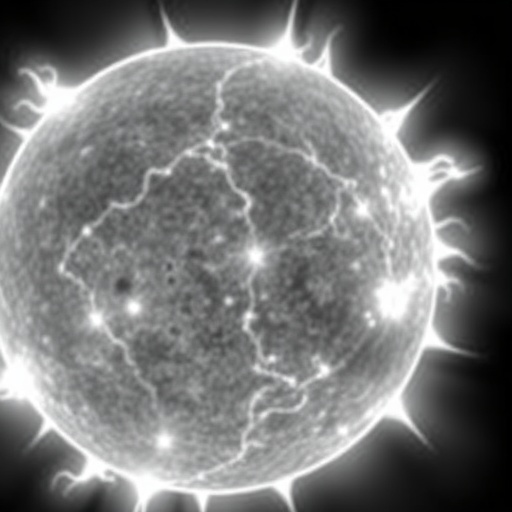
Researchers at Uppsala University report that the Sun contains about 55% more silver than earlier estimates suggested. Using updated, more physically realistic models of the Sun’s atmosphere, the team has revised the solar abundance of this trace element—an adjustment that helps close a long-standing discrepancy between the Sun and primitive solar-system material.

Although the Sun is dominated by hydrogen and helium, heavier elements such as silver, iron, and carbon exist in tiny fractions. Those fractions matter because they preserve information about how matter formed and evolved throughout the cosmos. In particular, the elemental composition of the Sun serves as a baseline for understanding other stars and the chemical development of the Milky Way.

The new result comes from spectroscopic analysis: when atoms in the Sun’s outer layers absorb specific wavelengths of light, they create dark absorption lines—fingerprints tied to individual elements. By comparing these silver spectral lines to theoretical predictions, the researchers infer how much silver must be present to reproduce the observed absorption features.

Earlier solar models relied on simplified assumptions about the Sun’s atmosphere and the behavior of silver atoms. In the new work, the team built a more detailed framework by combining a dynamical description of the Sun’s upper layers with improved atomic-physics calculations. Crucially, the calculations incorporate non-equilibrium (non-LTE) effects, allowing the radiation field to influence the same silver atoms responsible for the absorption lines.

This refinement changed the interpretation of the measured spectral signatures. With the enhanced model, the researchers could match the spectral lines more accurately, leading to the higher inferred silver content. The update also resolves a “missing silver” problem: previously, the solar silver abundance was lower than the amount found in chemically primitive meteorites formed around 4.6 billion years ago.

Now, the Sun’s revised silver abundance aligns much better with these ancient meteorites. That agreement strengthens the connection between stellar spectroscopic measurements and the composition of early solar-system building blocks.

The approach is also poised to become a broader tool. The team plans to apply the same non-LTE modeling strategy to other stars, aiming to track where silver forms and how it becomes distributed across the Milky Way over cosmic time.

The calculations were performed using the Swedish supercomputer Tetralith at the National Supercomputer Centre at Linköping University, bringing together expertise in stellar physics and atomic modeling to produce a more reliable abundance determination.

Keywords

solar silver, spectroscopy, non-LTE, stellar atmospheres, non-equilibrium modeling, chemical evolution, atomic physics, silver abundance, meteorites, Milky Way

Subject of Research: Not applicable
Article Title: Ag I model atom and the 3D non-LTE solar silver abundance
News Publication Date: 17-Jul-2026
Web References: http://dx.doi.org/10.1051/0004-6361/202659578
References: 10.1051/0004-6361/202659578
Image Credits: Anish Amarsi/Uppsala University

Article Title: Sun’s Silver Content Exceeds Earlier Estimates, Study Finds

Article References: Original research article

Image Credits: AI Generated

DOI: Not provided

Keywords: astrophysical spectroscopy, elemental abundance in stars, improved solar models, Milky Way chemical development, primitive solar-system material, solar atmospheric modeling, solar composition analysis, solar element discrepancy, spectroscopic analysis of the Sun, stellar chemical evolution, Sun's silver abundance, trace elements in the Sun

Tags: astrophysical spectroscopyelemental abundance in starsimproved solar modelsMilky Way chemical developmentprimitive solar-system materialsolar atmospheric modelingsolar composition analysissolar element discrepancyspectroscopic analysis of the Sunstellar chemical evolutionSun's silver abundancetrace elements in the Sun
Share26Tweet16
Previous Post

Osaka University, DNAFORM and INRB develop portable rapid Ebola diagnostic system

Next Post

Subjective Well-Being Mediates Link Between Caregiver Ability and Postoperative Resilience

Related Posts

IMAP-Hi: Mapping Interstellar Space With High-Energy Neutral Atoms
Space

IMAP-Hi: Mapping Interstellar Space With High-Energy Neutral Atoms

August 27, 2026
Generalized Chaplygin Gas Drives Cosmic Acceleration in f(R,Lm) Gravity
Space

Generalized Chaplygin Gas Drives Cosmic Acceleration in f(R,Lm) Gravity

August 26, 2026
MLSO/UCoMP Capture Helium-1083 nm Prominence Eruption in Middle Corona
Space

MLSO/UCoMP Capture Helium-1083 nm Prominence Eruption in Middle Corona

August 26, 2026
Vortex-Induced Scalaron Hair on BTZ Black Holes in Quadratic f(R) Gravity
Space

Vortex-Induced Scalaron Hair on BTZ Black Holes in Quadratic f(R) Gravity

August 26, 2026
Gravity and Time Dilation Emerge from Systems Linked to a Quantum Clock
Space

Gravity and Time Dilation Emerge from Systems Linked to a Quantum Clock

August 26, 2026
ESA Develops Alternative SPS Metrology Algorithm for PROBA-3 Formation Flying
Space

ESA Develops Alternative SPS Metrology Algorithm for PROBA-3 Formation Flying

August 26, 2026
Next Post
Subjective Well-Being Mediates Link Between Caregiver Ability and Postoperative Resilience

Subjective Well-Being Mediates Link Between Caregiver Ability and Postoperative Resilience

  • Mothers who receive childcare support from maternal grandparents show more

    Mothers who receive childcare support from maternal grandparents show more parental warmth, finds NTU Singapore study

    27656 shares
    Share 11059 Tweet 6912
  • University of Seville Breaks 120-Year-Old Mystery, Revises a Key Einstein Concept

    1061 shares
    Share 424 Tweet 265
  • Bee body mass, pathogens and local climate influence heat tolerance

    682 shares
    Share 273 Tweet 171
  • Researchers record first-ever images and data of a shark experiencing a boat strike

    546 shares
    Share 218 Tweet 137
  • Groundbreaking Clinical Trial Reveals Lubiprostone Enhances Kidney Function

    531 shares
    Share 212 Tweet 133
Science

Embark on a thrilling journey of discovery with Scienmag.com—your ultimate source for cutting-edge breakthroughs. Immerse yourself in a world where curiosity knows no limits and tomorrow’s possibilities become today’s reality!

RECENT NEWS

  • Human Activity Threatens Khumbu Glacier, Prompting Sustainable Everest Base Camp Plans
  • Isolated SACSIN HEPN Domain Exhibits RNA-Binding Activity
  • TUDCA restores maturation of aged eggs in vitro by reducing ER stress
  • UIDDA Unifies Model and Classifier Inputs to Predict Drug-Disease Associations

Categories

  • Agriculture
  • Anthropology
  • Archaeology
  • Athmospheric
  • Biology
  • Biotechnology
  • Blog
  • Bussines
  • Cancer
  • Chemistry
  • Climate
  • Earth Science
  • Editorial Policy
  • Marine
  • Mathematics
  • Medicine
  • Pediatry
  • Policy
  • Psychology & Psychiatry
  • Science Education
  • Social Science
  • Space
  • Technology and Engineering

Subscribe to Blog via Email

Enter your email address to subscribe to this blog and receive notifications of new posts by email.

Join 5,150 other subscribers

© 2025 Scienmag - Science Magazine

Welcome Back!

Login to your account below

Forgotten Password?

Retrieve your password

Please enter your username or email address to reset your password.

Log In
No Result
View All Result
  • HOME
  • SCIENCE NEWS
  • CONTACT US

© 2025 Scienmag - Science Magazine

Discover more from Science

Subscribe now to keep reading and get access to the full archive.

Continue reading
