


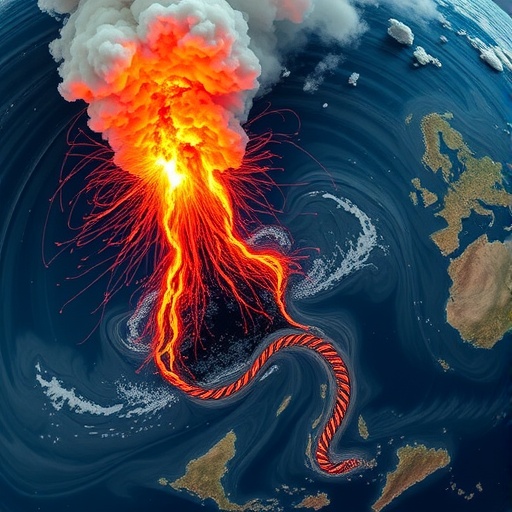
Historic volcanic eruptions left more than atmospheric smoke and short-lived cooling—they also appear to have written a lasting signal into Earth’s ocean circulation. In a new study published in Nature Communications, researchers report that past eruptions can imprint themselves on the planet’s global meridional overturning circulation (MOC), the slow conveyor belt that helps transport heat and control climate variability.
The team combines reanalysis datasets—modern reconstructions that merge observations with physical models—to build a coupled picture of how volcanic forcing propagates through the ocean–atmosphere system. Rather than treating eruptions as isolated atmospheric events, the analysis tracks how perturbations evolve into changes in upper-ocean stratification, mixed-layer depth, and the pathways that feed deep-water formation.
A key result is that volcanic episodes produce coherent, basin-wide adjustments in the MOC structure. These changes include shifts in the strength and configuration of overturning flows, suggesting that volcanic aerosols influence surface buoyancy fluxes and thereby modulate convection and water-mass transformation. The authors emphasize that the imprint is not merely transient: statistical patterns persist long enough to be detected across the coupled reanalysis framework.
To separate volcanic effects from internal variability, the study employs event-based comparisons and robust attribution logic across multiple eruption periods. The researchers examine spatial consistency, timing, and the alignment of circulation anomalies with physical mechanisms expected under volcanic forcing. They find that the coupled response is strongest where the ocean is most sensitive to changes in heat flux and salinity-driven density.
The work also addresses model–data coupling by focusing on circulation metrics that respond to changes in meridional transport. This approach links observed surface anomalies to deep-ocean pathways, supporting a mechanism in which volcanic aerosols alter radiative forcing, which then reshapes surface buoyancy and modifies overturning dynamics.
Importantly, the study suggests that the climate system can “remember” volcanic shocks through ocean circulation pathways. That memory could affect how future eruptions alter near-term climate trends, especially by influencing the baseline state of the MOC before subsequent forcing events.
As the world debates what drives interannual-to-decadal climate variability, the new findings raise the profile of volcanic forcing as an active ingredient in MOC variability. The results could improve how researchers initialize and interpret hindcasts and forecasts that rely on coupled ocean–atmosphere dynamics.
Overall, the research provides a new lens on volcanic impacts: eruptions may not only cool the planet temporarily, but can also reconfigure the ocean’s global circulation in ways that echo through time. For science readers, it is a vivid example of Earth system coupling—where chemistry, radiation, and deep ocean mechanics converge.
Cite Scienmag News
Violet Maxwell. (July 16, 2026). Volcanic eruptions leave imprint on coupled reanalysis global overturning circulation. Scienmag. https://scienmag.com/volcanic-eruptions-leave-imprint-on-coupled-reanalysis-global-overturning-circulation/
Violet Maxwell. "Volcanic eruptions leave imprint on coupled reanalysis global overturning circulation." Scienmag, 16 July 2026, https://scienmag.com/volcanic-eruptions-leave-imprint-on-coupled-reanalysis-global-overturning-circulation/. Accessed 4 September 2026.
Violet Maxwell. "Volcanic eruptions leave imprint on coupled reanalysis global overturning circulation." Scienmag. July 16, 2026. https://scienmag.com/volcanic-eruptions-leave-imprint-on-coupled-reanalysis-global-overturning-circulation/


