


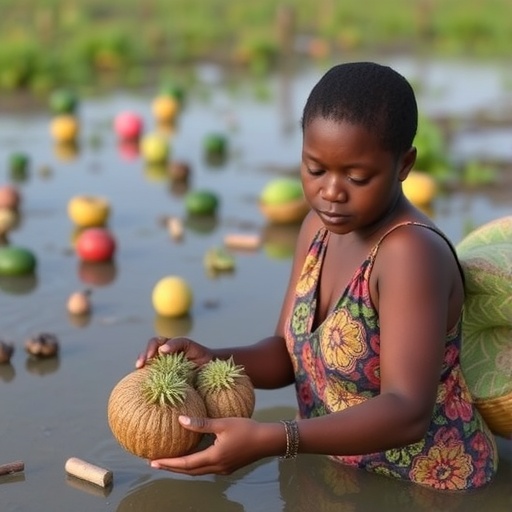
Small Island Developing States (SIDS) are experiencing climate impacts that are far more severe than global averages, even though they contribute less than 1% of greenhouse-gas emissions. Sea level rise, droughts, floods, and extreme heat are not just environmental threats—they are increasingly health and food security crises. A new Lancet Countdown report for 2025 brings these links into sharper focus by examining climate-related indicators specifically across SIDS.
One key analysis targets how the growing frequency of heatwaves and drought conditions affects access to food. Led by CMCC researcher Shouro Dasgupta and Professor Elizabeth Robinson at the Grantham Research Institute, the study connects climate signals to nutrition outcomes using an empirical approach. Heatwave-day and drought-month anomalies are calculated relative to a baseline period of 1981–2010, then matched with food security data to quantify shifting risk over time.
In 2023, the researchers estimate that an additional 2.7 million people—about 4.9% of the combined population of 26 SIDS, roughly 70 million people total—experienced moderate or severe food insecurity due to more frequent heatwaves and droughts. The results suggest a measurable climate-to-food pathway: higher heatwave-day frequency correlates with 5.74% higher moderate or severe food insecurity, while increasing drought frequency is associated with a 3.53% rise.
The report also highlights that vulnerability is amplified by structural constraints. Many SIDS rely heavily on food imports, so climate shocks that damage infrastructure or interrupt trade can rapidly translate into shortages and price spikes. In such settings, climate risk becomes an economic and health risk at the same time, particularly when fiscal space is limited.
Beyond food insecurity, climate impacts are showing up in broader health costs. In 2024, SIDS lost the equivalent of 1.27% of GDP due to reduced labor capacity—higher than the global figure of 0.99%. Over the early 2000s, heat-related mortality costs have increased by 432%, the steepest increase among tracked groups.
The study strengthens the case that climate action is not only about emissions but also about preventing cascading harms. It also aligns with the policy argument that limiting warming to 1.5°C is legally binding and that accountability may arise where causation to climate damage is established. For SIDS, the clock is accelerating—and the costs are showing up first.
Cite Scienmag News
Sloane Callahan. (July 16, 2026). Climate Change Disproportionately Threatens Food Security in Small Island Developing States. Scienmag. https://scienmag.com/climate-change-disproportionately-threatens-food-security-in-small-island-developing-states/
Sloane Callahan. "Climate Change Disproportionately Threatens Food Security in Small Island Developing States." Scienmag, 16 July 2026, https://scienmag.com/climate-change-disproportionately-threatens-food-security-in-small-island-developing-states/. Accessed 6 September 2026.
Sloane Callahan. "Climate Change Disproportionately Threatens Food Security in Small Island Developing States." Scienmag. July 16, 2026. https://scienmag.com/climate-change-disproportionately-threatens-food-security-in-small-island-developing-states/


