


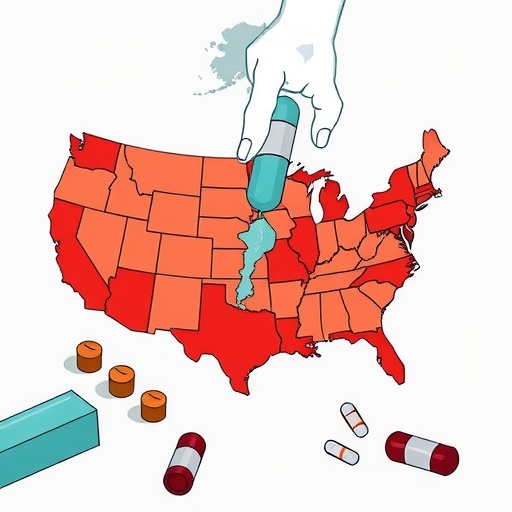
A new longitudinal analysis from Brown University reports that Americans’ perceptions of the effectiveness of U.S. illicit drug policy have remained stubbornly pessimistic—and have become increasingly partisan. Using decades of polling evidence, the study suggests that while concern about drugs persists across the political spectrum, optimism about progress is far less stable and now tracks federal political control.
The research, led by Brendan Saloner of Brown’s School of Public Health, draws on Gallup Poll Social Survey data spanning 2000 to 2025. By examining respondents’ views about whether the country is making progress against illicit drugs, the study reconstructs how public sentiment shifted across major policy eras, including the overdose epidemic and the expansion of cannabis legalization alongside changing federal approaches.
A central finding is that in most years between 2000 and 2025, fewer than half of Americans reported that the nation was making progress. The lowest point occurred in 2023, when perceived progress fell to just over 23%. By 2025, optimism rebounded to 44%, but it still did not yield a durable majority view that the U.S. is “winning” against illicit drugs.
The analysis also identifies a widening partisan gap. Americans were more likely to perceive progress when their preferred party held the White House, and this effect strengthened notably after the mid-2010s. Between 2023 and 2025, Republican perceptions of progress increased dramatically—by 54 points—highlighting how political context may shape interpretation of drug-policy outcomes.
Importantly, the study underscores a persistent mismatch between national and local experience. While most Americans describe illicit drugs as a serious national problem, far fewer say it is a serious problem in their own communities. This divergence indicates that public judgment of policy performance may be influenced by psychological distance, media framing, and the visibility of local impacts.
Saloner argues that the growing role of partisanship could make it harder to build broad public support for long-term strategy. He suggests policymakers may need to revise both communication strategies and messengers, potentially relying less on public health officials alone and more on trusted figures such as faith leaders or law enforcement.
The study’s findings appear in the Journal of Addiction Medicine.
Cite Scienmag News
Courtney Benton. (July 16, 2026). Americans See Illicit Drug Policy Through Growing Partisan Lens, Study Finds. Scienmag. https://scienmag.com/americans-see-illicit-drug-policy-through-growing-partisan-lens-study-finds/
Courtney Benton. "Americans See Illicit Drug Policy Through Growing Partisan Lens, Study Finds." Scienmag, 16 July 2026, https://scienmag.com/americans-see-illicit-drug-policy-through-growing-partisan-lens-study-finds/. Accessed 3 September 2026.
Courtney Benton. "Americans See Illicit Drug Policy Through Growing Partisan Lens, Study Finds." Scienmag. July 16, 2026. https://scienmag.com/americans-see-illicit-drug-policy-through-growing-partisan-lens-study-finds/


