


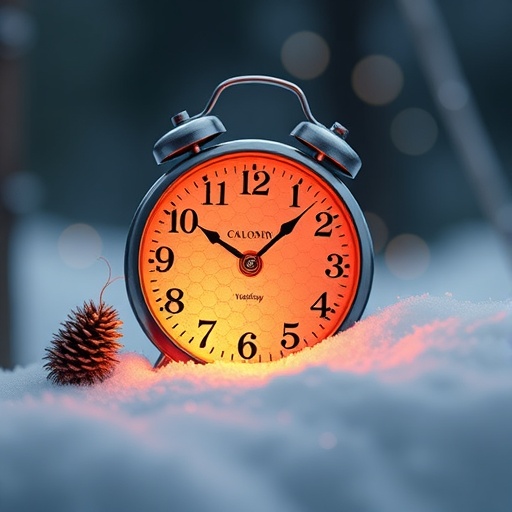
PULLMAN, Wash. — A team at Washington State University has uncovered a molecular mechanism that appears to “lock” animals into a reduced-activity winter mode until environmental conditions improve. The discovery, made using fruit flies, links seasonal physiology to a key component of the circadian clock—an internal timing system best known for regulating day–night rhythms.
In the study, researchers focused on a gene called timeless, a core circadian-clock element. Rather than producing only one functional product, timeless can be processed in different ways through alternative splicing, allowing the gene to generate distinct protein versions depending on the season. During winter, a specialized protein form is produced that reshapes the clock’s output.
This winter-specific protein shifts daily activity patterns and suppresses reproduction, effectively gating the organism’s seasonal program. The authors describe the effect as a “winter lock,” because the remodeled clock state persists until cues from the environment signal that it is time to transition back toward a summer pattern.
The work addresses a long-standing question in biology: how do organisms integrate environmental information such as changing day length and temperature into coordinated seasonal behavior? Although the circadian clock was suspected to contribute, the study provides a concrete molecular route by which clock architecture can be rearranged for seasonal adaptation.
By demonstrating that alternative splicing of a core clock gene can remodel circadian function, the findings support a model in which animals maintain multiple, seasonally tuned versions of the biological clock. In this framework, different protein configurations function like alternative wiring diagrams, allowing consistent timing yet flexible seasonal responses.
The researchers suggest that similar principles may operate in agricultural pests and disease-carrying insects, including mosquitoes. If seasonal timing in these species depends on comparable splicing-linked clock states, disrupting the process could offer new strategies for population control.
Beyond insects, the study may also inform how seasonal patterns influence human health. Some conditions, such as seasonal affective disorder, fluctuate with time of year, but the underlying biology remains incompletely understood.
The research was conducted with collaborators from Washington State University and the University of California, Davis, and was supported by the National Institutes of Health and the Pew Charitable Trusts.
Cite Scienmag News
Juliet Wilcox. (July 16, 2026). Study Uncovers a Winter-Adjusted Biological Clock in Living Organisms. Scienmag. https://scienmag.com/study-uncovers-a-winter-adjusted-biological-clock-in-living-organisms/
Juliet Wilcox. "Study Uncovers a Winter-Adjusted Biological Clock in Living Organisms." Scienmag, 16 July 2026, https://scienmag.com/study-uncovers-a-winter-adjusted-biological-clock-in-living-organisms/. Accessed 3 September 2026.
Juliet Wilcox. "Study Uncovers a Winter-Adjusted Biological Clock in Living Organisms." Scienmag. July 16, 2026. https://scienmag.com/study-uncovers-a-winter-adjusted-biological-clock-in-living-organisms/


