


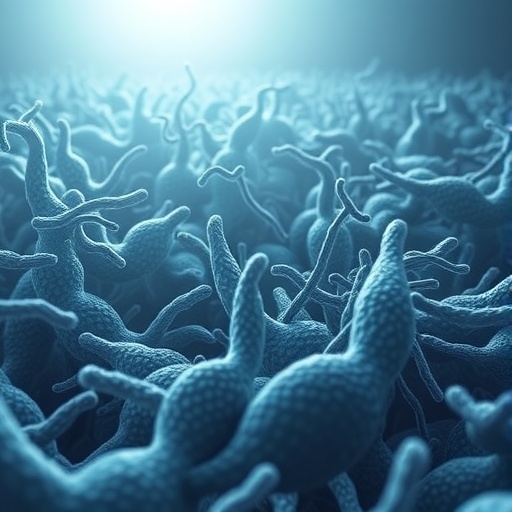
Tiny photosynthetic cyanobacteria may survive predator attacks by behaving less like solitary cells and more like organized herds. New research from Queen Mary University of London, published in The ISME Journal, shows that when cyanobacteria encounter foreign bacterial cues, they rapidly reorganize into dense protective clusters known as flocs. Instead of relying solely on growth to outcompete threats, these microbes invest energy in collective defense.
The study focuses on interactions between Synechocystis and the environmental predator Pseudomonas aeruginosa. Using controlled experiments, researchers observed that P. aeruginosa punctures and kills individual cyanobacterial cells, then consumes the released nutrients. This predatory strategy creates a strong selective pressure for countermeasures.
In response, cyanobacteria aggregate quickly, forming flocs that physically and chemically shield cells located deeper within the group. A surrounding extracellular slime layer further reduces predator access, effectively changing the geometry and vulnerability of the prey population. In other words, the same attack becomes less efficient once prey are spatially reorganized.
This discovery helps resolve a classic biological puzzle: why cyanobacteria would pay the apparent cost of floc formation. The work suggests the behavior is not incidental clumping but an evolved, coordinated defense mechanism. The resulting “herd” structure prioritizes survival of the population’s vulnerable core.
The team also tested mutant cyanobacteria unable to form these protective clusters. Predators performed better against these mutants, providing direct evidence that flocculation improves fitness under predation. Even more striking, the clustering response is triggered simply by contact with non-self bacteria, implying fine-scale recognition rather than a generic stress reaction.
Beyond microbial warfare, the findings connect predation to Earth’s carbon dynamics. Flocculated cyanobacteria are more likely to sink, transporting photosynthetically captured carbon into deeper waters where it can remain stored for longer periods—an essential component of the “biological carbon pump.”
The authors also raise a broader implication for ecosystem models: bacterial predation is often assumed to reduce carbon storage through consumption of organic matter. Under predation-driven flocculation, however, predators may indirectly enhance carbon burial by promoting sinking of photosynthetic partners.
Finally, the research reframes cyanobacteria as active social survivors. With these cells already abundant in lakes and oceans and responsible for a substantial share of global oxygen production, their collective defenses may represent a previously hidden lever on climate-relevant processes.
Cite Scienmag News
Morgan Morrow. (July 15, 2026). Bacteria form herds to evade predators, revealing new carbon cycle insight. Scienmag. https://scienmag.com/bacteria-form-herds-to-evade-predators-revealing-new-carbon-cycle-insight/
Morgan Morrow. "Bacteria form herds to evade predators, revealing new carbon cycle insight." Scienmag, 15 July 2026, https://scienmag.com/bacteria-form-herds-to-evade-predators-revealing-new-carbon-cycle-insight/. Accessed 4 September 2026.
Morgan Morrow. "Bacteria form herds to evade predators, revealing new carbon cycle insight." Scienmag. July 15, 2026. https://scienmag.com/bacteria-form-herds-to-evade-predators-revealing-new-carbon-cycle-insight/


