

Wednesday, July 15, 2026
Science
No Result
View All Result
  • Login
  • HOME
  • SCIENCE NEWS
  • CONTACT US
  • HOME
  • SCIENCE NEWS
  • CONTACT US
No Result
View All Result
Scienmag
No Result
View All Result
Home Science News Medicine

Local Complement C3 Shapes Control Myeloid Infiltration and Checkpoint Blockade Efficacy

July 15, 2026
in Medicine
Reading Time: 2 mins read
0
Local Complement C3 Shapes Control Myeloid Infiltration and Checkpoint Blockade Efficacy

Local Complement C3 Shapes Control Myeloid Infiltration and Checkpoint Blockade Efficacy

65
SHARES
587
VIEWS
Share on FacebookShare on Twitter
ADVERTISEMENT

A team investigating how tumors respond to immunotherapy reports that complement component C3 plays a decisive role—but only when it acts locally within the tumor microenvironment. Their findings, reported in Nature Communications, suggest that immune checkpoint blockade (ICB) efficacy can be shaped by where C3 is produced and how it influences myeloid cells that accumulate in and around tumors.

The study centers on a crucial distinction: circulating C3 versus complement C3 generated locally in tissues. While systemic complement activity has long been viewed as an immunomodulatory force, the researchers show that local C3 production is the determinant that tunes the inflammatory landscape relevant to checkpoint therapy. In other words, C3’s location, not merely its presence, governs treatment outcomes.

Mechanistically, local C3 was found to affect recruitment and behavior of myeloid populations that include macrophage- and monocyte-like cells. These cells are increasingly recognized as gatekeepers of tumor immunity, capable of either promoting anti-tumor T cell activity or suppressing it through cytokines, phagocytic programs, and antigen presentation pathways.

Using experimental models of ICB, the authors demonstrate that altering local complement C3 disrupts the immune cell composition inside tumors. Changes in myeloid infiltration correlated with differences in checkpoint response, indicating that complement-driven myeloid remodeling is a key step linking innate signals to adaptive anti-tumor immunity.

The work also supports a view of complement as a “local wiring” system for the tumor niche. By regulating myeloid cell trafficking and functional state, locally produced C3 can steer the tumor microenvironment toward either a permissive or inhibitory condition for T cell–mediated tumor killing during ICB.

Importantly, the results argue against a simplistic model in which systemic complement alone determines success. Instead, the paper highlights that locally available C3 can create microgradients of complement activity that reshape chemokine networks and myeloid recruitment programs at the tumor site.

From a translational perspective, the findings raise the possibility that therapies targeting C3 might need to be designed with spatial selectivity in mind. Broad systemic complement inhibition could carry trade-offs, whereas strategies that modulate tumor-local complement activation may preserve beneficial immune functions elsewhere while improving ICB performance.

Overall, this viral-science-news report reframes C3 as a spatial regulator of myeloid infiltration rather than a generic background immune factor. If confirmed in further studies, the concept of “local complement control” could guide next-generation immunotherapy combinations and patient stratification.

As immunotherapy strategies evolve, attention is shifting from single immune pathways to the architecture of tumor microenvironments. This study adds a compelling new piece: local complement C3 helps decide whether checkpoint blockade will succeed by controlling the innate immune cells that shape the battlefield.

Subject of Research: Immune checkpoint blockade efficacy and the role of complement C3 in shaping myeloid cell infiltration within the tumor microenvironment.

Article Title: Local, but not circulating, complement C3 shapes immune checkpoint blockade efficacy by controlling myeloid cell infiltration.

Article References: Miyai, Y., Shiraki, Y., Ando, R. et al. Local, but not circulating, complement C3 shapes immune checkpoint blockade efficacy by controlling myeloid cell infiltration. Nature Communications (2026). https://doi.org/10.1038/s41467-026-75542-3

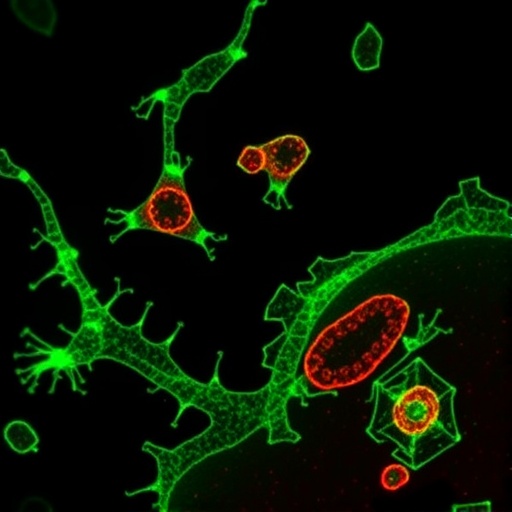
Image Credits: AI Generated

DOI: https://doi.org/10.1038/s41467-026-75542-3

Keywords: complement C3; immune checkpoint blockade; myeloid infiltration; tumor microenvironment; local complement activity; immune modulation

Tags: antigen presentation and phagocytosis in tumor microenvironmentcomplement C3 in cancer immunotherapycomplement-driven immune modulationcytokine signaling in tumor immune responseimmune checkpoint blockade mechanismsimpact of local complement production on immunotherapy efficacylocal vs systemic complement activitymacrophage and monocyte roles in tumor immunitymyeloid cell infiltration in tumorsregulation of tumor-infiltrating myeloid cellstumor immune landscape remodelingtumor microenvironment
Share26Tweet16
Previous Post

Longitudinal Urine Metabolomics Predicts High-Grade Brain Injury in Very Preterm Infants

Next Post

Early-Life Stress Alters Spontaneous Behavior in Cntnap2 Heterozygous Mice

Related Posts

Butyrate epigenetically sustains intestinal epithelial–T cell signaling for tolerance
Medicine

Butyrate epigenetically sustains intestinal epithelial–T cell signaling for tolerance

July 15, 2026
Correction: NLRP3 pyroptosis worsens mouse cardiac hypertrophy; irisin is protective
Medicine

Correction: NLRP3 pyroptosis worsens mouse cardiac hypertrophy; irisin is protective

July 15, 2026
Laryngoscopy attempts during transition linked to severe intraventricular hemorrhage in extreme preterms
Medicine

Laryngoscopy attempts during transition linked to severe intraventricular hemorrhage in extreme preterms

July 15, 2026
Older Adults’ Hip Abduction and Ankle Dorsiflexion Differences After Falls
Medicine

Older Adults’ Hip Abduction and Ankle Dorsiflexion Differences After Falls

July 15, 2026
Virtual Tumor Model Predicts Response to Liver Cancer Immunotherapy
Medicine

Virtual Tumor Model Predicts Response to Liver Cancer Immunotherapy

July 15, 2026
Fragmented European wetlands face uneven restoration needs and patchy recovery efforts
Medicine

Fragmented European wetlands face uneven restoration needs and patchy recovery efforts

July 15, 2026
Next Post
Early-Life Stress Alters Spontaneous Behavior in Cntnap2 Heterozygous Mice

Early-Life Stress Alters Spontaneous Behavior in Cntnap2 Heterozygous Mice

  • Mothers who receive childcare support from maternal grandparents show more

    Mothers who receive childcare support from maternal grandparents show more parental warmth, finds NTU Singapore study

    27656 shares
    Share 11059 Tweet 6912
  • University of Seville Breaks 120-Year-Old Mystery, Revises a Key Einstein Concept

    1061 shares
    Share 424 Tweet 265
  • Bee body mass, pathogens and local climate influence heat tolerance

    682 shares
    Share 273 Tweet 171
  • Researchers record first-ever images and data of a shark experiencing a boat strike

    546 shares
    Share 218 Tweet 137
  • Groundbreaking Clinical Trial Reveals Lubiprostone Enhances Kidney Function

    531 shares
    Share 212 Tweet 133
Science

Embark on a thrilling journey of discovery with Scienmag.com—your ultimate source for cutting-edge breakthroughs. Immerse yourself in a world where curiosity knows no limits and tomorrow’s possibilities become today’s reality!

RECENT NEWS

  • Economic Optimal Timing and Mix of Europe’s Coastal Adaptation to 2150
  • Butyrate epigenetically sustains intestinal epithelial–T cell signaling for tolerance
  • Designing Rational Home-Based Studies to Assess Infants’ Sleep Patterns
  • Correction: NLRP3 pyroptosis worsens mouse cardiac hypertrophy; irisin is protective

Categories

  • Agriculture
  • Anthropology
  • Archaeology
  • Athmospheric
  • Biology
  • Biotechnology
  • Blog
  • Bussines
  • Cancer
  • Chemistry
  • Climate
  • Earth Science
  • Editorial Policy
  • Marine
  • Mathematics
  • Medicine
  • Pediatry
  • Policy
  • Psychology & Psychiatry
  • Science Education
  • Social Science
  • Space
  • Technology and Engineering

Subscribe to Blog via Email

Enter your email address to subscribe to this blog and receive notifications of new posts by email.

Join 5,146 other subscribers

© 2025 Scienmag - Science Magazine

Welcome Back!

Login to your account below

Forgotten Password?

Retrieve your password

Please enter your username or email address to reset your password.

Log In
No Result
View All Result
  • HOME
  • SCIENCE NEWS
  • CONTACT US

© 2025 Scienmag - Science Magazine

Discover more from Science

Subscribe now to keep reading and get access to the full archive.

Continue reading
