

Wednesday, July 15, 2026
Science
No Result
View All Result
  • Login
  • HOME
  • SCIENCE NEWS
  • CONTACT US
  • HOME
  • SCIENCE NEWS
  • CONTACT US
No Result
View All Result
Scienmag
No Result
View All Result
Home Science News Medicine

Accelerometer Study Compares 24-H Movement Patterns Across Prediabetes and Diabetes

July 15, 2026
in Medicine
Reading Time: 2 mins read
0
Accelerometer Study Compares 24-H Movement Patterns Across Prediabetes and Diabetes

Accelerometer Study Compares 24-H Movement Patterns Across Prediabetes and Diabetes

65
SHARES
587
VIEWS
Share on FacebookShare on Twitter
ADVERTISEMENT

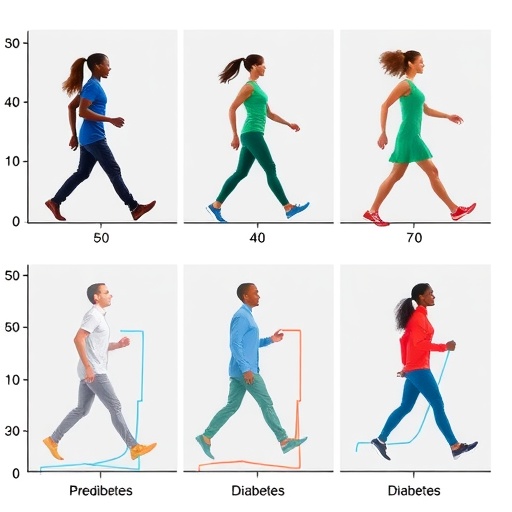
A new population-based analysis is sharpening the picture of how a full day’s mix of movement relates to abnormal blood sugar. Using continuous accelerometer monitoring, researchers examined four tightly linked behaviors—sleep, sedentary behavior (SB), light-intensity physical activity (LIPA), and moderate-to-vigorous physical activity (MVPA)—as parts of a single 24-hour composition.

Rather than treating each behavior independently, the study applied compositional data analysis (CoDA), a statistical framework designed for “mutually exclusive parts of a whole.” This matters because increasing time in one behavior inherently reduces time available for others, and traditional models can misrepresent these trade-offs.

The goal was to connect 24-hour movement patterns with distinct pre-diabetes phenotypes: isolated impaired fasting plasma glucose (i-IFG), isolated impaired glucose tolerance (i-IGT), and a combined IFG + IGT state, as well as diagnosed diabetes. By evaluating the relative balance across the whole day, the researchers aimed to identify activity substitutions that could be more informative than isolated averages.

Accelerometer-derived data provided objective estimates of how participants actually distributed their time. The analysis then translated CoDA outputs into associations with each glucose-related phenotype, highlighting that “more activity” is not a one-size-fits-all message.

The findings suggest that the movement profile linked to fasting impairment differs from that linked to tolerance impairment, implying that metabolic pathways may respond selectively to different combinations of sleep and activity intensity. In practical terms, shifting the composition—such as reallocating time away from sedentary periods toward specific activity intensity—could correspond to lower disease likelihood.

For diabetes, the study reinforces the importance of the daily activity structure. It also underscores how sleep length and quality, captured as part of the same composition, may interact with physical activity patterns when considered together.

Because the approach respects the closed nature of time-use data, CoDA may offer a clearer route for designing behavior targets. Instead of prescribing single behaviors in isolation, future guidelines could consider “what to replace,” optimizing the 24-hour balance.

Published in International Journal of Obesity, the work by Rong, Ho, and Chau (2026) demonstrates that accelerometer-based compositional modeling can reveal nuanced associations across normoglycemia, multiple pre-diabetes phenotypes, and diabetes.


Subject of Research: 24-hour movement behaviors and glucose regulation
Article Title: Compositional analyses of accelerometer-measured 24-h movement behaviors among adults with normoglycemia, pre-diabetes phenotypes, and diabetes: a population-based study.
Article References: Rong, J., Ho, M. & Chau, P.H. Int J Obes (2026). https://doi.org/10.1038/s41366-026-02162-8
Image Credits: AI Generated
DOI: https://doi.org/10.1038/s41366-026-02162-8
Keywords: sleep, sedentary behavior, light-intensity physical activity, moderate-to-vigorous physical activity, compositional data analysis, pre-diabetes phenotypes, diabetes

Tags: movement patterns and interventions should be tailored to specific prediabetes subtypes and diabetes.
Share26Tweet16
Previous Post

Two-Photon Interference Links Independent Atomic and Quantum Dot Single-Photon Sources for Hybrid Networks

Next Post

New Trends in Lobbying for Psychiatry and Psychology

Related Posts

Researchers Improve Allergy Testing to Detect Antibodies Behind Reactions
Medicine

Researchers Improve Allergy Testing to Detect Antibodies Behind Reactions

July 15, 2026
Regulatory Hurdles Undermine Cell Therapy Approvals: Lessons from IND and BLA Failures
Medicine

Regulatory Hurdles Undermine Cell Therapy Approvals: Lessons from IND and BLA Failures

July 15, 2026
Machine Learning Method Widens Accurate Use of Martin-Hopkins LDL Risk Equation
Medicine

Machine Learning Method Widens Accurate Use of Martin-Hopkins LDL Risk Equation

July 15, 2026
SIRT5-SUCLG2 Desuccinylation Axis Delays Ovarian Aging Through Mitochondrial-Epigenetic Control
Medicine

SIRT5-SUCLG2 Desuccinylation Axis Delays Ovarian Aging Through Mitochondrial-Epigenetic Control

July 15, 2026
Quality Improvement Project Enhances Neonatology Research Experience for Families
Medicine

Quality Improvement Project Enhances Neonatology Research Experience for Families

July 15, 2026
Day After Mass Shooting Sees Rise in Traffic Accidents
Medicine

Day After Mass Shooting Sees Rise in Traffic Accidents

July 15, 2026
Next Post
New Trends in Lobbying for Psychiatry and Psychology

New Trends in Lobbying for Psychiatry and Psychology

  • Mothers who receive childcare support from maternal grandparents show more

    Mothers who receive childcare support from maternal grandparents show more parental warmth, finds NTU Singapore study

    27656 shares
    Share 11059 Tweet 6912
  • University of Seville Breaks 120-Year-Old Mystery, Revises a Key Einstein Concept

    1061 shares
    Share 424 Tweet 265
  • Bee body mass, pathogens and local climate influence heat tolerance

    682 shares
    Share 273 Tweet 171
  • Researchers record first-ever images and data of a shark experiencing a boat strike

    546 shares
    Share 218 Tweet 137
  • Groundbreaking Clinical Trial Reveals Lubiprostone Enhances Kidney Function

    531 shares
    Share 212 Tweet 133
Science

Embark on a thrilling journey of discovery with Scienmag.com—your ultimate source for cutting-edge breakthroughs. Immerse yourself in a world where curiosity knows no limits and tomorrow’s possibilities become today’s reality!

RECENT NEWS

  • Novel Prognostic Biomarker and Oncogenic Driver Identified in Colorectal Cancer
  • ROS Dynamics Controlled by Polyoxometalate-Functionalized Fe3O4 Nanozyme for Infected Wound Healing
  • Researchers Improve Allergy Testing to Detect Antibodies Behind Reactions
  • Warming Seas Drive Marine Fish to Expand Ranges and Migrate Deeper in Europe

Categories

  • Agriculture
  • Anthropology
  • Archaeology
  • Athmospheric
  • Biology
  • Biotechnology
  • Blog
  • Bussines
  • Cancer
  • Chemistry
  • Climate
  • Earth Science
  • Editorial Policy
  • Marine
  • Mathematics
  • Medicine
  • Pediatry
  • Policy
  • Psychology & Psychiatry
  • Science Education
  • Social Science
  • Space
  • Technology and Engineering

Subscribe to Blog via Email

Enter your email address to subscribe to this blog and receive notifications of new posts by email.

Join 5,146 other subscribers

© 2025 Scienmag - Science Magazine

Welcome Back!

Login to your account below

Forgotten Password?

Retrieve your password

Please enter your username or email address to reset your password.

Log In
No Result
View All Result
  • HOME
  • SCIENCE NEWS
  • CONTACT US

© 2025 Scienmag - Science Magazine

Discover more from Science

Subscribe now to keep reading and get access to the full archive.

Continue reading
