


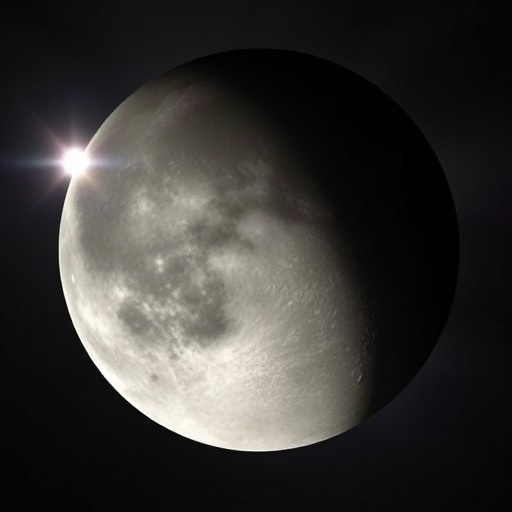
A new study using lunar noble-gas measurements reports evidence that the Moon’s far side experienced deeper solar-wind penetration than previously inferred. The key signal comes from neon isotopes extracted from CE6 soils, a young regolith unit, where the measured ^20Ne/^22Ne ratios suggest a strong contribution from solar-wind–derived helium/neon (SW-Ne) that has undergone significant isotopic fractionation.
The authors interpret the CE6 ^20Ne/^22Ne enrichment as reflecting heavier isotopes being preferentially retained relative to lighter ones, a pattern usually associated with fractionation of SW-Ne during exposure. Crucially, when the inferred abundance of fractionated SW-Ne in lunar soils is compared with expectations from other environments—such as the lunar nearside soils, or the Genesis mission’s solar-wind capture target—the CE6 ratios do not match the simplest scenarios.
Earlier models often explain ^20Ne/^22Ne fractionation through preferential sputtering, where steady-state sputtering equilibrium values are predicted to be near 12.73. While that estimate broadly matches many lunar samples, it overshoots the CE6 aliquots, implying that CE6 cannot be explained by sputtering alone. The study also evaluates single-stage diffusion and erosion models, which would require extreme near-total loss of neon (about 99% for diffusion and ~95% for erosion) to reach the observed fractionation level of 11.2—conditions the data do not support.
Instead, the CE6 samples show no corresponding decline in noble-gas concentrations when compared with other lunar soils. On the contrary, CE6’s median Ne concentration is slightly higher than that of CE5, weakening diffusion/erosion explanations that predict a concurrent depletion of implanted species. Moreover, CE5 and CE6 come from similar latitudes, leaving little room for temperature-driven diffusion differences.
The authors also argue that long-term solar-wind anomalies are unlikely, citing an independent ^40Ar/^36Ar_tr record from CE6 regolith that closely matches CE5. Taken together, these inconsistencies indicate that CE6’s neon isotopic signature likely reflects a more complex interplay of processes rather than any one mechanism acting in isolation.
One possibility raised by the researchers is that CE6 includes a neon component whose ^20Ne/^22Ne ratio is lower than the canonical fractionated solar-wind value (about 11.2). Such mixing, combined with multiple fractionation steps, could produce the observed ratios without erasing noble-gas abundances. They emphasize that testing these ideas will require future work to compare near- and far-side irradiation parameters more directly.
The findings suggest that Sun–Earth–Moon interactions are more spatially heterogeneous than assumed, potentially tying the “stable” ^20Ne/^22Ne variability across solar system reservoirs to differences in where and how solar wind penetrates lunar regolith. As a result, the Moon’s near and far sides may preserve distinct chapters of solar-wind history in their noble-gas archives.
If confirmed and expanded, the work would refine how planetary surfaces process solar wind and how isotopic fingerprints can diagnose penetration depth and regolith exposure pathways across airless bodies. Beyond the Moon, the approach offers a route to evaluating fractionation physics in other contexts where noble gases archive solar and space-weather influences.
Cite Scienmag News
Violet Maxwell. (July 15, 2026). Noble gas records show deeper solar wind penetration on Moon’s far side. Scienmag. https://scienmag.com/noble-gas-records-show-deeper-solar-wind-penetration-on-moons-far-side/
Violet Maxwell. "Noble gas records show deeper solar wind penetration on Moon’s far side." Scienmag, 15 July 2026, https://scienmag.com/noble-gas-records-show-deeper-solar-wind-penetration-on-moons-far-side/. Accessed 5 September 2026.
Violet Maxwell. "Noble gas records show deeper solar wind penetration on Moon’s far side." Scienmag. July 15, 2026. https://scienmag.com/noble-gas-records-show-deeper-solar-wind-penetration-on-moons-far-side/


