


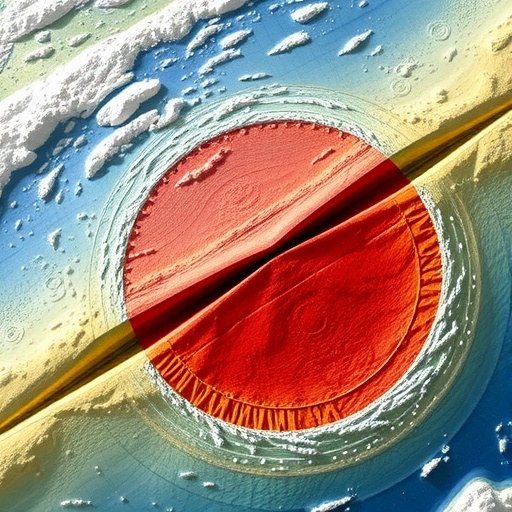
A new study argues that earthquake “doublets” in subduction zones—two closely spaced ruptures that occur as if they are linked—may follow the statistical behavior of an Omori process rather than representing purely independent events. Published in Communications Earth & Environment in 2026, the work by Jiang, Stein, and Trugman points to a mechanism in which megathrust tear faults modulate triggering, shaping the timing and clustering of subsequent shocks.
Subduction megathrusts are known for generating some of the largest earthquakes on Earth. Yet in many regions, sequences do not unfold as a single rupture followed by aftershocks in the usual way. Instead, researchers observe events that arrive in pairs, separated by short intervals, suggesting a special physical interaction within the plate boundary zone.
The authors focus on how ruptures can develop during fault evolution. In their framework, megathrust tear faults—structures that partition or offset portions of the megathrust—can influence stress transfer and rupture propagation. Rather than acting as isolated defects, these tear fault geometries may create conditions that make a second mainshock-like event emerge from the same evolving stress state.
Central to the paper is the claim that the doublet timing resembles an Omori process. The Omori law describes how the rate of earthquakes decays after a main event. By treating the first rupture as a triggering source and incorporating the role of tear fault interaction, the study interprets the second rupture as part of a time-dependent aftershock-like sequence with altered hazard characteristics.
Technically, the analysis connects observed temporal patterns of doublets with statistical expectations for Omori-type decay. The authors argue that incorporating megathrust tear fault interaction into models helps reconcile why some doublets appear distinct from typical aftershock swarms while still conforming to a broader triggering law.
If correct, the implications for seismic hazard could be profound. Forecasting typically relies on aftershock decay rates; however, doublets can be misclassified as separate, independent events. A refined interpretation that treats doublets as Omori-promoted phenomena could improve short-term risk assessments after a major subduction earthquake.
The study also underscores the importance of structural complexity at megathrust interfaces. Tear faults, often discussed in tectonic and geodynamic contexts, may have a direct observable signature in rupture sequences—effectively turning geometry into timing.
By linking rupture mechanics, fault interaction, and time-dependent seismicity statistics, the new results suggest that some “twin shocks” in subduction zones are not anomalies. They may be a predictable outcome of how megathrust systems self-organize under stress, providing a path toward more realistic hazard models in the world’s most dangerous convergent margins.
Cite Scienmag News
Violet Maxwell. (July 15, 2026). Megathrust tear faults trigger Omori-like earthquake doublets in subduction zones. Scienmag. https://scienmag.com/megathrust-tear-faults-trigger-omori-like-earthquake-doublets-in-subduction-zones/
Violet Maxwell. "Megathrust tear faults trigger Omori-like earthquake doublets in subduction zones." Scienmag, 15 July 2026, https://scienmag.com/megathrust-tear-faults-trigger-omori-like-earthquake-doublets-in-subduction-zones/. Accessed 3 September 2026.
Violet Maxwell. "Megathrust tear faults trigger Omori-like earthquake doublets in subduction zones." Scienmag. July 15, 2026. https://scienmag.com/megathrust-tear-faults-trigger-omori-like-earthquake-doublets-in-subduction-zones/


