


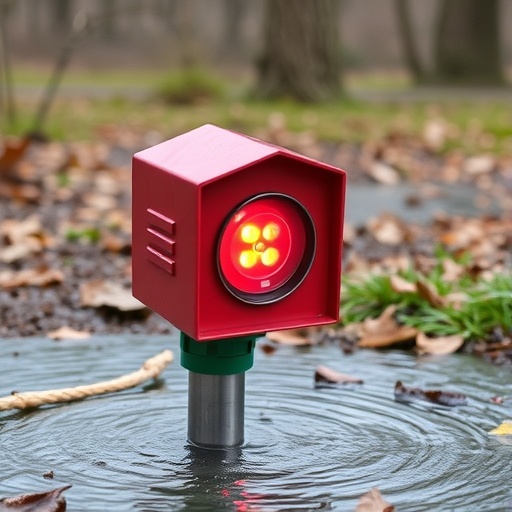
In the wake of the catastrophic July 4, 2025 floods in Central Texas—where 139 people lost their lives—an associate professor at The University of Texas at Austin began developing a new kind of outdoor flood alarm. The goal: a device that is low-tech, extremely loud, and simple enough to be “set and forget,” much like a smoke detector.
One year after the effort started, the technology is moving toward reality. A provisional patent application was filed on June 22, and UT’s Discovery to Impact commercialization unit has helped support the small business behind the device, RiseAlert, LLC.
The project gained urgency after learning about the Camp Mystic tragedy, in which 27 campers and counselors died. Daniella Rempe, a hydrology associate professor at UT’s Jackson School of Geosciences, assembled a team of collaborators to translate disaster lessons into a practical safety system. Her partners include David Dralle of the U.S. Department of Agriculture Forest Service and Jesse Hahm of Simon Fraser University.
The design takes a deliberately simple route. Like high-water alarms used for septic systems, the system combines a water-level sensor with an alarm and a warning light. Unlike indoor leak detectors, it is engineered for outdoor flood conditions and intended to alert people as floodwater rises at a specific property.
A central focus is affordability and reliability. The team is designing for minimal maintenance and low power consumption, targeting a battery life of at least 10 years. The enclosure and components are meant to be weather- and pest-resistant, ensuring performance during harsh storms rather than after.
The alarm does not rely on the internet, cellular service, or a companion phone app. Rempe argues that avoiding connectivity reduces failure points during emergencies and helps the device keep functioning when people need it most.
For installation, the hardware is intended to be mounted downslope from a residence—such as to a tree or fence post—so it can sense rising water at the relevant threshold. When the water level reaches the preset height, the sensor triggers both an audible alarm and a visible warning light.
Rempe sees a major safety gap in flood warning technology: while indoor flood alarms are common, there are few life-safety devices built for detecting life-threatening outdoor flooding before it reaches a doorway. Some communities deploy area-wide sirens or text alerts, but these may not reflect conditions at individual properties.
Ultimately, the team’s approach reflects a hydrologist’s perspective. Advanced instrumentation helps characterize floods and droughts, but the most effective intervention may be a straightforward last line of defense—one that can be deployed broadly, quickly, and affordably.
News Publication Date:
No information provided
Web References:
No information provided
References:
No information provided
Cite Scienmag News
Violet Maxwell. (July 15, 2026). Hydrology Professor Creates Simple Outdoor Flood Alarm to Save Lives. Scienmag. https://scienmag.com/hydrology-professor-creates-simple-outdoor-flood-alarm-to-save-lives/
Violet Maxwell. "Hydrology Professor Creates Simple Outdoor Flood Alarm to Save Lives." Scienmag, 15 July 2026, https://scienmag.com/hydrology-professor-creates-simple-outdoor-flood-alarm-to-save-lives/. Accessed 3 September 2026.
Violet Maxwell. "Hydrology Professor Creates Simple Outdoor Flood Alarm to Save Lives." Scienmag. July 15, 2026. https://scienmag.com/hydrology-professor-creates-simple-outdoor-flood-alarm-to-save-lives/


