

Tuesday, July 14, 2026
Science
No Result
View All Result
  • Login
  • HOME
  • SCIENCE NEWS
  • CONTACT US
  • HOME
  • SCIENCE NEWS
  • CONTACT US
No Result
View All Result
Scienmag
No Result
View All Result
Home Science News Social Science

Scientists’ credibility varies with audience and perceived intentions

July 13, 2026
in Social Science
Reading Time: 2 mins read
0
Scientists’ credibility varies with audience and perceived intentions

Scientists’ credibility varies with audience and perceived intentions

65
SHARES
587
VIEWS
Share on FacebookShare on Twitter
ADVERTISEMENT

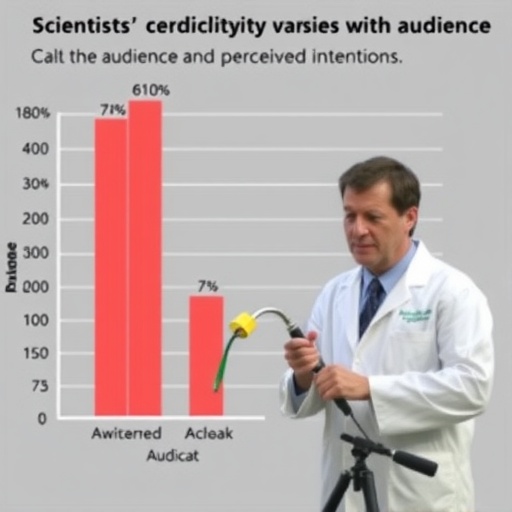
Scientists’ credibility is not just about expertise—it heavily depends on public perceptions of their underlying motivations, a groundbreaking study from Virginia Tech reveals. This insight challenges traditional assumptions about scientific communication, emphasizing that trust hinges on the belief that scientists act to serve the public good.

In a novel survey-based experiment, researchers Dara Wald, associate professor, and Shumaila Bhatti, postdoctoral fellow, both from Virginia Tech’s School of Public and International Affairs, categorized the American public into five distinct groups according to how they perceive scientists’ credibility: enthusiasts, optimists, moderates, skeptics, and estranged. These groups differ significantly not only in how much they trust scientists but also in their support for science-driven environmental and health policies, as well as their political and demographic profiles.

The study highlights a critical communication gap: while scientists often rely on their expertise and factual knowledge to convey credibility, the public’s trust is more strongly influenced by perceived intentions and whether scientists are seen as genuinely pursuing the common good. “Science communication traditionally focuses on competence and research findings, but the public also demands transparency about the purposes and values guiding the science,” said Bhatti.

To probe these dynamics, the researchers exposed participants to articles covering both a non-controversial issue (salmonella) and a politically charged topic (heatwaves) and assessed how perceived credibility shifted across contexts. Results showed substantial variation: for example, moderates were contextually engaged, showing support in some cases but skepticism in others, while skeptics and the estranged groups consistently distrusted scientific motives and institutions.

Such divisions are not inconsequential. Wald explains, “For urgent threats like flood warnings, public trust in the motivations behind scientific advice is vital. Without trust, people may ignore warnings meant to protect lives and property—regardless of the scientific accuracy.” The findings suggest that addressing these motivational perceptions could improve public engagement with science, fostering more effective policy support and health behaviors.

The researchers call for scientists to broaden their communication strategies beyond explaining the “what” of their research to also communicating the “why”—the ethical commitments and intentions that drive their work. This nuanced approach may help bridge the disconnect and create more inclusive science communication that resonates with diverse audiences.

In sum, this pioneering work deconstructs the monolithic view of “the public” and underscores the importance of addressing motivational credibility as a cornerstone of building public trust in science. It opens the door to more tailored communication strategies that meet the public’s expectations, potentially transforming how science interfaces with society.

Funding was provided by the National Science Foundation and the National Institutes of Health, supporting the project’s focus on refining our understanding of public trust in scientific institutions.


Subject of Research: Public perceptions of scientists’ credibility and motivations
Article Title: There is not one public: divergent perceptions of scientists’ source credibility in the United States
News Publication Date: July 10, 2026
Web References: http://dx.doi.org/10.1057/s41599-026-07609-x
Image Credits: Photos courtesy of Dara Wald and Shumaila Bhatti
Keywords: Science communication, Science policy, Environmental policy, Perception, Public trust

Tags: audience perception of sciencecredibility of scientistsperceived scientist motivationspublic perception of scientific integritypublic trust in scientistsscience and health policy supportscience communicationscience communication and transparencyscience communication strategiesscience credibility and political viewsscience-driven environmental policiesscience-public relationship
Share26Tweet16
Previous Post

UMA Scientists Enhance Morphine’s Pain-Relief Effectiveness

Next Post

UH Mānoa Study Finds Hawaiian Hotspot Temperature Rising

Related Posts

Robot umpires reduce bias against star baseball hitters
Social Science

Robot umpires reduce bias against star baseball hitters

July 13, 2026
Teen autism brains respond less to unfamiliar voices, study shows
Social Science

Teen autism brains respond less to unfamiliar voices, study shows

July 13, 2026
Asian House Shrew Reveals Secret Maritime Trade Network
Social Science

Asian House Shrew Reveals Secret Maritime Trade Network

July 13, 2026
Study Links Cosmetic Procedure Addiction to Social Media and Body Image
Social Science

Study Links Cosmetic Procedure Addiction to Social Media and Body Image

July 13, 2026
Human Impact Shapes Urban Tree Species Diversity, Climate Influences Evolutionary Traits
Social Science

Human Impact Shapes Urban Tree Species Diversity, Climate Influences Evolutionary Traits

July 13, 2026
Beach Season Arrives Early but Remains Unequal for Many Visitors
Social Science

Beach Season Arrives Early but Remains Unequal for Many Visitors

July 13, 2026
Next Post
UH Mānoa Study Finds Hawaiian Hotspot Temperature Rising

UH Mānoa Study Finds Hawaiian Hotspot Temperature Rising

  • Mothers who receive childcare support from maternal grandparents show more

    Mothers who receive childcare support from maternal grandparents show more parental warmth, finds NTU Singapore study

    27656 shares
    Share 11059 Tweet 6912
  • University of Seville Breaks 120-Year-Old Mystery, Revises a Key Einstein Concept

    1061 shares
    Share 424 Tweet 265
  • Bee body mass, pathogens and local climate influence heat tolerance

    682 shares
    Share 273 Tweet 171
  • Researchers record first-ever images and data of a shark experiencing a boat strike

    546 shares
    Share 218 Tweet 137
  • Groundbreaking Clinical Trial Reveals Lubiprostone Enhances Kidney Function

    531 shares
    Share 212 Tweet 133
Science

Embark on a thrilling journey of discovery with Scienmag.com—your ultimate source for cutting-edge breakthroughs. Immerse yourself in a world where curiosity knows no limits and tomorrow’s possibilities become today’s reality!

RECENT NEWS

  • AI Advances Revolutionize Oncology Drug Discovery from Targets to Therapies
  • New Study Links Muscle Health to Diabetes Risk
  • International Team Synthesizes Unexpectedly Stable Strongly Bent Sandwich Molecule
  • Dolphins Spotted Returning to the Sea of Japan

Categories

  • Agriculture
  • Anthropology
  • Archaeology
  • Athmospheric
  • Biology
  • Biotechnology
  • Blog
  • Bussines
  • Cancer
  • Chemistry
  • Climate
  • Earth Science
  • Editorial Policy
  • Marine
  • Mathematics
  • Medicine
  • Pediatry
  • Policy
  • Psychology & Psychiatry
  • Science Education
  • Social Science
  • Space
  • Technology and Engineering

Subscribe to Blog via Email

Enter your email address to subscribe to this blog and receive notifications of new posts by email.

Join 5,146 other subscribers

© 2025 Scienmag - Science Magazine

Welcome Back!

Login to your account below

Forgotten Password?

Retrieve your password

Please enter your username or email address to reset your password.

Log In
No Result
View All Result
  • HOME
  • SCIENCE NEWS
  • CONTACT US

© 2025 Scienmag - Science Magazine

Discover more from Science

Subscribe now to keep reading and get access to the full archive.

Continue reading
