


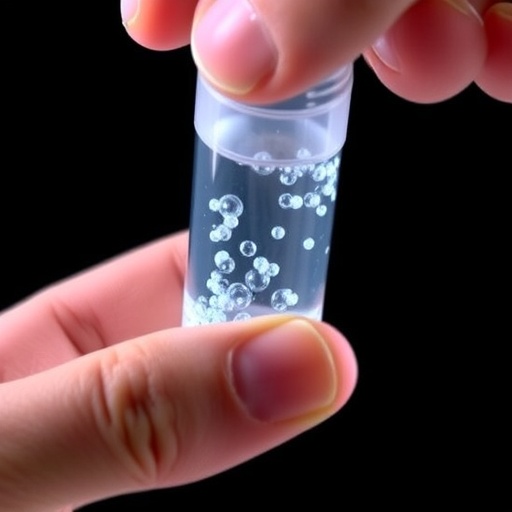
Scientists at the Institute of Science Tokyo have pioneered a cutting-edge biosensor that rapidly detects nanoplastics, specifically polystyrene nanoparticles (PS-NPs), in environmental water samples. This breakthrough addresses the critical need for simpler, faster detection methods for nanoscale plastic pollutants, which have become an increasing concern due to their pervasive presence in ecosystems and potential health risks to humans.
Nanoplastics, defined as plastic particles under 1,000 nanometers in size, result from the breakdown of larger plastic debris. Their minute scale makes traditional detection techniques, reliant on microscopy or spectroscopy, both time-consuming and cost-prohibitive. The newly developed biosensor overcomes these challenges by employing surface plasmon resonance (SPR) combined with a highly selective polystyrene-binding peptide immobilized on a gold film.
The underlying mechanism involves an optical sensing process wherein laser light excites collective electron oscillations (surface plasmons) at the interface of a gold-coated sensor. Binding of polystyrene nanoparticles to the peptide-functionalized surface alters the local refractive index, causing measurable shifts in the SPR signal. This label-free detection method yields real-time data with minimal sample preparation.
Testing revealed the biosensor’s ability to detect PS-NPs as small as 50 nm within 20 minutes in model freshwater environments. The system demonstrated a low detection limit of 1.3 micrograms per milliliter and was validated using environmental water samples from aquariums and natural ponds spiked with nanoparticles. These results underscore the sensor’s practical applicability for environmental monitoring.
Key to the sensor’s specificity is the use of a polyethylene glycol (PEG) linker that immobilizes the polystyrene-binding peptide onto the gold film. This molecular design minimizes non-specific bindings, enhancing sensitivity and accuracy. The straightforward sample processing and rapid turnaround mark a substantial improvement over conventional methods that often require sophisticated instruments and laborious preparations.
As nanoplastics continue to accumulate due to ongoing plastic degradation, the capacity to efficiently monitor their presence becomes crucial. This biosensor represents a transformative tool for researchers and environmental agencies, facilitating routine nanoplastic surveillance and advancing our understanding of nanoparticle distribution, behavior, and ecological impact.
The work, led by Associate Professor Mana Toma and Assistant Professor Shuo Cheng, will be published in the September 2026 issue of Biosensors and Bioelectronics. Their innovation not only sets a new standard in nanoplastic detection but also exemplifies the integration of nanotechnology and environmental science to tackle emerging pollution challenges.
Keywords
Nanoplastics, biosensor, surface plasmon resonance, polystyrene nanoparticles, environmental monitoring, water pollution, label-free detection, nanotechnology
Cite Scienmag News
Sylvia Mullen. (July 13, 2026). Biosensor Quickly Identifies Nanoplastics in Water Samples. Scienmag. https://scienmag.com/biosensor-quickly-identifies-nanoplastics-in-water-samples/
Sylvia Mullen. "Biosensor Quickly Identifies Nanoplastics in Water Samples." Scienmag, 13 July 2026, https://scienmag.com/biosensor-quickly-identifies-nanoplastics-in-water-samples/. Accessed 4 September 2026.
Sylvia Mullen. "Biosensor Quickly Identifies Nanoplastics in Water Samples." Scienmag. July 13, 2026. https://scienmag.com/biosensor-quickly-identifies-nanoplastics-in-water-samples/


