


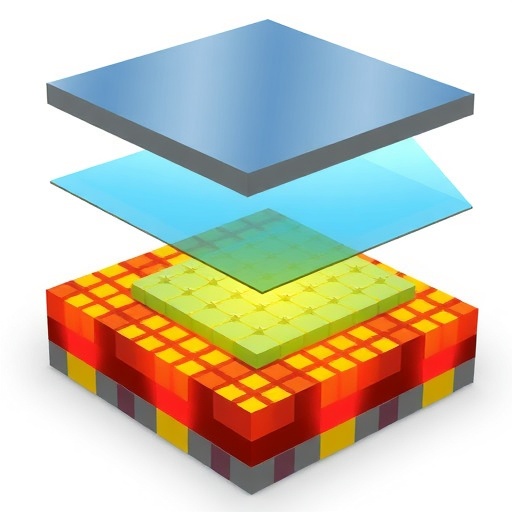
A groundbreaking advancement in perovskite–organic tandem solar cells (TSCs) has emerged from recent research, addressing long-standing challenges related to stability and efficiency in wide-bandgap (WBG) mixed-halide perovskites. These WBG materials, especially those with high bromine content, are pivotal as front cell absorbers in TSC architectures but have traditionally suffered from halide inhomogeneity and light-driven halide segregation. Such instability severely hampers device performance and operational durability.
The research team introduced a novel photo-transformable additive, 4-[3-(trifluoromethyl)-3H-diazirin-3-yl]benzylamine (TDB), into the perovskite precursor solutions. This additive embodies a two-pronged approach to enhance phase stability and performance. Initially, during the crystallization phase, TDB acts to suppress the premature precipitation of bromine-rich regions, fostering a more homogeneous halide distribution. This halide uniformity is further promoted during post-crystallization annealing, accelerating ion mixing and ensuring a more consistent material composition.
Beyond the fabrication stage, TDB exhibits dynamic behavior under operational illumination. Exposure to light transforms TDB into a new chemical species that exhibits strong adsorption at perovskite grain boundaries. This transformation is crucial as it mitigates the formation of iodide-related defects which typically serve as centers for carrier trapping and ionic migration—key factors that drive the deleterious halide segregation under light. By passivating these vulnerable boundary sites, the stabilizer effectively suppresses defect-assisted degradation mechanisms.
The practical outcomes of this strategy are impressive. A WBG perovskite solar cell with an energy bandgap of 1.88 eV demonstrated a power conversion efficiency (PCE) of 20.01%. This efficiency is complemented by an open-circuit voltage of 1.42 V and a fill factor exceeding 85%, benchmarks that reflect both high photovoltaic performance and reduced recombination losses. Equally compelling is the improved photostability, with the device maintaining superior operational parameters under sustained illumination.
The impact of TDB extends into tandem device applications where perovskite absorbers are paired with organic sub-cells. When integrated into a monolithic perovskite–organic tandem solar cell, the system achieved a remarkable PCE of 28.80%, underscored by a certified steady-state efficiency of 28.04%. Such performance situates this technology at the forefront of tandem photovoltaics, pushing closer to practical commercial viability.
Significantly, the tandem cells continued to operate robustly over time, retaining 90% of their initial PCE after 625 hours of continuous operation following the rigorous ISOS-L-1 protocol, which simulates real-world light exposure conditions. This durability addresses one of the key hurdles in perovskite-based technologies—long-term stability under sunlight.
This study not only highlights the critical role of photo-transformable additives in stabilizing mixed-halide perovskites but also demonstrates a versatile pathway to combine high efficiency with enhanced operational lifetime. The insights into halide mixing dynamics and defect suppression mechanisms provide a new framework for designing resilient perovskite materials and devices.
As perovskite–organic tandem cells march toward commercialization, innovations like the TDB stabilizer could be pivotal in delivering cost-effective, high-efficiency, and durable photovoltaic solutions. This advancement brings the photovoltaic community one step closer to overcoming the instability bottleneck, potentially revolutionizing solar energy harvesting.
Cite Scienmag News
Denise Maddox. (July 13, 2026). Perovskite-Organic Tandem Solar Cells Enhanced by Photo-Transformable Stabilizer. Scienmag. https://scienmag.com/perovskite-organic-tandem-solar-cells-enhanced-by-photo-transformable-stabilizer/
Denise Maddox. "Perovskite-Organic Tandem Solar Cells Enhanced by Photo-Transformable Stabilizer." Scienmag, 13 July 2026, https://scienmag.com/perovskite-organic-tandem-solar-cells-enhanced-by-photo-transformable-stabilizer/. Accessed 4 September 2026.
Denise Maddox. "Perovskite-Organic Tandem Solar Cells Enhanced by Photo-Transformable Stabilizer." Scienmag. July 13, 2026. https://scienmag.com/perovskite-organic-tandem-solar-cells-enhanced-by-photo-transformable-stabilizer/


