


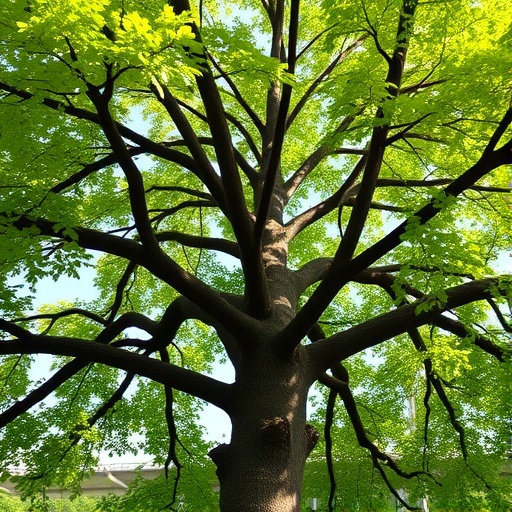
In an era marked by accelerating urbanization, the traditional paradigms of managing urban greenery are undergoing a profound transformation. A groundbreaking study published in npj Urban Sustainability introduces a pioneering framework that fuses relational values with the concept of multispecies justice to redefine how cities approach treescape management. This novel perspective not only challenges the anthropocentric lens through which urban nature has long been viewed but also proposes an inclusive, ethical approach that honors the intrinsic worth of trees as co-inhabitants of our cities.
The researchers, led by J.O. Kenter and colleagues, argue that trees hold a complex web of significances beyond mere physical or economic benefits. Urban trees contribute to human well-being, cultural identity, and ecosystem services, yet they also possess relational values—meanings and connections that emerge from human interactions and shared experiences. By integrating these relational dimensions into policy and planning, the study provides a robust platform for participatory governance, encouraging communities to actively engage in shaping their urban environments.
Crucially, the study advances the principle of multispecies justice, asserting that ethical urban planning must account for the rights and needs of non-human life forms. This approach confronts the traditional hierarchy in urban management that privileges human interests, pushing for equitable consideration of other species that rely on urban forests for habitat and survival. The framework recognizes that urban treescapes are dynamic living systems, comprised not only of trees but also of the myriad species—birds, insects, fungi—that form interdependent ecological networks.
Employing a combination of ecological data, social science insights, and ethical theory, the study illustrates practical ways to operationalize these values through policy instruments and community-led initiatives. Such integration promises to improve biodiversity conservation in cities while fostering social cohesion and resilience. For example, participatory mapping exercises can reveal the layered relationships between communities and specific trees, informing conservation priorities that resonate with local cultural narratives.
The implications of this research resonate well beyond urban forestry. As climate change intensifies, the role of trees in carbon sequestration and urban cooling becomes critical. The framework proposed by Kenter et al. suggests that achieving sustainable urban futures depends equally on nurturing social and ecological bonds. It presses urban planners and stakeholders to rethink the principle of ‘value’ in urban nature, acknowledging that trees cannot be reduced to commodities or infrastructure alone.
This study also highlights the challenges inherent in balancing competing interests among diverse urban stakeholders, necessitating innovative governance models that facilitate dialogue between humans and other species representatives, be they scientists, conservationists, or citizen advocates. By encouraging plural narratives and value systems, cities can evolve into spaces of coexistence rather than domination.
Ultimately, “Tree Value Visions” calls for a paradigm shift in urban treescape management that transcends utilitarianism, embracing a multispecies ethic that enshrines care, respect, and shared rights. This vision not only enriches human experience but secures the health of urban ecosystems integral to life on the planet.
As urban areas continue to expand globally, this study’s insights could serve as a vital blueprint for future cities striving for sustainability that inclusively respects all species making these spaces their homes.
Cite Scienmag News
Courtney Benton. (July 13, 2026). Integrating Multispecies Justice in Urban Tree Management. Scienmag. https://scienmag.com/integrating-multispecies-justice-in-urban-tree-management/
Courtney Benton. "Integrating Multispecies Justice in Urban Tree Management." Scienmag, 13 July 2026, https://scienmag.com/integrating-multispecies-justice-in-urban-tree-management/. Accessed 5 September 2026.
Courtney Benton. "Integrating Multispecies Justice in Urban Tree Management." Scienmag. July 13, 2026. https://scienmag.com/integrating-multispecies-justice-in-urban-tree-management/


