

Thursday, September 3, 2026
Science
No Result
View All Result
  • Login
  • HOME
  • SCIENCE NEWS
  • CONTACT US
  • HOME
  • SCIENCE NEWS
  • CONTACT US
No Result
View All Result
Scienmag
No Result
View All Result
Home Science News Cancer

Anthropometric Traits and Metabolic Biomarkers Linked to Pancreatic Cancer Risk

July 12, 2026
in Cancer
Nathaniel Bowman
By Nathaniel Bowman Scienmag Editorial Profile - Precision Oncology
Reading Time: 2 mins read
0
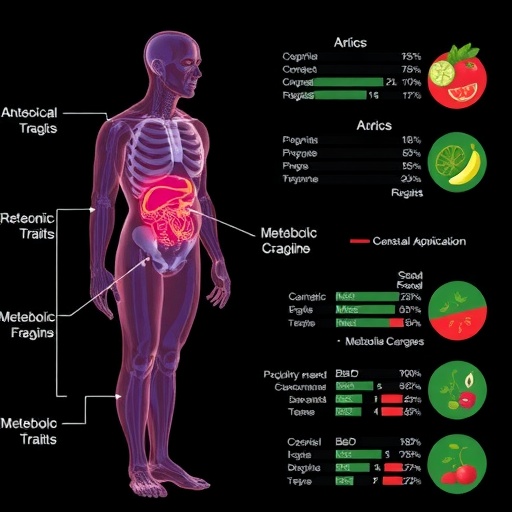
Anthropometric Traits and Metabolic Biomarkers Linked to Pancreatic Cancer Risk

Anthropometric Traits and Metabolic Biomarkers Linked to Pancreatic Cancer Risk

65
SHARES
587
VIEWS
Share on FacebookShare on Twitter
ADVERTISEMENT

A groundbreaking new study published in the British Journal of Cancer sheds light on the intricate relationships between body measurements, metabolic biomarkers, and the risk of developing pancreatic cancer. Utilizing data from the extensive UK Biobank cohort, researchers from a multinational team employed sophisticated causal mediation analysis to unravel how anthropometric traits influence cancer risk through metabolic pathways.

Pancreatic cancer remains one of the deadliest malignancies worldwide, partly due to its typically late diagnosis and complex etiology. Despite known associations between obesity and cancer risk, the mechanisms linking body shape and metabolism to pancreatic oncogenesis have remained elusive. This new study addresses critical gaps by distilling which measurable physiological traits may act as direct or indirect contributors to pancreatic tumor development.

The researchers focused on anthropometric attributes such as body mass index (BMI), waist circumference, and body fat distribution. Biomarkers reflecting metabolic health—including insulin resistance indicators, lipid profiles, and glucose metabolism parameters—were simultaneously analyzed. By integrating these variables via causal mediation models, the investigators could discern how much of the cancer risk attributed to body size is actually mediated through metabolic dysfunction.

Among the landmark findings, visceral adiposity emerged as a potent risk factor mediated significantly by impaired glucose regulation and dyslipidemia. This implies that excess fat around abdominal organs not only correlates with cancer risk but also triggers metabolic disturbances that may drive carcinogenesis. Conversely, some biomarkers linked to systemic inflammation showed weaker mediation effects, suggesting multi-pathway interactions beyond inflammation alone.

Such precise mediation analysis marks a substantial advancement over traditional correlation studies. It allows researchers to quantify the percentage of pancreatic cancer risk explained by metabolic changes secondary to adiposity, highlighting potential targets for intervention. Lifestyle or pharmacological strategies aimed at improving insulin sensitivity and lipid metabolism may thus hold promise in reducing cancer incidence in overfat individuals.

The study’s robust methodology leverages the breadth of the UK Biobank dataset, ensuring comprehensive control for confounding variables and enhancing the validity of causal claims. Machine learning algorithms further refined biomarker selection, fortifying the analytical rigor. These approaches collectively underpin the translational potential of findings.

Looking forward, these insights pave the way for personalized risk assessment frameworks integrating anthropometric and metabolic profiles. Identifying high-risk individuals for early screening or preventive measures could dramatically improve pancreatic cancer outcomes. Moreover, the elucidation of metabolic pathways offers new avenues for drug development targeting the tumor microenvironment.

In sum, this research exemplifies the power of combining epidemiological data with advanced statistical modeling to decode cancer pathogenesis. It underscores the intricate interplay between body composition and metabolic health as a critical determinant of pancreatic cancer risk, opening new doors for clinical innovation and public health strategies.


Subject of Research: The causal relationship between anthropometric traits, metabolic biomarkers, and pancreatic cancer risk.

Article Title: Anthropometric traits, metabolic biomarkers, and pancreatic cancer risk: a causal mediation analysis in UK Biobank.

Article References: Amadou, A., Freisling, H., Mercoeur, B., Bohmann, P., Stein, M. J., Noh, H., Gebremariam, A., Sedlmeier, A. M., Peruchet-Noray, L., Gan, Q., Leitzmann, M. F., Baurecht, H., & Fervers, B. (2026). Anthropometric traits, metabolic biomarkers, and pancreatic cancer risk: a causal mediation analysis in UK Biobank. British Journal of Cancer. https://doi.org/10.1038/s41416-026-03524-9

Image Credits: AI Generated

DOI: 10.1038/s41416-026-03524-9

Keywords: anthropometric measurements and metabolic biomarkers, body fat distribution and cancer risk, causal mediation analysis in cancer research, glucose metabolism parameters in cancer studies, insulin resistance and pancreatic tumor development, lipid profiles and pancreatic oncogenesis, long-term risk factors for pancreatic cancer, metabolic dysfunction as a mediator in cancer risk, obesity and pancreatic cancer, pancreatic cancer risk, UK Biobank cohort pancreatic cancer study, visceral adiposity and cancer mechanisms

Cite Scienmag News

Nathaniel Bowman. (July 12, 2026). Anthropometric Traits and Metabolic Biomarkers Linked to Pancreatic Cancer Risk. Scienmag. https://scienmag.com/anthropometric-traits-and-metabolic-biomarkers-linked-to-pancreatic-cancer-risk/


Nathaniel Bowman. "Anthropometric Traits and Metabolic Biomarkers Linked to Pancreatic Cancer Risk." Scienmag, 12 July 2026, https://scienmag.com/anthropometric-traits-and-metabolic-biomarkers-linked-to-pancreatic-cancer-risk/. Accessed 3 September 2026.

Nathaniel Bowman. "Anthropometric Traits and Metabolic Biomarkers Linked to Pancreatic Cancer Risk." Scienmag. July 12, 2026. https://scienmag.com/anthropometric-traits-and-metabolic-biomarkers-linked-to-pancreatic-cancer-risk/

Tags: anthropometric measurements and metabolic biomarkersbody fat distribution and cancer riskcausal mediation analysis in cancer researchglucose metabolism parameters in cancer studiesinsulin resistance and pancreatic tumor developmentlipid profiles and pancreatic oncogenesislong-term risk factors for pancreatic cancermetabolic dysfunction as a mediator in cancer riskobesity and pancreatic cancerpancreatic cancer riskUK Biobank cohort pancreatic cancer studyvisceral adiposity and cancer mechanisms
Share26Tweet16
Previous Post

Sedentary Time and Sleep Impact Cognitive Health in Older Diabetics

Next Post

KAIST Creates AI to Detect Early Cerebrovascular Disease Signs at Home

Related Posts

Digital health tools reshape cancer prevention alongside traditional in-person care
Cancer

Digital health tools reshape cancer prevention alongside traditional in-person care

September 3, 2026
What influences cancer survivors’ participation in colorectal and breast screening
Cancer

What influences cancer survivors’ participation in colorectal and breast screening

September 3, 2026
α-Synuclein curbs glioma growth via CDH13–JNK/c-Jun signaling pathway
Cancer

α-Synuclein curbs glioma growth via CDH13–JNK/c-Jun signaling pathway

September 3, 2026
A heterogeneous multimodal ensemble framework for multi-omics breast cancer prognosis
Cancer

A heterogeneous multimodal ensemble framework for multi-omics breast cancer prognosis

September 3, 2026
Largest Study of Its Kind Reveals How Australian Dogs Fare Against Lymphoma
Cancer

Largest Study of Its Kind Reveals How Australian Dogs Fare Against Lymphoma

September 3, 2026
New Animal Model Tests Chemotherapy Efficacy and Toxicity
Cancer

New Animal Model Tests Chemotherapy Efficacy and Toxicity

September 3, 2026
Next Post
KAIST Creates AI to Detect Early Cerebrovascular Disease Signs at Home

KAIST Creates AI to Detect Early Cerebrovascular Disease Signs at Home

  • Mothers who receive childcare support from maternal grandparents show more optimized

    Mothers who receive childcare support from maternal grandparents show more parental warmth, finds NTU Singapore study

    27656 shares
    Share 11059 Tweet 6912
  • University of Seville Breaks 120-Year-Old Mystery, Revises a Key Einstein Concept

    1061 shares
    Share 424 Tweet 265
  • Bee body mass, pathogens and local climate influence heat tolerance

    682 shares
    Share 273 Tweet 171
  • Researchers record first-ever images and data of a shark experiencing a boat strike

    546 shares
    Share 218 Tweet 137
  • Groundbreaking Clinical Trial Reveals Lubiprostone Enhances Kidney Function

    531 shares
    Share 212 Tweet 133
Science

Embark on a thrilling journey of discovery with Scienmag.com—your ultimate source for cutting-edge breakthroughs. Immerse yourself in a world where curiosity knows no limits and tomorrow’s possibilities become today’s reality!

RECENT NEWS

  • Digital health tools reshape cancer prevention alongside traditional in-person care
  • What influences cancer survivors’ participation in colorectal and breast screening
  • α-Synuclein curbs glioma growth via CDH13–JNK/c-Jun signaling pathway
  • Vasospasm and Delayed Ischemia After Aneurysmal Rupture With Hemorrhage

Categories

  • Agriculture
  • Anthropology
  • Archaeology
  • Athmospheric
  • Biology
  • Biotechnology
  • Blog
  • Bussines
  • Cancer
  • Chemistry
  • Climate
  • Earth Science
  • Editorial Policy
  • Marine
  • Mathematics
  • Medicine
  • Pediatry
  • Policy
  • Psychology & Psychiatry
  • Science Education
  • Social Science
  • Space
  • Technology and Engineering

Subscribe to Blog via Email

Enter your email address to subscribe to this blog and receive notifications of new posts by email.

Join 5,151 other subscribers

© 2025 Scienmag - Science Magazine

Welcome Back!

Login to your account below

Forgotten Password?

Retrieve your password

Please enter your username or email address to reset your password.

Log In
No Result
View All Result
  • HOME
  • SCIENCE NEWS
  • CONTACT US

© 2025 Scienmag - Science Magazine

Discover more from Science

Subscribe now to keep reading and get access to the full archive.

Continue reading