

Tuesday, August 25, 2026
Science
No Result
View All Result
  • Login
  • HOME
  • SCIENCE NEWS
  • CONTACT US
  • HOME
  • SCIENCE NEWS
  • CONTACT US
No Result
View All Result
Scienmag
No Result
View All Result
Home Science News Psychology & Psychiatry

Genetic Risk Links Suicide Attempts and Alcohol Use Disorder Outcomes

July 10, 2026
in Psychology & Psychiatry
Reading Time: 2 mins read
0
Genetic Risk Links Suicide Attempts and Alcohol Use Disorder Outcomes

Genetic Risk Links Suicide Attempts and Alcohol Use Disorder Outcomes

65
SHARES
587
VIEWS
Share on FacebookShare on Twitter
ADVERTISEMENT

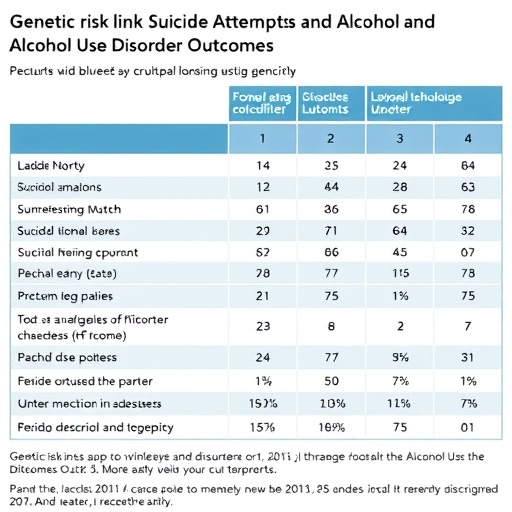
A groundbreaking new study has unveiled the intricate relationship between genetic predispositions and psychosocial outcomes related to suicide attempts and alcohol use disorder (AUD). Published in Translational Psychiatry, this research sheds light on how aggregate genetic risk factors can delineate distinct psychosocial profiles, providing a refined roadmap for future psychiatric interventions.

The study represents a significant leap forward in psychiatric genetics, as researchers combined vast genomic datasets with detailed psychosocial assessments. The team, led by Edwards, Ohlsson, and Stephenson, analyzed polygenic risk scores (PRS) to quantify the cumulative impact of multiple genetic variants associated with both suicide attempts and AUD. This comprehensive approach enabled the identification of distinctive psychosocial trajectories based on an individual’s genetic makeup.

One of the pivotal findings is the demonstration of a spectrum of psychosocial outcomes influenced by an aggregate genetic burden. People with higher genetic risk scores were more likely to exhibit complex psychosocial impairments, such as increased emotional dysregulation, impaired social functioning, and heightened vulnerability to stress. Importantly, these factors often interact synergistically, exacerbating the risk for suicidal behavior and problematic alcohol use.

By integrating polygenic risk profiling with psychosocial data, the researchers could map nuanced profiles that go beyond simple diagnostic categories. This stratification is crucial for precision psychiatry, as it allows clinicians to tailor interventions based on an individual’s genetic and psychological risk constellation rather than relying solely on symptom-based diagnosis.

Molecular mechanisms underpinning these findings suggest that genetic variants influencing neurotransmitter systems, stress response pathways, and neurodevelopmental processes collectively modulate susceptibility to suicidal behavior and AUD. This complexity underscores the need for multi-dimensional models combining genetics, environment, and psychosocial stressors to fully understand these mental health challenges.

The implications for clinical practice are profound. Identification of aggregate genetic risk scores could lead to early detection of vulnerable individuals, enabling proactive therapeutic strategies to mitigate adverse outcomes. Additionally, the study emphasizes the potential to develop personalized treatment regimens that target the specific biological and psychological pathways implicated in each patient’s unique risk profile.

This research catalyzes a shift toward a holistic model of mental health, where genetic information is integrated seamlessly with psychosocial context. It paves the way for novel biomarkers that could revolutionize risk assessment and intervention for suicidal behavior and AUD, two pressing public health concerns worldwide.

As the field advances, future studies will likely explore how such aggregate genetic risk scores interplay with environmental exposures and life events. Understanding these complex interactions holds promise for unraveling the pathophysiology of suicide and addiction, ultimately informing better prevention and treatment paradigms.

In summary, Edwards and colleagues’ work marks a seminal step in decoding the genetic architecture underlying psychiatric outcomes. Through innovative use of aggregate genetic risk models, this study illuminates the psychosocial profiles that shape the vulnerabilities to suicide attempt and alcohol use disorder, offering hope for more effective, personalized mental health care.


Subject of Research: Genetic risk and psychosocial outcomes related to suicide attempt and alcohol use disorder

Article Title: Elucidating psychosocial outcome profiles as a function of aggregate genetic risk for suicide attempt and alcohol use disorder

Article References:
Edwards, A.C., Ohlsson, H., Stephenson, M. et al. Elucidating psychosocial outcome profiles as a function of aggregate genetic risk for suicide attempt and alcohol use disorder. Transl Psychiatry (2026). https://doi.org/10.1038/s41398-026-04256-3

Image Credits: AI Generated

DOI: https://doi.org/10.1038/s41398-026-04256-3

Tags: advances in translational psychiatry for suicide and AUDgenetic and environmental interactions in mental health outcomesgenetic influences on emotional regulation and social functioningGenetic risk factors for suicide and alcohol use disordergenomic datasets in mental health researchintegrative approaches in psychiatric risk assessmentmolecular genetics of suicidal behavior and alcohol dependencepersonalized psychiatric interventions based on genetic profilingpolygenic risk scores in psychiatric geneticspsychosocial impacts of genetic predisposition to substance usepsychosocial profiles linked to genetic predispositions
Share26Tweet16
Previous Post

Iron oxide melts transform structurally under Earth’s outer-core pressures

Next Post

New Integrated Device Synthesizes and Analyzes Photonic Polarization

Related Posts

Child Maltreatment Histories Linked to Partner Violence, Distress, and Lower Relationship Satisfaction
Psychology & Psychiatry

Child Maltreatment Histories Linked to Partner Violence, Distress, and Lower Relationship Satisfaction

August 25, 2026
How Large Language Models Are Accelerating the Decline of Linguistic Diversity
Psychology & Psychiatry

How Large Language Models Are Accelerating the Decline of Linguistic Diversity

August 25, 2026
Study estimates glutamate and GABA genes’ distinct causal effects in autism
Psychology & Psychiatry

Study estimates glutamate and GABA genes’ distinct causal effects in autism

August 24, 2026
Trial-to-trial decision shifts shape confidence, study finds
Psychology & Psychiatry

Trial-to-trial decision shifts shape confidence, study finds

August 24, 2026
Study Measures Prevalence and Impact of Overstated Causal Claims in Social Science
Psychology & Psychiatry

Study Measures Prevalence and Impact of Overstated Causal Claims in Social Science

August 24, 2026
Which Non-Drug Interventions Improve Executive Function and Attention in Youth With ADHD?
Psychology & Psychiatry

Which Non-Drug Interventions Improve Executive Function and Attention in Youth With ADHD?

August 22, 2026
Next Post
New Integrated Device Synthesizes and Analyzes Photonic Polarization

New Integrated Device Synthesizes and Analyzes Photonic Polarization

  • Mothers who receive childcare support from maternal grandparents show more

    Mothers who receive childcare support from maternal grandparents show more parental warmth, finds NTU Singapore study

    27656 shares
    Share 11059 Tweet 6912
  • University of Seville Breaks 120-Year-Old Mystery, Revises a Key Einstein Concept

    1061 shares
    Share 424 Tweet 265
  • Bee body mass, pathogens and local climate influence heat tolerance

    682 shares
    Share 273 Tweet 171
  • Researchers record first-ever images and data of a shark experiencing a boat strike

    546 shares
    Share 218 Tweet 137
  • Groundbreaking Clinical Trial Reveals Lubiprostone Enhances Kidney Function

    531 shares
    Share 212 Tweet 133
Science

Embark on a thrilling journey of discovery with Scienmag.com—your ultimate source for cutting-edge breakthroughs. Immerse yourself in a world where curiosity knows no limits and tomorrow’s possibilities become today’s reality!

RECENT NEWS

  • Dental calculus reveals diverse diets among commoners in premodern Osaka, Japan
  • Hunter-gatherers sleep as long as modern humans, but at different times
  • Study Finds Forest Trees Barely Acclimate to Prolonged Drought
  • Analysis Reveals Sex Differences in Postoperative Pain and Opioid Use Across Asia

Categories

  • Agriculture
  • Anthropology
  • Archaeology
  • Athmospheric
  • Biology
  • Biotechnology
  • Blog
  • Bussines
  • Cancer
  • Chemistry
  • Climate
  • Earth Science
  • Editorial Policy
  • Marine
  • Mathematics
  • Medicine
  • Pediatry
  • Policy
  • Psychology & Psychiatry
  • Science Education
  • Social Science
  • Space
  • Technology and Engineering

Subscribe to Blog via Email

Enter your email address to subscribe to this blog and receive notifications of new posts by email.

Join 5,150 other subscribers

© 2025 Scienmag - Science Magazine

Welcome Back!

Login to your account below

Forgotten Password?

Retrieve your password

Please enter your username or email address to reset your password.

Log In
No Result
View All Result
  • HOME
  • SCIENCE NEWS
  • CONTACT US

© 2025 Scienmag - Science Magazine

Discover more from Science

Subscribe now to keep reading and get access to the full archive.

Continue reading
