


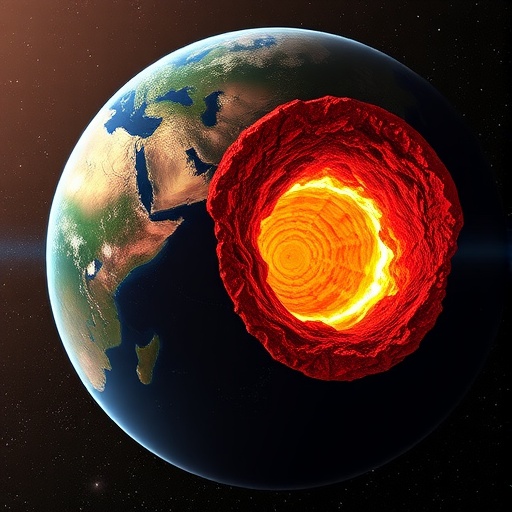
In a groundbreaking study poised to reshape our understanding of Earth’s deep interior, researchers have unveiled new insights into the behavior of iron oxide melts under the extreme pressures found in the planet’s outer core. The work, led by Crépisson, Fitzgerald, and Peake, reveals how iron oxides evolve structurally at pressures exceeding a million times that of the surface atmosphere, shedding light on fundamental processes governing Earth’s magnetic field and geodynamics.
The team employed cutting-edge diamond anvil cell experiments combined with advanced synchrotron X-ray diffraction techniques to simulate and directly observe iron oxide melts at pressures akin to those nearly 3,000 kilometers beneath Earth’s surface. These conditions replicate the outer core’s environment, a fluid layer primarily composed of molten iron alloy that generates Earth’s magnetic field through complex convective motions.
What distinguishes this research is the revelation that iron oxides, long considered simple components within the core’s melt, undergo unexpected structural transformations under these intense conditions. Contrary to previous assumptions of primarily homogenous liquid states, the study identifies distinct melting behaviors and local atomic arrangements that evolve as pressure increases. These structural variations influence the physical properties of the melt, such as density, viscosity, and electrical conductivity, all critical factors affecting geomagnetic field generation and heat transfer.
The researchers found that iron oxide melts do not remain amorphous but instead exhibit pressure-induced short-range order, with oxygen and iron atoms forming transient coordination units that dynamically fluctuate. This nuanced understanding challenges existing models that treat the outer core melt as a uniform metallic fluid, suggesting instead a more complex, heterogeneous system with variable chemical bonding and structural motifs.
Such findings have profound implications for interpreting seismic data and geomagnetic observations, as the elastic and conductive properties tied to these structural changes could explain anomalies detected in Earth’s deep interior. By refining the mineral physics of core materials, this research bridges laboratory experiments with geophysical phenomena, enabling more accurate models of Earth’s thermal evolution and magnetic dynamics.
Moreover, the study emphasizes the pivotal role of iron oxides in governing the outer core’s phase relations and chemical stratification. The demonstrated structural evolution points to potential chemical heterogeneities that may drive convective flows and influence the sustainability of the geodynamo over geological timescales.
This landmark investigation represents a fusion of mineral physics, high-pressure experimentation, and geophysical modeling, providing an unprecedented window into the enigmatic realm of Earth’s core. As technologies continue to advance, future research building on these findings promises to further unravel the complexities of planetary interiors, not only of Earth but also of iron-rich exoplanets across the galaxy.
The implications of this study extend beyond Earth sciences, offering insights into material behavior under extreme conditions that could inform fields ranging from materials science to planetary exploration. For now, the planet’s deepest mysteries are a step closer to being understood, thanks to the detailed mapping of iron oxide melts under conditions once thought inaccessible.
Cite Scienmag News
Violet Maxwell. (July 10, 2026). Iron oxide melts transform structurally under Earth’s outer-core pressures. Scienmag. https://scienmag.com/iron-oxide-melts-transform-structurally-under-earths-outer-core-pressures/
Violet Maxwell. "Iron oxide melts transform structurally under Earth’s outer-core pressures." Scienmag, 10 July 2026, https://scienmag.com/iron-oxide-melts-transform-structurally-under-earths-outer-core-pressures/. Accessed 3 September 2026.
Violet Maxwell. "Iron oxide melts transform structurally under Earth’s outer-core pressures." Scienmag. July 10, 2026. https://scienmag.com/iron-oxide-melts-transform-structurally-under-earths-outer-core-pressures/


