


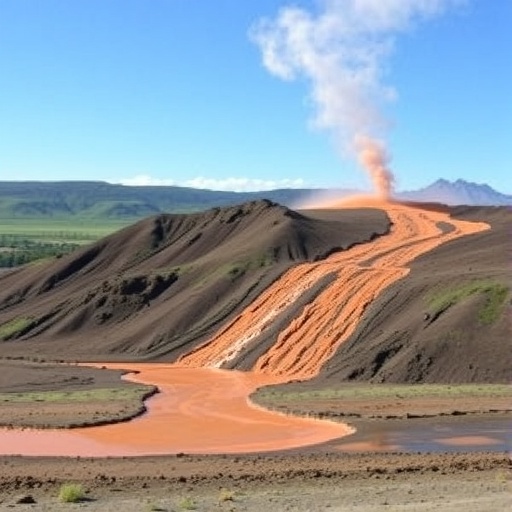
Contrary to popular belief, mud volcanoes do not always unleash spectacular, fiery torrents of mud in massive, sudden eruptions. A groundbreaking study focusing on the Lokbatan mud volcano in Azerbaijan reveals that these geological features function quite differently than previously thought. Rather than large explosive events, many mud volcano eruptions are relatively small, brief, and incremental.
Led by the University of Oslo, an international team of geologists employed a combination of fieldwork, satellite data, and geophysical techniques to dissect the dynamics of mud flows at Lokbatan. Their observations unveiled an ongoing, slow-moving process beneath the surface, where an underlying water-saturated layer serves as a natural lubricant. This hidden stratum enables overlying mud deposits to shift gradually, resembling the creeping motion of glaciers rather than violent volcanic eruptions.
Rather than producing extensive new mud deposits in one go, these smaller eruptions effectively “reactivate” older mud flows resting on the volcano’s slopes. This reactivation triggers a slow, stepwise sliding motion that, over years, reshapes the landscape in subtle yet significant ways that elude casual observation.
The study proposes a novel conceptual model of mud volcano activity in which large mud flows accumulate progressively through repeated minor events. Each small eruption nudges the existing mud down the slope, generating what the researchers describe as a “creeping” phenomenon. This revelation challenges the long-held perception that major mud volcano flows arise from singular catastrophic expulsions.
Understanding this creeping behavior has profound implications for hazard assessment and monitoring efforts in regions dominated by mud volcanism. By recognizing the importance of incremental, dispersed activity, geoscientists can better predict landscape changes and associated risks.
These findings underscore the intricate interplay between geological and hydrological processes beneath mud volcanoes, where subsurface water pressure modulation can mobilize vast sediment masses over extended periods. It illuminates a previously underestimated mode of mass wasting that operates quietly but steadily.
The international research team combined expertise from Norway, the Czech Republic, Switzerland, France, Italy, and Azerbaijan to shed new light on one of Earth’s most enigmatic geological systems. Their integrative approach illustrates the power of combining remote sensing with detailed field measurements to unravel complex earth processes.
As our understanding of mud volcanic mechanisms evolves, this research paves the way for more nuanced monitoring strategies, potentially improving early warning systems that protect communities vulnerable to these dynamic terrains.
Cite Scienmag News
Violet Maxwell. (July 9, 2026). Scientists Reveal New Insights Into Mud Volcano Flow Dynamics. Scienmag. https://scienmag.com/scientists-reveal-new-insights-into-mud-volcano-flow-dynamics/
Violet Maxwell. "Scientists Reveal New Insights Into Mud Volcano Flow Dynamics." Scienmag, 9 July 2026, https://scienmag.com/scientists-reveal-new-insights-into-mud-volcano-flow-dynamics/. Accessed 4 September 2026.
Violet Maxwell. "Scientists Reveal New Insights Into Mud Volcano Flow Dynamics." Scienmag. July 9, 2026. https://scienmag.com/scientists-reveal-new-insights-into-mud-volcano-flow-dynamics/


