

Monday, August 10, 2026
Science
No Result
View All Result
  • Login
  • HOME
  • SCIENCE NEWS
  • CONTACT US
  • HOME
  • SCIENCE NEWS
  • CONTACT US
No Result
View All Result
Scienmag
No Result
View All Result
Home Science News Medicine

Ear Acupuncture Shows Promise for Migraine Relief

July 10, 2026
in Medicine
Reading Time: 2 mins read
0
Ear Acupuncture Shows Promise for Migraine Relief

Ear Acupuncture Shows Promise for Migraine Relief

65
SHARES
587
VIEWS
Share on FacebookShare on Twitter
ADVERTISEMENT

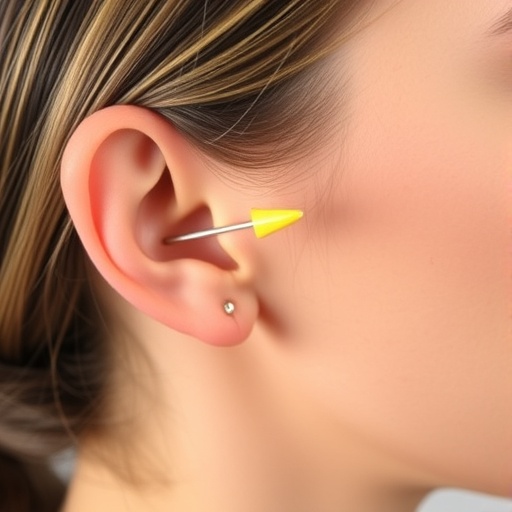
A recent randomized clinical trial suggests that auriculotherapy, a form of acupuncture targeting specific points on the ear, may reduce migraine pain and improve patients’ quality of life. Presented at the Federation of European Neuroscience Societies (FENS) Forum 2026, the study investigated cerebral hemodynamics and pain modulation in women suffering from chronic migraine.

Led by physiotherapist Fernanda Belle from the University of Southern Santa Catarina (UNISUL), Brazil, the trial involved 68 women diagnosed with migraines occurring at least 15 days monthly. The participants were randomly divided to receive either auriculotherapy—semi-permanent needles stimulating migraine-related auricular points followed by mustard seed application—or a sham procedure targeting unrelated ear points, also maintained with mustard seeds.

Pain intensity and migraine impact on daily life were measured using the McGill Pain Questionnaire and the Headache Impact Test (HIT-6) at three intervals: prior to treatment, immediately afterward, and 30 days post-treatment. Both groups exhibited significant pain reductions and improved daily function scores over time. In the auriculotherapy group, pain scores decreased by approximately 18% at 30 days, whereas the sham group showed a 13% reduction. However, statistical analysis revealed no significant superiority of auriculotherapy over the sham treatment in pain relief or functional impact.

Neurophysiological assessments employed hemoencephalography (HEG®), a non-invasive near-infrared spectroscopy technique, to monitor prefrontal cortex blood flow and oxygenation as indirect markers of neural activity. Both groups displayed changes in oxygenation levels throughout the study, although distinct temporal patterns between auriculotherapy and sham groups remained unclear. These findings underscore the feasibility of objectively tracking cerebral hemodynamic responses in chronic migraine sufferers undergoing complementary treatments.

Auriculotherapy’s potential therapeutic mechanisms may relate to its modulation of the neuroimmune axis—a bidirectional communication system between the nervous and immune systems implicated in pain sensitization and inflammation. The ear’s neural connections to the vagus, trigeminal, and cervical nerves, all involved in nociception and autonomic regulation, provide a plausible anatomical basis for such modulation.

As a complementary modality rather than a replacement for standard migraine management, auriculotherapy presents a promising adjunctive strategy, particularly considering the high prevalence and disabling nature of migraines in women. Still, researchers acknowledge the need for larger-scale investigations to corroborate these preliminary outcomes and elucidate underlying biological pathways.

Professor Christina Dalla, an expert in neuropsychopharmacology, applauded the study’s rigorous methodology and emphasized the importance of complementary approaches alongside conventional therapies. With further validation, auriculotherapy could enrich multidisciplinary migraine care and improve patient-centered outcomes.

Subject of Research:
People

Article Title:
Auriculotherapy modulates cerebral hemodynamics and pain in women with migraine: a randomized double-blind trial

News Publication Date:
10-Jul-2026

Image Credits:
Fernanda Belle

Keywords:
Migraines, Headaches, Acupuncture, Clinical studies, Clinical trials, Pain

Tags: acupuncture point stimulation for chronic headachesauriculotherapy clinical trialcerebral hemodynamics in migraineear acupuncture for migraine reliefear acupuncture pain managementefficacy of auriculotherapy compared to placeboHeMOencephalography in migraine researchmigraine quality of life improvementmigraine treatment non-pharmacologicalneurophysiological effects of auriculotherapynon-invasive migraine pain reductionsham-controlled ear acupuncture study
Share26Tweet16
Previous Post

Kessler Foundation Named Top Workplace by NJBIZ for 2026

Next Post

Solar Oscillations, Flares, and Tornadoes Unveiled by Scientists

Related Posts

Calreticulin-targeted L-asparaginase–flagellin conjugate boosts Salmonella’s antitumor effectiveness
Medicine

Calreticulin-targeted L-asparaginase–flagellin conjugate boosts Salmonella’s antitumor effectiveness

August 9, 2026
Short-Term Animal-Product Restriction Rapidly Alters Human Proteogenomic Profiles
Medicine

Short-Term Animal-Product Restriction Rapidly Alters Human Proteogenomic Profiles

August 8, 2026
UVA-Induced Hyperploidization Causes Fibrosis in Post-Mitotic Fuchs Dystrophy Corneal Cells
Medicine

UVA-Induced Hyperploidization Causes Fibrosis in Post-Mitotic Fuchs Dystrophy Corneal Cells

August 8, 2026
Healthy Vaccinee Effect Shapes Evaluation of Updated COVID-19 Vaccines in Older Adults
Medicine

Healthy Vaccinee Effect Shapes Evaluation of Updated COVID-19 Vaccines in Older Adults

August 8, 2026
Nanoparticle pan-Ebolavirus vaccine protects rodents against lethal Zaire and Sudan virus infections
Medicine

Nanoparticle pan-Ebolavirus vaccine protects rodents against lethal Zaire and Sudan virus infections

August 8, 2026
AI Framework Unifies MRI Tumor Segmentation, Grading, Staging, and Malignancy Detection
Medicine

AI Framework Unifies MRI Tumor Segmentation, Grading, Staging, and Malignancy Detection

August 8, 2026
Next Post
Solar Oscillations, Flares, and Tornadoes Unveiled by Scientists

Solar Oscillations, Flares, and Tornadoes Unveiled by Scientists

  • Mothers who receive childcare support from maternal grandparents show more

    Mothers who receive childcare support from maternal grandparents show more parental warmth, finds NTU Singapore study

    27656 shares
    Share 11059 Tweet 6912
  • University of Seville Breaks 120-Year-Old Mystery, Revises a Key Einstein Concept

    1061 shares
    Share 424 Tweet 265
  • Bee body mass, pathogens and local climate influence heat tolerance

    682 shares
    Share 273 Tweet 171
  • Researchers record first-ever images and data of a shark experiencing a boat strike

    546 shares
    Share 218 Tweet 137
  • Groundbreaking Clinical Trial Reveals Lubiprostone Enhances Kidney Function

    531 shares
    Share 212 Tweet 133
Science

Embark on a thrilling journey of discovery with Scienmag.com—your ultimate source for cutting-edge breakthroughs. Immerse yourself in a world where curiosity knows no limits and tomorrow’s possibilities become today’s reality!

RECENT NEWS

  • Single-Fiber 3D Shape Sensing Uses Femtosecond-Laser-Inscribed Orthogonal Eccentric Scatterers
  • How Dogs Evolved Worldwide to Mirror the Traits of Their Human Companions
  • Selective breeding reduces genetic diversity in traditional cattle herds, research finds
  • How Neuroblastoma Balances Replication Stress and Genome Stability Across Chromosome 17q

Categories

  • Agriculture
  • Anthropology
  • Archaeology
  • Athmospheric
  • Biology
  • Biotechnology
  • Blog
  • Bussines
  • Cancer
  • Chemistry
  • Climate
  • Earth Science
  • Editorial Policy
  • Marine
  • Mathematics
  • Medicine
  • Pediatry
  • Policy
  • Psychology & Psychiatry
  • Science Education
  • Social Science
  • Space
  • Technology and Engineering

Subscribe to Blog via Email

Success! An email was just sent to confirm your subscription. Please find the email now and click 'Confirm Follow' to start subscribing.

Join 5,149 other subscribers

© 2025 Scienmag - Science Magazine

Welcome Back!

Login to your account below

Forgotten Password?

Retrieve your password

Please enter your username or email address to reset your password.

Log In
No Result
View All Result
  • HOME
  • SCIENCE NEWS
  • CONTACT US

© 2025 Scienmag - Science Magazine
