

Thursday, July 9, 2026
Science
No Result
View All Result
  • Login
  • HOME
  • SCIENCE NEWS
  • CONTACT US
  • HOME
  • SCIENCE NEWS
  • CONTACT US
No Result
View All Result
Scienmag
No Result
View All Result
Home Science News Marine

Scientists Reveal the Mysteries Behind Basking Shark’s Strange Skin

July 9, 2026
in Marine
Reading Time: 2 mins read
0
Scientists Reveal the Mysteries Behind Basking Shark’s Strange Skin

Scientists Reveal the Mysteries Behind Basking Shark’s Strange Skin

65
SHARES
587
VIEWS
Share on FacebookShare on Twitter
ADVERTISEMENT

New Insights into Basking Shark Skin Reveal Unique Adaptations for Filter Feeding

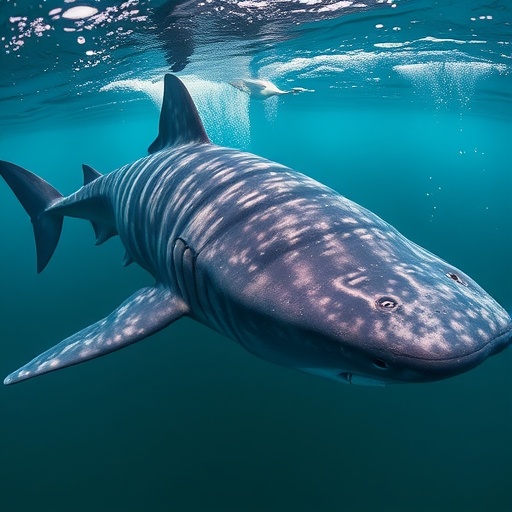
Recent research has uncovered an extraordinary feature of basking sharks (Cetorhinus maximus) that distinguishes them from other shark species: a unique pattern and morphology of their dermal denticles. These small, tooth-like structures cover shark skin, typically serving to reduce drag, prevent parasite attachment, and provide protective armor. However, basking sharks exhibit a radically different arrangement and shape of denticles, a discovery that offers fresh perspectives on their specialized feeding mechanics.

Unlike the smooth, streamlined denticles on most sharks that align towards the tail to enhance hydrodynamics, basking shark denticles form dense clusters resembling “paver blocks.” These blocks are separated by skin folds and are composed of large, fang-like denticles oriented in seemingly random directions. Measuring up to half a millimeter across—visible to the naked eye—these denticles contrast sharply with the microscopic scale of those in other sharks. This distinctive morphology correlates with the basking shark’s slow swimming speeds and extreme oral deformations during ram filter feeding.

Researchers employed a combination of laser scanning, micro-CT imaging, and mechanical tensile tests to analyze the three-dimensional arrangement and mechanical properties of these denticles. Their findings suggest that this clustered denticle pattern confers both protective benefits and remarkable skin flexibility, enabling the mouth to stretch extensively while filtering large volumes of water for plankton. The arrangement allows denticle crowns to interdigitate across folds, effectively covering the skin when the shark’s mouth is closed.

Comparisons with closely related species, including sand tiger sharks and other filter feeders like megamouth sharks, underscore how singular this adaptation is among sharks. Fossil evidence further indicates that this unique denticle architecture evolved alongside the development of filter-feeding structures in ancestral basking sharks, hinting at a deep evolutionary link between feeding strategies and skin morphology.

The research challenges prevailing conceptions about shark skin, which is typically regarded as optimized for speed and hydrodynamics. Instead, the basking shark’s denticles exemplify an evolutionary trade-off, where the demands of filter feeding and slow locomotion have liberated the skin’s structure from hydrodynamic constraints. This specialization may also enhance parasite resistance by creating separations between the protective blocks of denticles.

Beyond its biological significance, this discovery has potential applications in biomimetic design. The balance between structural support and flexibility embodied by basking shark skin could inspire innovations in flexible sportswear, medical bandages, and other materials requiring both protection and stretchability.

This research, funded by the Human Frontier Science Program, was presented at the Society for Experimental Biology conference and led by Mike Schindler, a PhD student in Mason Dean’s lab at the City University of Hong Kong.

Subject of Research: Basking shark dermal denticle morphology and function
Article Title: New Insights into Basking Shark Skin Reveal Unique Adaptations for Filter Feeding
News Publication Date: Not specified
Web References: Not provided
References: Presented at the Society for Experimental Biology conference
Image Credits: Mike Schindler
Keywords: basking shark, dermal denticles, filter feeding, skin morphology, biomimicry, shark biology, evolutionary adaptation

Tags: basking shark skindermal denticle morphologyfilter feeding mechanisms in sharkshydrodynamics of basking sharkslaser scanning of dermal structuresmechanical properties of shark denticlesmicro-CT imaging of shark skinshark defense armorshark skin evolutionshark skin microstructureslow-swimming shark adaptationsunique shark skin adaptations
Share26Tweet16
Previous Post

Scientists Reveal Rapid Butterfly Effect Dynamics in Deep Ocean Currents

Next Post

Global study reveals key process controlling cellular fat energy use

Related Posts

International Team Warns Science Alone Can’t Save Coral Reefs
Marine

International Team Warns Science Alone Can’t Save Coral Reefs

July 8, 2026
Geoengineering Potential to Mitigate Extreme El Niño Events Explored
Marine

Geoengineering Potential to Mitigate Extreme El Niño Events Explored

July 8, 2026
South Australia’s algal bloom is the most toxic microalga recorded.
Marine

South Australia’s algal bloom is the most toxic microalga recorded.

July 6, 2026
Study Reveals Potential Hidden Threats of Common COVID-19 Drugs to Marine Life
Marine

Study Reveals Potential Hidden Threats of Common COVID-19 Drugs to Marine Life

July 2, 2026
Tufts University and Bigelow Laboratory Partnership Enhances Graduate Student Research Experiences
Marine

Tufts University and Bigelow Laboratory Partnership Enhances Graduate Student Research Experiences

July 1, 2026
Sponges Enhance Productivity of Tropical Coral Reefs Through Photosynthesis
Marine

Sponges Enhance Productivity of Tropical Coral Reefs Through Photosynthesis

July 1, 2026
Next Post
Global study reveals key process controlling cellular fat energy use

Global study reveals key process controlling cellular fat energy use

  • Mothers who receive childcare support from maternal grandparents show more

    Mothers who receive childcare support from maternal grandparents show more parental warmth, finds NTU Singapore study

    27656 shares
    Share 11059 Tweet 6912
  • University of Seville Breaks 120-Year-Old Mystery, Revises a Key Einstein Concept

    1061 shares
    Share 424 Tweet 265
  • Bee body mass, pathogens and local climate influence heat tolerance

    682 shares
    Share 273 Tweet 171
  • Researchers record first-ever images and data of a shark experiencing a boat strike

    546 shares
    Share 218 Tweet 137
  • Groundbreaking Clinical Trial Reveals Lubiprostone Enhances Kidney Function

    531 shares
    Share 212 Tweet 133
Science

Embark on a thrilling journey of discovery with Scienmag.com—your ultimate source for cutting-edge breakthroughs. Immerse yourself in a world where curiosity knows no limits and tomorrow’s possibilities become today’s reality!

RECENT NEWS

  • Epitope Editing Enables Safe Transplantation and In Vivo Cell Selection
  • New Method Enables Electrical Control of Helimagnetic Structures
  • Study shows lung tumors hijack nervous system to starve body
  • Small PowerPoint tweaks greatly improve learning outcomes

Categories

  • Agriculture
  • Anthropology
  • Archaeology
  • Athmospheric
  • Biology
  • Biotechnology
  • Blog
  • Bussines
  • Cancer
  • Chemistry
  • Climate
  • Earth Science
  • Editorial Policy
  • Marine
  • Mathematics
  • Medicine
  • Pediatry
  • Policy
  • Psychology & Psychiatry
  • Science Education
  • Social Science
  • Space
  • Technology and Engineering

Subscribe to Blog via Email

Enter your email address to subscribe to this blog and receive notifications of new posts by email.

Join 5,147 other subscribers

© 2025 Scienmag - Science Magazine

Welcome Back!

Login to your account below

Forgotten Password?

Retrieve your password

Please enter your username or email address to reset your password.

Log In
No Result
View All Result
  • HOME
  • SCIENCE NEWS
  • CONTACT US

© 2025 Scienmag - Science Magazine

Discover more from Science

Subscribe now to keep reading and get access to the full archive.

Continue reading
