

Thursday, July 9, 2026
Science
No Result
View All Result
  • Login
  • HOME
  • SCIENCE NEWS
  • CONTACT US
  • HOME
  • SCIENCE NEWS
  • CONTACT US
No Result
View All Result
Scienmag
No Result
View All Result
Home Science News Medicine

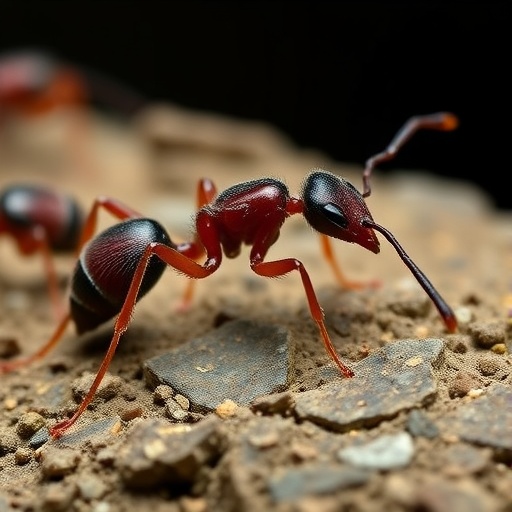
Ancient Neuropeptides Control Alloparental Behavior in Ants

July 9, 2026
in Medicine, Technology and Engineering
Reading Time: 2 mins read
0
Ancient Neuropeptides Control Alloparental Behavior in Ants

Ancient Neuropeptides Control Alloparental Behavior in Ants

65
SHARES
587
VIEWS
Share on FacebookShare on Twitter
ADVERTISEMENT

Ancient Neuropeptides Link Nutrition to Alloparental Care in Ants

A groundbreaking study has unveiled how ancient neuropeptides, originally involved in feeding regulation, have been co-opted to govern parental care behaviors in ants. This scientific advance sheds light on the intricate molecular mechanisms that underpin social behavior evolution, with implications for understanding complex neurobiological circuits conserved across species.

Researchers focused on two highly conserved neuropeptides: neuropeptide F (NPF) and allatostatin A (AstA). These molecules have long been implicated in the modulation of feeding behaviors, typically exerting opposing effects—NPF promotes feeding during hunger, whereas AstA suppresses feeding during satiety. The team investigated whether these ancestral neuromodulators also regulate brood-care behavior in the clonal raider ant, Ooceraea biroi.

Using an experimental design where cohorts of young ants were subjected to either prolonged starvation or feeding, the scientists measured both behavioral interactions with larvae and neuropeptide levels in specific brain regions. Starved ants displayed significantly increased brood-care behavior, engaging more with larvae compared to their well-fed counterparts. Crucially, no larval cannibalism occurred, suggesting that starvation selectively enhanced caregiving rather than aggressive or foraging behaviors.

This counterintuitive finding contrasts with patterns observed in many solitary and social insects, where hunger typically drives increased foraging rather than parental care. The authors propose this reversal reflects the species’ unique phasic life cycle, characterized by alternating reproductive and foraging phases, during which the neuroendocrine regulation of behavior undergoes pronounced shifts.

Immunohistochemical analyses revealed that in starved ants, NPF levels rose significantly in the antennal lobe and anterior dorsoposterior protocerebrum (adPC), key neural centers involved in sensory processing and behavioral regulation. Conversely, AstA levels increased in the antennal lobe and protocerebrum of fed ants, aligning with their reduced brood-care activity. These region-specific neuromodulatory changes parallel shifts in behavior, indicating a direct biochemical mechanism linking nutritional state to alloparental care.

The study highlights an ancient neurochemical framework that transitions an animal’s behavioral priorities—from feeding to nurturing—through the modulation of conserved neuropeptide pathways. Moreover, the co-option of feeding-related circuitry for social function demonstrates a remarkable example of evolutionary innovation in the neural control of complex social behaviors.

By elucidating how age and nutritional status influence NPF and AstA expression in ant brains, this work provides unprecedented insight into the neuromodulatory basis of division of labor and social interactions in eusocial insects. It opens avenues for further exploration into how ancient molecular systems have been adapted to shape the dynamics of cooperative brood care, a hallmark of insect sociality.

This discovery has broader implications, offering a model for understanding the neurogenetic foundations of caregiving behaviors not only in insects but potentially across diverse animal taxa where feeding circuits may underlie parental and alloparental care strategies.

Subject of Research:
The regulation of alloparental care in ants through conserved feeding-related neuropeptides.

Article Title:
Ancient feeding-related neuropeptides regulate alloparenting in ants.

Article References:
Paul, A., Kay, T., Lacroix, I. et al. Ancient feeding-related neuropeptides regulate alloparenting in ants. Nature (2026). https://doi.org/10.1038/s41586-026-10747-6

Image Credits: AI Generated

DOI:
https://doi.org/10.1038/s41586-026-10747-6

Tags: ant neuropeptides NPF and AstA modulate alloparental behavior in response to nutritional statelinking feeding regulation pathways to social caregiving behaviorsrevealing conserved neurobiological mechanisms across species.
Share26Tweet16
Previous Post

Brain’s Role in Linking Obesity to Gait Abnormalities Explored

Next Post

Standard fetal growth charts frequently miss identifying at-risk babies

Related Posts

Football fans perform over 800,000 CPR compressions at FIFA events
Medicine

Football fans perform over 800,000 CPR compressions at FIFA events

July 9, 2026
Humanoid Robots Tested for Surgical Use in Live Feasibility Study
Medicine

Humanoid Robots Tested for Surgical Use in Live Feasibility Study

July 9, 2026
Measuring Gender Inequality in Modern Visual Art Institutions
Technology and Engineering

Measuring Gender Inequality in Modern Visual Art Institutions

July 9, 2026
Cement Production Linked to Microplastic Pollution in Groundwater, Study Finds
Technology and Engineering

Cement Production Linked to Microplastic Pollution in Groundwater, Study Finds

July 9, 2026
Insilico Medicine Reports First Half 2026 Positive Profit Alert
Medicine

Insilico Medicine Reports First Half 2026 Positive Profit Alert

July 9, 2026
BET inhibition reveals glycolytic vulnerability via HIF1α in triple-negative breast cancer
Medicine

BET inhibition reveals glycolytic vulnerability via HIF1α in triple-negative breast cancer

July 9, 2026
Next Post
Standard fetal growth charts frequently miss identifying at-risk babies

Standard fetal growth charts frequently miss identifying at-risk babies

  • Mothers who receive childcare support from maternal grandparents show more

    Mothers who receive childcare support from maternal grandparents show more parental warmth, finds NTU Singapore study

    27656 shares
    Share 11059 Tweet 6912
  • University of Seville Breaks 120-Year-Old Mystery, Revises a Key Einstein Concept

    1061 shares
    Share 424 Tweet 265
  • Bee body mass, pathogens and local climate influence heat tolerance

    682 shares
    Share 273 Tweet 171
  • Researchers record first-ever images and data of a shark experiencing a boat strike

    546 shares
    Share 218 Tweet 137
  • Groundbreaking Clinical Trial Reveals Lubiprostone Enhances Kidney Function

    531 shares
    Share 212 Tweet 133
Science

Embark on a thrilling journey of discovery with Scienmag.com—your ultimate source for cutting-edge breakthroughs. Immerse yourself in a world where curiosity knows no limits and tomorrow’s possibilities become today’s reality!

RECENT NEWS

  • High-Speed Movies Revolutionize Scientific Disease Research Techniques
  • Football fans perform over 800,000 CPR compressions at FIFA events
  • New Genetic Screen Advances Understanding of Human Development
  • Humanoid Robots Tested for Surgical Use in Live Feasibility Study

Categories

  • Agriculture
  • Anthropology
  • Archaeology
  • Athmospheric
  • Biology
  • Biotechnology
  • Blog
  • Bussines
  • Cancer
  • Chemistry
  • Climate
  • Earth Science
  • Editorial Policy
  • Marine
  • Mathematics
  • Medicine
  • Pediatry
  • Policy
  • Psychology & Psychiatry
  • Science Education
  • Social Science
  • Space
  • Technology and Engineering

Subscribe to Blog via Email

Enter your email address to subscribe to this blog and receive notifications of new posts by email.

Join 5,147 other subscribers

© 2025 Scienmag - Science Magazine

Welcome Back!

Login to your account below

Forgotten Password?

Retrieve your password

Please enter your username or email address to reset your password.

Log In
No Result
View All Result
  • HOME
  • SCIENCE NEWS
  • CONTACT US

© 2025 Scienmag - Science Magazine

Discover more from Science

Subscribe now to keep reading and get access to the full archive.

Continue reading
