

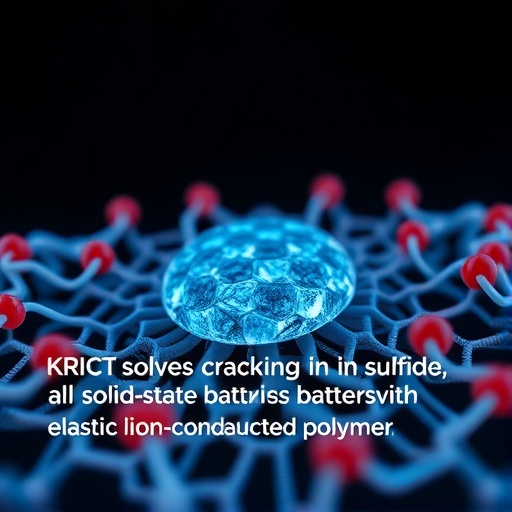
![[1] KRICT Research Team](https://scienmag.com/wp-content/plugins/wp-fastest-cache-premium/pro/images/blank.gif)
view more
Credit: Korea Research Institute of Chemical Technology(KRICT)
A research team has developed a technology that enhances the lifespan and stability of all-solid-state batteries by utilizing a rubber-like elastic ion-conductive material.
Dr. Dong Wook Kim and his research team at the Korea Research Institute of Chemical Technology (KRICT), in collaboration with Professor Seong-Ju Hwang’s team at Yonsei University and Professor Ho Seok Park’s team at Sungkyunkwan University, developed a technology that incorporates an “elastic ion-conductive polymer” into sulfide-based all-solid-state batteries to reduce cracking and interfacial degradation generated during charge-discharge cycling and thereby improve battery durability.
As electric vehicle adoption accelerates worldwide, all-solid-state batteries are attracting significant attention as next-generation energy storage systems. Unlike conventional lithium-ion batteries that use flammable liquid electrolytes, all-solid-state batteries employ solid electrolytes, offering superior safety. Among various solid electrolyte materials, sulfide-based electrolytes have gained particular interest from global battery manufacturers because they exhibit liquid-like ionic conductivity, enabling fast charging and high-power operation.
However, sulfide-based all-solid-state batteries suffer from a critical challenge. Because rigid solid electrolytes and electrodes are in direct contact, repeated charge-discharge cycles cause volumetric changes in electrode materials, leading to the accumulation of internal stress and crack formation. These cracks interrupt ion and electron transport pathways, resulting in rapid capacity degradation and shortened battery life. To maintain stable contact between the electrode and electrolyte, high external stack pressure is typically required, increasing both battery weight and manufacturing costs.
Previous efforts attempted to address this issue by introducing buffer layers such as nitrile butadiene rubber (NBR) binders or polyethylene oxide (PEO) between electrodes and sulfide electrolytes. However, these approaches often suffered from reduced ionic conductivity or undesirable side reactions, limiting their practical application.
To overcome these limitations, the research team developed a composite electrolyte in which an elastic ion-conductive polymer is infiltrated into the sulfide electrolyte. A liquid precursor was introduced into the porous electrolyte structure and subsequently cured into a crosslinked network, filling the voids between electrolyte particles.
The elastic polymer performs two critical functions. First, like a seismic damper in buildings, it absorbs stress generated by electrode expansion and contraction during cycling and strengthens adhesion between the electrode and electrolyte, thereby suppressing crack formation. Second, it fills internal voids within the electrolyte and provides additional lithium-ion transport pathways, helping maintain effective lithium-ion conductivity.
Experimental results demonstrated that cells incorporating the elastic polymer operated stably for more than 2,500 hours during repeated lithium plating/stripping tests, which mimic the charge-discharge cycling behavior. While conventional sulfide electrolytes experienced progressive interfacial degradation, the composite electrolyte maintained a stable interface throughout cycling.
The technology also improved performance under high-rate charging and discharging conditions. After 200 charge-discharge cycles, batteries without the elastic polymer retained only 22% of their initial capacity, whereas batteries incorporating the elastic polymer maintained 75% capacity retention—more than three times higher. This indicates significantly reduced performance degradation during long-term operation.
Importantly, the researchers confirmed that the technology also reduces dependence on external stack pressure. Conventional sulfide-based all-solid-state batteries require high operating pressure to maintain interfacial contact between electrodes and electrolytes. In contrast, batteries employing the elastic ion-conductive polymer exhibited relatively stable performance even under lower-pressure conditions. This finding is particularly meaningful for commercialization because it may contribute to simplified battery structures and reduced manufacturing costs.
The research team plans to further validate the technology in large-format battery cells and electric vehicle operating environments.
“This technology addresses one of the most critical challenges in sulfide-based all-solid-state batteries—the issue of mechanical stability,” said Dr. Dong Wook Kim of KRICT.
Dr. Seokmin Shin, President of KRICT, added, “We expect this technology to contribute to the development of highly safe next-generation batteries for electric vehicles and energy storage systems.”
The research was published in the May 2026 issue of Energy Storage Materials (IF 20.2), a leading international journal in the field of materials science. Dr. Dong Wook Kim served as the corresponding author, while Juhyoung Kim (KRICT–Yonsei University) and Hyo Won Bae (KRICT–Sungkyunkwan University) participated as co-first authors.
###
KRICT is a non-profit research institute funded by the Korean government. Since its foundation in 1976, KRICT has played a leading role in advancing national chemical technologies in the fields of chemistry, material science, environmental science, and chemical engineering. Now, KRICT is moving forward to become a globally leading research institute tackling the most challenging issues in the field of Chemistry and Engineering and will continue to fulfill its role in developing chemical technologies that benefit the entire world and contribute to maintaining a healthy planet. More detailed information on KRICT can be found at
This research was supported by the KRICT Fundamental Research Program and the National Research Council of Science & Technology (NST) Global TOP Strategic Research Program (GTL24011-000).
Journal
Energy Storage Materials
Article Title
Chemo-mechanical interfacial stabilization using elastic ion-conductive polymers in sulfide-based all-solid-state batteries
Article Publication Date
2-May-2026
Jungmin Lee
National Research Council of Science & Technology
ljm@nst.re.kr
Journal
Energy Storage Materials
Article Title
Chemo-mechanical interfacial stabilization using elastic ion-conductive polymers in sulfide-based all-solid-state batteries
Article Publication Date
2-May-2026
bu içeriği 600 ile 800 kelime arasında olacak şekilde ve alt başlıklar ve madde içermiyecek şekilde ünlü bir science magazine için İngilizce olarak yeniden yaz. Teknik açıklamalar içersin ve Viral science news olacak şekilde İngilizce yaz. Haber dışında başka bir şey içermesin. Haber içerisinde 8 ile 10 paragraf olsun ve toplam uzunluk 600 ile 800 kelime arasında kalsın. Cevapta sadece haber olsun. Ayrıca haberi yazdıktan sonra içerikten yararlanarak aşağıdaki başlıkların bilgisi var ise haberin altında doldur. Eğer yoksa bilgisi ilgili kısmı yazma.:
Subject of Research:
Article Title:
News Publication Date:
Web References:
References:
Image Credits:

