

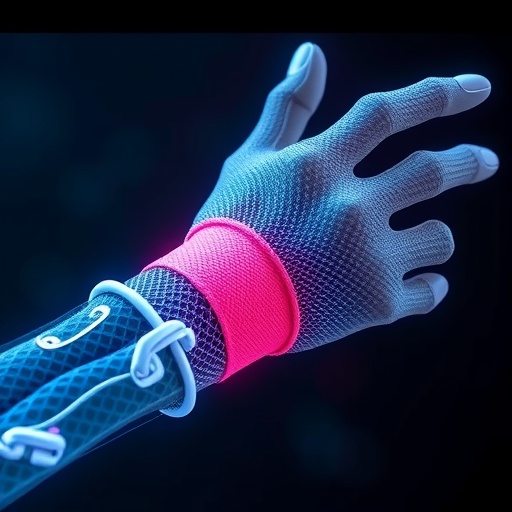
A flexible, stretchy bandage laced with carbon nanotubes could finally give surgeons real-time awareness of how snake-like medical robots are bending deep inside the body—without the hefty price tag of existing fiber-optic systems. A research team led by Professor Haojian Lu at Zhejiang University has developed a piezoresistive fiber bandage that wraps around standard continuum robots and measures their three-dimensional shape using nothing more than electrical resistance changes, trained neural networks, and a fabrication cost of less than one US dollar per sensing segment.
Continuum robots, which steer through tortuous anatomy using elastic bending sections rather than rigid joints, have become indispensable for minimally invasive procedures such as bronchoscopy, rhinoscopy and gastrointestinal endoscopy. Yet one persistent frustration haunts their clinical adoption: the inability to know exactly what shape the robot is adopting once it disappears from view. Optical shape sensors exist, but they require fragile glass fibers, expensive interrogator units, and often demand internal channels that many off-the-shelf robots simply do not have. Lu’s team set out to create a sensor that could be retrofitted onto existing robots without modifying their internal structure, and the result is a soft, thin bandage that adds only 0.6 millimeters to the robot’s diameter.
The sensor begins as a colloidal dispersion of multi-walled carbon nanotubes in a thermoplastic polyurethane matrix. After solution evaporation, the mixture solidifies into a continuous film just 250 micrometers thick and 4 millimeters wide. This piezoresistive fiber bandage, or PFB, can stretch to 400 percent of its original length without rupture and exhibits a nearly linear relationship between electrical resistance and mechanical strain up to 30 percent elongation. When wound helically around a robot’s surface, the nanotube networks experience compression and tension as the structure bends, producing measurable resistance shifts along the fiber. By embedding multiple electrodes every two centimeters, the team can sample resistance at discrete points, creating a rich, spatially resolved data stream of the robot’s deformation.
Translating those resistance signals into an accurate three-dimensional shape is far from straightforward. The mapping is nonlinear and complicated by uneven assembly, manufacturing variations and friction. Rather than attempting a first-principles analytical model, the researchers adopted a data-driven strategy. They divided the robot into three segments, each instrumented with its own fiber bandage, and collected thousands of motion-capture ground-truth measurements while the robot flexed through its range. Three compact fully-connected neural networks were then trained to map the local resistance vectors directly to the arc parameters of a piecewise-constant-curvature model—bending angle and the plane of rotation. For a single actuated section, the network achieved an average absolute error of just 3.05 degrees for bending angle and 7.49 degrees for rotation plane angle. When the whole multi-section robot traced an irregular closed trajectory, those errors rose modestly to 5.05 degrees and 13.23 degrees, respectively, still well within the bounds useful for intraoperative guidance.
To prove the system could handle real anatomical complexity, the team 3D-printed phantoms of a human sinus, a bronchial tree, and a duodenum, each forcing distinct bending configurations—distal-only curvature for the sinus, combined distal and middle bending for the bronchus, and an S-shaped triple curve for the duodenum. In every case, the neural networks reconstructed the robot’s shape solely from resistance data, matching the phantom geometries reliably. The group then graduated to ex vivo tissue, inserting the sensor-clad robot into a pig intestine to simulate a gastrointestinal endoscopy. Throughout navigation of the soft, slippery canal, the bandage provided continuous shape feedback without losing fidelity, demonstrating its potential on biological tissue that is far less predictable than printed plastic.
The economic and practical arguments are compelling. Each sensing segment costs under a dollar, several orders of magnitude cheaper than fiber Bragg grating interrogators. Because the fiber is soft and thin, it reduces the robot’s ultimate bending angle by roughly 20 degrees, a penalty the team describes as negligible for most procedures. This combination of low cost, ease of installation, and high stretchability could democratize shape sensing across a much wider array of continuum robots, including those already deployed in hospitals.
Challenges remain before the bandage sees clinical use. The current prototype has numerous base wires that can hinder movement, and the piecewise-constant-curvature assumption introduces systematic errors in some configurations. Long-term signal drift under repeated cycling, compatibility with sterilization processes, and scalable wiring harnesses all need further investigation. The team also plans to explore whether the same piezoresistive fiber can simultaneously detect contact forces, transforming the bandage into a dual-purpose sensor for both shape and haptic feedback. If successful, such a skin-like sensing layer could give surgeons a sense of “touch” at the tip of a steerable catheter, adding a crucial dimension to minimally invasive interventions.
Subject of Research: Shape sensing of slender medical continuum robots using a carbon nanotube piezoresistive fiber bandage
Article Title: Enhancing Shape Sensing of Slender Medical Continuum Robot Using Carbon Nanotube Piezoresistive Fiber Bandage
News Publication Date: June 24, 2026
Web References: DOI: 10.34133/cbsystems.0622
References: P. Xiang, X. Mi, H. Zhang, F. Wang, X. Yang, Y. Wang, R. Xiong, S. Liu, H. Lu, “Enhancing Shape Sensing of Slender Medical Continuum Robot Using Carbon Nanotube Piezoresistive Fiber Bandage,” Cyborg and Bionic Systems, June 24, 2026.
Image Credits: Haojian Lu, Department of Control Science and Engineering, Zhejiang University
Keywords
carbon nanotubes, piezoresistive sensor, medical robotics, continuum robot, shape sensing, soft robotics, neural networks, minimally invasive surgery


