

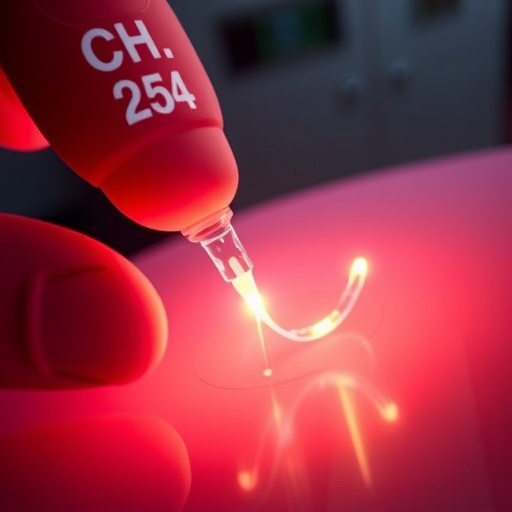
A new artificial intelligence system can predict exactly how fast a drug-releasing patch or implant will deliver its medicine by observing only the very earliest moments of a laboratory experiment. Developed by engineers at Brown University, the method promises to collapse the months or years normally required to fine-tune controlled-release materials into a fraction of that time, potentially bringing advanced bandages, long-acting implants, and transdermal patches to patients much faster and at lower cost.
“The current methodology for developing controlled-release materials is based on experiment,” said Vikas Srivastava, an associate professor of engineering at Brown and the study’s senior author. “You design a material, test it with experiment, tweak the design and experiment again. That takes a lot of time.” The new approach, he explains, uses artificial intelligence that already understands the fundamental physics of molecular diffusion to leapfrog most of that trial-and-error loop.
The technology relies on a class of algorithms called physics-informed neural networks, or PINNs. Unlike standard deep learning models, which must infer every pattern from reams of training data, PINNs have the governing equations of a physical process built directly into their architecture. Originally conceived by Brown applied mathematician George Karniadakis, these networks learn in a way that respects, for instance, conservation laws or, in this case, Fick’s Law of Diffusion — the classic mathematical description of how molecules drift from regions of high concentration to low concentration. Because the network is already “aware” that a drug’s release is governed by diffusion, it needs far fewer real-world measurements to lock onto an accurate long-term forecast.
In the study, published in the Journal of Drug Delivery Science and Technology, Srivastava along with Brown graduate Daanish Qureshi and research professor Khemraj Shukla built PINNs that ingested a short initial segment of experimental drug-release data from various polymer-based materials. The models then attempted to project the full release curve — how the concentration of a therapeutic agent decays over hours or days. For simple, flat materials, the PINNs produced predictions that matched the actual experimental outcomes after seeing just the first 6 percent of the data. When the team tested more intricate materials, deliberately designed with folds or wrinkles to modulate surface area and release kinetics, the networks still needed only 33 percent of the experimental timeline before their forecasts aligned with reality.
“We’re basically cutting the time required for experiment by 94 percent for simple materials and 67 percent for more complex ones,” Srivastava summarized. “In pharmaceutical development, time is money. We’re hopeful that this approach can help in getting products to patients more quickly and less expensively.”
To bolster the reliability of its predictions even in the face of unavoidable laboratory noise, the team also implemented a Bayesian version of the PINN framework. Laboratory measurements always carry a degree of uncertainty — tiny temperature fluctuations, slight variations in mixing, instrumental drift. Bayesian neural networks treat the model’s own internal parameters as probability distributions rather than fixed numbers, allowing them to quantify the uncertainty in every prediction. The result is an output that not only reproduces the experimental release profile more faithfully but also comes with confidence intervals, giving formulation scientists a clearer picture of how much they can trust the forecast before committing to costly full-scale trials.
The immediate target of the work is external drug delivery systems like patches and bandages, where a drug diffuses from a polymer matrix into the skin. However, the same underlying physics — Fickian diffusion — governs the release of medication from many oral pills, inserts, and injectable depots. Srivastava notes that the demonstrated approach could be extended straightforwardly to those dosage forms as well. Because the PINN framework is agnostic to the specific geometry or material chemistry, a manufacturer developing an extended-release tablet, for example, could train a similar network on early dissolution data and rapidly screen dozens of candidate formulations before ever running a full 24-hour dissolution test.
The potential savings are striking. Formulation scientists currently invest enormous resources in generating exhaustive release profiles for every prototype. An AI that can confidently extrapolate from a few early data points could divert that effort toward more innovative designs, shorten the path through regulatory stability testing, and lower the overall cost of bringing controlled-release therapies to market. With the new PINN-based method, a process that once demanded weeks of repetitive measurements might be compressed into a single day of data collection followed by a near-instant computation.
“We believe this demonstrates an area in which AI can make a real difference in developing products that improve people’s lives,” Srivastava said. As physics-informed neural networks mature, they may become standard tools on the pharmaceutical scientist’s bench, not replacing experiment but sharply reducing the number of experiments that need to be done.
Subject of Research: Physics-informed neural networks for predicting drug release from controlled-release materials
Article Title: Drug release modeling using Physics-Informed Neural Networks
News Publication Date: 1-Jul-2026
Web References: 10.1016/j.jddst.2026.108654
References: Journal of Drug Delivery Science and Technology, DOI: 10.1016/j.jddst.2026.108654
Image Credits: Not available
Keywords
Physics-informed neural networks, drug delivery, controlled release, Fickian diffusion, artificial intelligence, Bayesian neural networks, pharmaceutical development, polymer matrices


