


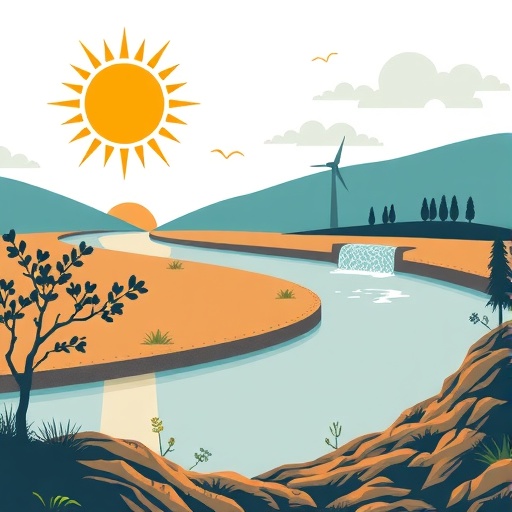
As the global agricultural sector strives to decouple from volatile conventional energy markets, solar power has emerged as an increasingly pivotal player. Its appeal lies not only in being a clean and cost-effective source of electricity but also in its potential to power essential irrigation systems vital for modern farming operations. Yet, a significant technical hurdle persists: the mismatch between solar energy availability and irrigation demands, especially since irrigation often requires power during non-sunlight hours. This discrepancy has historically relegated solar energy to a supplementary role, limiting its capacity to fully supplant traditional energy sources within agricultural irrigation networks.
In a groundbreaking study conducted by researchers from the University of Córdoba, an innovative hybrid approach to solar energy integration within irrigation communities has been explored, demonstrating a transformative path toward energy autonomy. Focusing on a real-world use case in Andalusia, Spain, the team examined the Margen Izquierda del Genil irrigation community, spanning approximately 6,000 hectares in regions including Lora del Río, Peñaflor, and Palma del Río. This community is in the process of installing a state-of-the-art 9-megawatt peak (MWp) photovoltaic (PV) system intended to replace conventional electricity for pumping water—an energy-intensive process fundamental to irrigation.
The irrigation system employs an elevational engineering strategy where water is pumped from the Genil River to a reservoir situated 80 meters above the source. From this elevated reservoir, gravity takes over, enabling water to flow naturally downwards, irrigating crops without additional energy inputs. This vertical difference in elevation is pivotal, as it offers a unique opportunity to integrate energy storage and on-demand power generation within the irrigation infrastructure itself, thereby addressing one of the key limitations of solar energy: storage.
The solar PV array is designed not merely to produce electricity coinciding with daytime irrigation demands but to enable a hybrid system where surplus solar energy can be stored in the form of potential energy—water elevated in the reservoir. This method effectively transforms the reservoir into a “true battery,” capable of supplying hydraulic energy on demand by releasing water to drive turbines that generate electricity when sunlight is absent or energy needs exceed instantaneous solar production. Such an ingenious energy storage solution capitalizes on the natural features of the irrigation system to buffer energy supply fluctuations, enhance autonomy, and ensure energy availability aligns with irrigation schedules.
The researchers identified and modeled four distinct operational scenarios to quantify economic and environmental benefits under varying utilizations of solar power. The baseline scenario reflects conventional energy dependency, with costs subject to electricity market volatility. The second scenario adds a PV system solely dedicated to the irrigation community’s onsite energy consumption, yet without surplus energy commercialization. While this reduces reliance on purchased energy, it confines irrigation scheduling to daylight hours, maintaining some dependency on the conventional grid.
Introducing a third scenario, the community gains the ability to sell surplus solar-generated electricity back to the grid, unlocking revenue streams that offset investment and operational expenses. This step not only enhances financial viability but amplifies the incentives for solar adoption. However, the fourth and most forward-thinking scenario integrates the hybrid model with stored potential energy in the elevated reservoir, representing an advanced, circular energy system with superior operational flexibility, resilience, and sustainability.
Extensive data spanning 2021 to 2024, capturing fluctuations in market prices, water availability, and irrigation demand, underpins the study’s findings. By adopting a realistic dataset, the researchers ensured their conclusions would be resilient to real-world challenges faced by irrigation communities. The hybrid model capitalizes on the 80-meter elevation difference to store energy as pumped water, effectively decoupling irrigation operations from solar energy’s intermittent profile and market electricity pricing volatility.
This hybrid circuit provides multiple strategic advantages. First, it introduces unprecedented autonomy, freeing the community from dependence on external electricity supply timing and costs. Second, the system enhances operational flexibility by enabling irrigation activities to proceed regardless of sunlight availability. Third, it reduces greenhouse gas emissions by prioritizing renewable over fossil-derived energy, thus contributing to broader sustainability goals. Finally, the model offers a blueprint applicable to other irrigation districts worldwide where elevational differences can be harnessed similarly.
Maaike Van de Loo, the study’s lead author, emphasizes that prior work in this field grappled with harmonizing solar energy flux with irrigation demands. By addressing energy storage through the elevation-based hydraulic system, this study transcends traditional solar implementation limitations. The proposed energy sovereignty model is resilient to economic and climatic variability, a critical factor as agriculture increasingly contends with extreme weather and fluctuating energy markets.
This pioneering research stands at the crossroads of renewable energy engineering, agronomy, and sustainable resource management, offering a compelling vision for the future of irrigation networks. The integration of solar photovoltaic generation with pumped-storage hydraulic infrastructure exemplifies how leveraging physical landscape features can answer modern energy challenges, marrying ecological stewardship with agricultural productivity.
Published in the esteemed Journal of Cleaner Production, this study emerges from the HY4RES project, which strategically develops hybrid renewable energy solutions across the Atlantic Area, funded by the European Union’s Interreg program. Its innovative approach and empirically substantiated benefits position it as a leading case study for policy makers, energy engineers, and agricultural practitioners focused on the transition to clean, reliable, and cost-effective irrigation power systems.
By realizing this hybrid model, irrigation communities like Margen Izquierda del Genil can transcend traditional energy constraints, moving decisively towards a sustainable energy future marked by independence, resilience, and environmental responsibility. This research paves the way for reimagined agricultural landscapes where energy and water systems coexist symbiotically, addressing global challenges of food security and renewable energy deployment under climate change imperatives.
Cite Scienmag News
Faith Mcneil. (July 1, 2026). Harnessing Solar and Hydropower: A Path to Energy Sovereignty for Irrigation Communities. Scienmag. https://scienmag.com/harnessing-solar-and-hydropower-a-path-to-energy-sovereignty-for-irrigation-communities/
Faith Mcneil. "Harnessing Solar and Hydropower: A Path to Energy Sovereignty for Irrigation Communities." Scienmag, 1 July 2026, https://scienmag.com/harnessing-solar-and-hydropower-a-path-to-energy-sovereignty-for-irrigation-communities/. Accessed 31 August 2026.
Faith Mcneil. "Harnessing Solar and Hydropower: A Path to Energy Sovereignty for Irrigation Communities." Scienmag. July 1, 2026. https://scienmag.com/harnessing-solar-and-hydropower-a-path-to-energy-sovereignty-for-irrigation-communities/


