


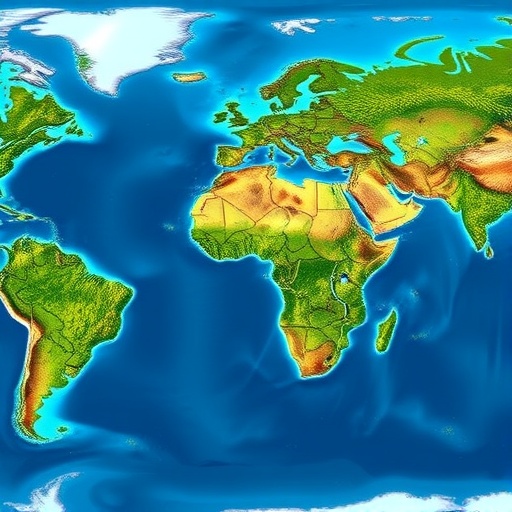
In a groundbreaking advancement for marine science, researchers have developed the first-ever high-resolution global map of seagrass ecosystems, transforming our understanding of these vital underwater plants. Seagrass, often overshadowed by more charismatic oceanic flora like corals, plays an integral role in carbon sequestration, coastal protection, and marine biodiversity. This study, led by Arizona State University’s Center for Global Discovery and Conservation Science and published in Nature on June 24, 2026, leverages state-of-the-art artificial intelligence and supercomputing to address the critical knowledge gap about seagrass distribution and its global ecological contributions.
Seagrass is often misunderstood as seaweed; however, it is a true flowering plant with roots, capable of flowering and seed production. Its subterranean roots stabilize sediment, reducing coastal erosion while simultaneously fostering carbon sequestration by trapping and burying organic material. This root-mediated sediment retention is vital to preserving coastlines and mitigating the effects of climate change. Through a combined approach involving satellite imagery, AI-driven detection algorithms, and rigorous field verification dives, researchers have quantified that seagrass ecosystems store approximately 640 teragrams of carbon in the upper sediment layers globally, equivalent to the annual carbon emissions produced by 500 million cars.
Creating a comprehensive seagrass map was an immense technical challenge. Unlike coral reefs, whose structures are comparatively fixed and easier to detect via satellite, seagrass beds are spatially variable, dynamic, and ephemeral. The team employed a convolutional neural network trained on vast amounts of satellite data combined with “ground truth” observational datasets collected by divers worldwide. This integration enabled the AI to distinguish seagrass from visually similar underwater substrates like algae, coral, rock, or sand with remarkable accuracy. The satellite-based model could detect seagrass presence within 10-meter squared areas, categorizing them as dense or sparse depending on vegetation coverage.
The mapping work was substantially supported by ASU’s advanced computational infrastructure, particularly the Agave and Sol supercomputers. These systems facilitated the deep learning processes required to analyze millions of satellite images spanning the globe, demonstrating the transformative potential of computational science in marine ecology. Presently, the detection capability is limited to depths of about 30 meters due to satellite sensor constraints, although future hyperspectral sensors could extend this range to cover deeper seagrass meadows, offering even greater resolution and accuracy.
Findings reveal that seagrass populations are heavily clustered near the coastlines of five key nations: the United States, the Bahamas, Cuba, Australia, and Indonesia, collectively harboring nearly 70% of the global seagrass cover. Satellite data comparisons over four years, from 2019–2020 to 2023–2024, indicate a concerning global loss rate of around 1% annually. Anthropogenic impacts such as coastal development, agricultural runoff, and pollution significantly contribute to these declines, with episodic climate events like hurricanes and marine heatwaves exacerbating vulnerabilities. Despite these losses, some regions have shown promising signs of recovery, underscoring the potential for targeted conservation efforts to restore and bolster these ecosystems.
The ecological importance of seagrass transcends carbon storage. It acts as a natural water purifier by filtering pollutants and serves as a critical habitat, providing food and refuge for a wide array of marine organisms, including commercially important fish species. These ecosystems underpin coastal fisheries and contribute to the livelihoods of millions, emphasizing the socio-economic value intertwined with environmental health. Furthermore, seagrass beds ameliorate coastal storm impacts by buffering wave energy, safeguarding communities from extreme weather events.
The integration of the seagrass map into established platforms like the Allen Coral Atlas marks a significant innovation in marine spatial planning. This unified monitoring system now encompasses both coral and seagrass data, facilitating more holistic management strategies for coastal and marine protected areas. Presently, only about 21% of seagrass habitats are encompassed within marine protected zones, which is alarming considering that nearly 80% of observed seagrass loss occurs outside these boundaries. This underscores the urgent need to expand protection measures and implement conservation priorities informed by empirical spatial data.
Seagrass restoration efficacy is already evident in isolated locations such as South Bay, California, and points in Cuba, where ecological improvements coincide with active restoration projects and enhanced water quality regimes. Seagrass, unlike slower-recovering ecosystems like coral reefs, can regenerate relatively quickly, making restoration initiatives potentially more impactful within shorter timeframes. This rapid response amplifies the importance of ongoing monitoring to track ecosystem health and the success of conservation interventions.
This research embodies a turning point, transitioning seagrass ecosystems from ecological enigmas to quantifiable, observable entities integral to climate mitigation and biodiversity conservation strategies. By leveraging technological advancements in AI and remote sensing, scientists and policymakers can now make informed, data-driven decisions for the stewardship of coastal environments vulnerable to accelerating global change. The study’s comprehensive methodology and promising outcomes signal a new era in marine ecosystem management, highlighting the synergy of interdisciplinary research spanning ecology, computer science, and environmental policy.
The study was bolstered by collaboration among diverse institutions, including Florida International University, James Cook University, The Nature Conservancy’s Caribbean Division, and Australian universities. It also received funding from the Jet Propulsion Laboratory, illustrating the expansive cooperative effort required for such an ambitious scientific endeavor. As the scope of satellite technology expands, and computational models grow more sophisticated, continual advancements are anticipated in ocean ecosystem mapping, providing essential insight into the Earth’s most valuable but often underappreciated natural resources.
Ultimately, this global seagrass map doesn’t just represent a scientific milestone but offers a beacon of hope in the conservation toolkit. It enables targeted restoration, enhanced pollution regulation, and strategic marine protected area enhancements that factor in these critical underwater meadows. By safeguarding and rehabilitating seagrass ecosystems, humanity can bolster carbon sequestration, preserve biodiversity, and protect coastal communities, reinforcing the ocean’s resilience in a changing climate.
News Publication Date: 24-Jun-2026
Web References:
- Arizona State University’s Center for Global Discovery and Conservation Science: https://globalfutures.asu.edu/gdcs/
- Allen Coral Atlas: https://allencoralatlas.org/
- DOI link to article: http://dx.doi.org/10.1038/s41586-026-10704-3
References:
Li, J., et al. (2026). Global high-resolution mapping of seagrass to support conservation. Nature. DOI: 10.1038/s41586-026-10704-3
Keywords
Marine ecosystems, Marine conservation, Artificial intelligence, Seagrass mapping, Carbon sequestration, Coastal protection, Remote sensing, Deep learning, Climate mitigation, Biodiversity conservation
Cite Scienmag News
Margaret Porter. (June 24, 2026). Groundbreaking Global Seagrass Map Reveals Crucial Insights for Conservation Efforts. Scienmag. https://scienmag.com/groundbreaking-global-seagrass-map-reveals-crucial-insights-for-conservation-efforts/
Margaret Porter. "Groundbreaking Global Seagrass Map Reveals Crucial Insights for Conservation Efforts." Scienmag, 24 June 2026, https://scienmag.com/groundbreaking-global-seagrass-map-reveals-crucial-insights-for-conservation-efforts/. Accessed 3 September 2026.
Margaret Porter. "Groundbreaking Global Seagrass Map Reveals Crucial Insights for Conservation Efforts." Scienmag. June 24, 2026. https://scienmag.com/groundbreaking-global-seagrass-map-reveals-crucial-insights-for-conservation-efforts/


