


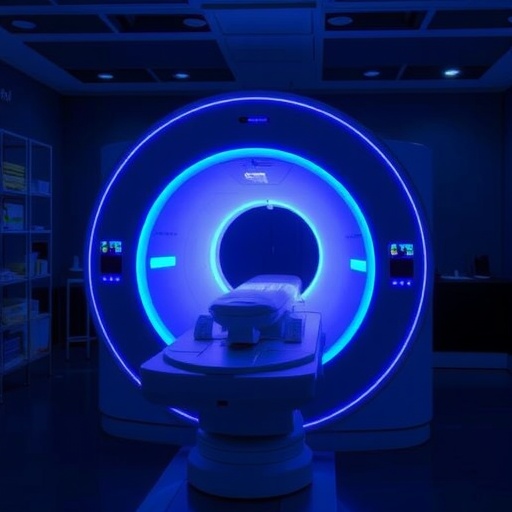
In a groundbreaking advancement poised to revolutionize breast cancer diagnostics, researchers from the Technion – Israel Institute of Technology, in collaboration with leading institutions in the United States, have unveiled a novel magnetic resonance imaging (MRI) technique that drastically accelerates imaging speed while significantly enhancing scan quality. Published in the prestigious journal Nature Communications, this innovative method, dubbed ELITE, harnesses the combined power of artificial intelligence and sophisticated mathematical modeling to push the boundaries of dynamic breast MRI technology.
Dynamic breast MRI has long been a critical tool in the early detection and diagnosis of breast cancer, providing over 90% sensitivity—far surpassing traditional screening methods such as mammography and ultrasound, which hover around 50-60%. Despite this superior accuracy, conventional dynamic MRI faces inherent limitations tied to temporal resolution: producing high-quality, detailed images generally requires prolonged scan times. These lengthy acquisition periods, often extending to one or two minutes per frame, constrain the ability to capture the rapid kinetics of contrast agents traversing breast tissue, thereby limiting real-time insight into tumor physiology and vascular behavior.
The ELITE methodology directly confronts these challenges by integrating advanced mathematical models capable of deciphering the structural and functional tissue patterns intrinsic to breast anatomy with the power of deep learning. Specifically, the research team employed a Residual Network (ResNet) architecture fine-tuned to denoise images and correct artifacts, enabling the reconstruction of high-fidelity MR images from undersampled data. This intelligent synthesis not only mitigates the distortions typically introduced by accelerated scanning protocols but also fills in missing information, effectively bridging gaps left by incomplete data acquisition.
Such a leap in temporal resolution—achieving one usable image per second, a rate orders of magnitude faster than traditional protocols—ushers in unprecedented capabilities for clinicians. Real-time visualization of contrast agent dynamics offers a window into tumor microenvironment characteristics such as blood flow and vascular permeability, biological factors that are pivotal in distinguishing malignant tumors from benign counterparts and assessing tumor aggressiveness. By capturing these subtle physiological cues more accurately, ELITE holds promise for enhancing diagnostic confidence and potentially guiding more personalized treatment strategies.
The study’s clinical validation involved 54 patients, wherein ELITE demonstrated superior tumor conspicuity compared to existing breast MRI techniques. Enhanced image clarity and significantly reduced noise levels facilitated precise tumor delineation, showcasing the method’s potential to improve diagnostic sensitivity in a population where timely detection is of paramount importance. Moreover, the considerable reduction in scan time per patient is expected to improve clinical workflow efficiency, allowing more women access to high-quality MRI screening without the bottlenecks imposed by lengthy exams.
The underpinning computational framework of ELITE reflects a multidisciplinary synergy between biomedical engineering, MRI physics, artificial intelligence, and clinical radiology. Dr. Eddy Solomon, the principal investigator from Technion’s Faculty of Biomedical Engineering, emphasized the role of mathematical modeling in identifying and exploiting tissue-specific patterns alongside AI-powered noise suppression. This holistic approach represents a significant departure from conventional MRI reconstruction techniques, paving the way for real-time, high-resolution imaging in clinical settings.
Importantly, ELITE’s potential utility extends beyond breast imaging. Preliminary tests suggest its applicability to brain, head, and neck MRI examinations, indicating a broad scope for diagnostics enhancement across various anatomical sites. Furthermore, the underlying principles may be transferable to other imaging modalities, heralding a new era of intelligent, fast, and biologically insightful medical imaging tools that could redefine both diagnostic and interventional imaging practices.
This latest advancement builds upon previous work published a year earlier by Dr. Solomon and collaborators at New York University (NYU). Their prior research established a comprehensive AI-focused breast MRI database comprising 300 scans designed to refine and train machine learning models. The ELITE study leverages these datasets to propel deep learning architectures targeted at overcoming physical and computational constraints inherent to conventional MRI practices.
Financial support from the National Institutes of Health (NIH) and the Radiological Society of North America (RSNA) underscores the broader medical community’s recognition of the project’s significance. Collaborative efforts with Weill Cornell Medical College and the NYU Center for Advanced Imaging Innovation and Research have enriched the study, combining expertise from multiple leading institutions to tackle one of breast cancer diagnosis’s most pressing challenges.
Future directions for ELITE involve further clinical trials to validate its diagnostic performance across diverse patient populations and tumor types. Researchers are optimistic that this technology will not only improve early breast cancer detection but also enable more nuanced understanding of tumor biology in vivo. Such insights could prove instrumental in customizing therapeutic interventions and monitoring treatment response with unprecedented detail.
Beyond the technical and clinical horizons, ELITE signals a transformative shift towards more accessible MRI diagnostics. By reducing scan times while maintaining or exceeding current image quality standards, this approach can alleviate logistical and patient compliance barriers, especially for populations historically underserved by MRI technologies due to length and complexity of scans. Ultimately, this innovation enhances both the patient experience and clinical outcomes.
Dynamic breast MRI, once limited by a trade-off between temporal and spatial resolution, now steps into a new era where both can be optimized in tandem. ELITE exemplifies how cutting-edge artificial intelligence and mathematical insight can revolutionize long-established medical imaging practices, driving progress towards faster, smarter, and more precise cancer diagnostics worldwide.
News Publication Date: 19-May-2026
Web References:
https://www.nature.com/articles/s41467-026-72776-z
References:
Solomon, E., et al. (2026). Dynamic breast MRI with Flexible Temporal Resolution Aided by Deep Learning. Nature Communications. DOI: 10.1038/s41467-026-72776-z
- Dr. Eddy Solomon. Photo credit: Leo DeLuca
- ELITE demonstration images and video showcasing enhanced tumor visualization and vascular morphology in breast MRI scans.
Cite Scienmag News
Nathaniel Bowman. (June 23, 2026). AI Revolutionizes MRI Efficiency with Groundbreaking Advances. Scienmag. https://scienmag.com/ai-revolutionizes-mri-efficiency-with-groundbreaking-advances/
Nathaniel Bowman. "AI Revolutionizes MRI Efficiency with Groundbreaking Advances." Scienmag, 23 June 2026, https://scienmag.com/ai-revolutionizes-mri-efficiency-with-groundbreaking-advances/. Accessed 3 September 2026.
Nathaniel Bowman. "AI Revolutionizes MRI Efficiency with Groundbreaking Advances." Scienmag. June 23, 2026. https://scienmag.com/ai-revolutionizes-mri-efficiency-with-groundbreaking-advances/


