


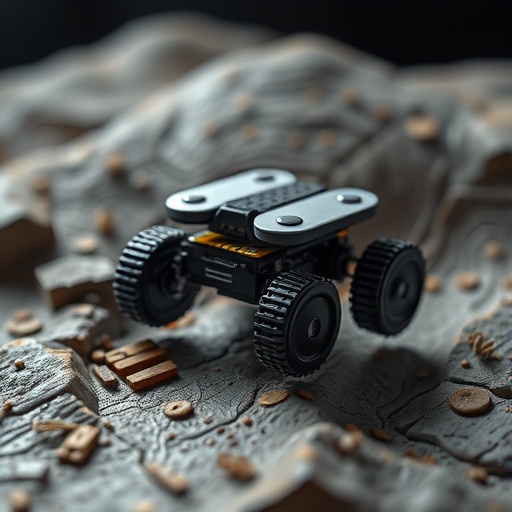
In a groundbreaking advancement within the realm of microrobotics, a team of researchers has unveiled a novel reinforcement learning-based control strategy designed to empower microrobotic swarms with autonomous navigation abilities in previously unknown environments. This frontier in robotics addresses one of the discipline’s most daunting challenges: enabling swarms composed of numerous minute robots to collectively and adaptively navigate complex, dynamic surroundings without full prior knowledge or centralized control.
Microrobotic swarms have attracted widespread scientific and engineering interest due to their distributed intelligence, collective decision-making, and the promise of accomplishing intricate tasks ranging from targeted drug delivery to environmental sensing. However, despite their potential, their intrinsic limitations—especially partial observation capabilities and limited onboard sensing—have severely constrained their ability to perform navigation and obstacle avoidance autonomously. In unknown terrains, classical algorithms often falter, particularly when faced with dynamically shifting obstacles or unforeseen disruptions.
The ingenious methodology proposed hinges on leveraging reinforcement learning (RL), a branch of artificial intelligence wherein agents learn optimal policies through trial and error interactions with the environment, receiving feedback in the form of rewards or penalties. By training microrobotic swarms via RL in highly diverse simulated environments, these agents develop robust strategies for exploration and navigation, capable of generalizing beyond the confines of their training scenarios. Yet, the notorious sim-to-real gap—the discrepancies between simulated training conditions and real-world complexities—presents a critical hurdle that limits the direct applicability of learned policies.
To surmount this impasse, the research introduces a sophisticated sim-to-real transfer protocol grounded in multi-level domain randomization, an approach wherein variations are systematically added across multiple simulation parameters to emulate the unpredictable nature of reality. These perturbations affect environmental conditions, perception noise, actuation inaccuracies, and underlying robotic dynamics, effectively desensitizing the learned policy to discrepancies that would otherwise degrade real-world performance. Importantly, this comprehensive randomization, combined with the intricate reinforcement learning framework, enables seamless adaptation of the swarm’s control algorithms from simulation into uncertain, previously unencountered environments.
A key innovation of the work lies in the integration of temporally extended attention mechanisms within the control model architecture. Unlike reactive strategies that rely exclusively on current inputs, this approach encodes a historical context of sensory observations across time, enabling the swarm to infer latent environmental features and predict hidden obstacles or dynamic changes. Such temporal attention empowers the microrobots to consider past trajectories and sensory signals holistically, thereby improving decision-making efficacy under partial observability constraints.
The control policy itself operationalizes magnetic actuation commands, a preferred modality for microrobotics due to its ability to remotely influence tiny machines without onboard power sources. By continuously selecting actuation inputs based on both immediate sensory feedback and long-term context, the swarm navigates effectively even through cluttered, dynamic environments where fixed obstacles and moving targets coexist.
Benchmarking the autonomously controlled swarm against skilled human operators in diverse simulated scenarios revealed that this AI-driven approach matches or even surpasses human-level performance in navigation speed, adaptability, and obstacle avoidance. This parity underscores the potential for these intelligent swarms to execute complex missions in real-world conditions that would be challenging or unsafe for human intervention.
Beyond straightforward navigation, the team demonstrated the versatility of their system by orchestrating sophisticated behaviors such as cargo transportation, where the swarm collectively manages the movement of payloads through constrained spaces. The algorithms also enable dynamic target tracking, whereby the swarm continuously pursues mobile objectives despite disturbances or incomplete sensory data.
Another notable capability is recovery from transient vision loss. Utilizing the temporal attention framework, the swarm maintains stable control despite brief interruptions in sensing, compensating through memory and estimations derived from recent observations. This robustness is crucial for practical deployments in environments where sensor occlusion or noise is inevitable.
The experimental results further emphasize the swarm’s ability to hover stably and hold position, maneuvering precisely under partial observation without constant external guidance. Such hovering capability opens doors for applications requiring fine positioning or surveillance in intricate spaces.
An insightful analysis of the swarm’s decision-making process via attention score visualization revealed that the system prioritizes tasks dynamically based on mission-critical objectives. Actions are not merely reflexive reactions but are optimized toward goal achievement, enabling trajectories that efficiently circumvent obstacles while maintaining focus on long-term targets. This emergent task prioritization demonstrates a form of artificial collective intelligence grounded in real-time environmental assessment.
The implications of this research stretch far beyond microrobotics, heralding a new paradigm wherein small-scale robotic collectives achieve resilience, autonomy, and flexible intelligence through learned behavior and adaptive control. Future extensions might incorporate heterogeneous swarms with differentiated roles, further amplifying operational capabilities in medical, environmental, or industrial contexts.
Moreover, the fusion of reinforcement learning with advanced sim-to-real transfer and temporal attention architectures provides a blueprint for other robotic domains grappling with partial observability and dynamic uncertainties. Autonomous underwater vehicles, aerial drone fleets, and warehouse automation systems could all benefit from analogous frameworks calibrated for their specific environments.
While practical deployment of microrobotic swarms faces engineering challenges—such as reliable fabrication, robust communication, and real-time sensing—the demonstrated control strategy marks a decisive stride toward viable operations in the wild. The ability to navigate autonomously in complex, unknown surroundings expands the horizon for swarm robotics from controlled laboratory conditions to real-world utility.
In the broader context of AI-driven robotics, this research showcases the power of combining learning-based control with thoughtful simulation methodologies and architectural innovations. As artificial agents increasingly encounter uncertainty and partial information, frameworks that blend temporal reasoning with robust generalization will form the backbone of future autonomous systems.
Ultimately, the success of this microrobotic swarm navigation strategy points to a transformative leap in how intelligent robotic collectives perceive, decide, and act collectively in unknown environments. Such autonomous swarms promise to revolutionize fields as diverse as precision medicine, environmental monitoring, search and rescue, and industrial automation, all hinging on their newfound capacity to self-direct and adapt amid complexity and uncertainty.
Cite Scienmag News
Denise Maddox. (June 22, 2026). Smart Microrobots Navigate Unknown Terrains Autonomously. Scienmag. https://scienmag.com/smart-microrobots-navigate-unknown-terrains-autonomously/
Denise Maddox. "Smart Microrobots Navigate Unknown Terrains Autonomously." Scienmag, 22 June 2026, https://scienmag.com/smart-microrobots-navigate-unknown-terrains-autonomously/. Accessed 3 September 2026.
Denise Maddox. "Smart Microrobots Navigate Unknown Terrains Autonomously." Scienmag. June 22, 2026. https://scienmag.com/smart-microrobots-navigate-unknown-terrains-autonomously/


