


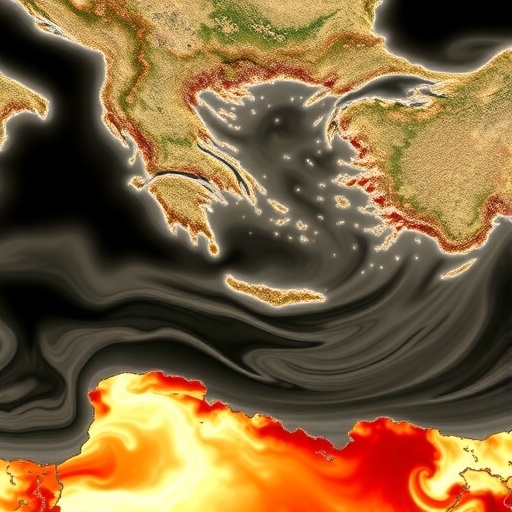
In an extraordinary advance in our understanding of early Holocene oceanographic dynamics, a recent study reveals a vigorous outflow from the Black Sea into the Aegean Sea around 11,000 years ago, profoundly impacting the onset of sluggish deep-water convection in the latter basin. This groundbreaking research, conducted by Evangelinos, Campderrós, Trias-Navarro, and their colleagues, challenges previous assumptions about early Holocene marine circulation patterns in the Eastern Mediterranean and redefines the complex interplay between regional hydrology and oceanographic processes.
The early Holocene epoch, roughly spanning from 11,700 to 8,200 years ago, marked a period of significant climatic transitions following the last glacial maximum. During this time, melting ice sheets contributed to substantial changes in sea level and the freshwater budget of marine basins. The Black Sea, situated at the nexus between continental freshwater inputs and the marine Mediterranean environment, played a pivotal role in modulating regional water mass exchanges. However, prior investigations offered limited insights into the magnitude and influence of its connection to the Aegean Sea.
Employing an integrated approach combining paleoceanographic proxies, high-resolution sediment core analyses, and advanced numerical modeling, the research team meticulously reconstructed the timing, intensity, and consequences of Black Sea outflows during the early Holocene. The results show a robust and sustained volumetric discharge from the Black Sea through the Dardanelles strait, substantially enhancing the salinity and density gradients in the Aegean basin. This intensified outflow propagated a cascade of oceanographic changes, triggering an early onset of sluggish deep-water convection which is key for nutrient cycling, biogeochemical processes, and the overall circulation of the Eastern Mediterranean.
The Black Sea’s outflow was largely driven by postglacial freshwater accumulation and subsequent overspill, a process linked to rapid ice sheet retreat and enhanced riverine inputs from the Eurasian hinterland. These inputs altered the hydrological balance in the Black Sea, elevating its water level sufficient to breach the sill thresholds connecting it with the Aegean. This breach was not a gentle trickle but an energetic pulse of brackish to saline waters that modulated the stratification within the receiving basin. The stratification evolution critically influenced vertical mixing and the ventilation of deeper waters, which prior to this event had been far more vigorous or perhaps absent.
Geochemical signatures extracted from sediment cores, including stable isotope ratios and trace metal concentrations, provide compelling evidence for this intensified Black Sea outflow. Notably, the team documented shifts in δ18O and δ13C signatures compatible with an influx of lower salinity waters at depths that coincide with emergent changes in benthic foraminiferal assemblages. These biological proxies reflect alterations in oxygenation and nutrient availability, tightly coupled to the changes in water column mixing. By correlating these findings with hydrogen isotopic measurements in organic molecular biomarkers, the researchers further elucidated detailed hydrological conditions that underpinned the Black Sea discharge dynamics.
Hydrodynamic modeling simulates the complex interactions between the discharged Black Sea water and the Aegean’s resident water masses, illustrating the resultant sluggish deep-water convection patterns. Unlike the vigorous overturning seen in other Mediterranean sub-basins, the Aegean’s deep-water formation at this time was subdued, governed by the altered buoyancy forcing from the Black Sea influx. Such sluggish convection slows the renewal of deep waters and reshapes elemental cycling, impacting nutrient regeneration and carbon sequestration, with far-reaching consequences on regional marine ecosystems.
This shift in oceanographic conditions at the start of the Holocene further implicates climate feedback mechanisms, as changes in sea surface temperature and salinity could have influenced atmospheric circulation patterns over the Eastern Mediterranean. The study posits that the altered convection regime may have modulated regional climate variability through ocean-atmosphere interactions, potentially linked with the onset of Neolithic cultural developments along the surrounding coastlines due to modified marine productivity and resource availability.
Complementing sedimentological and geochemical datasets with finely resolved chronologies, the researchers critically examined the chronology of inflow pulses vis-à-vis regional climatic archives. Their findings suggest a strong temporal coherence between Black Sea outflow episodes and episodic cooling events recorded in ice cores and speleothems, underscoring a coupled ocean-atmosphere response during this pivotal climate period. This reinforces the importance of marine gateways as sensitive indicators and modulators of earth system dynamics during abrupt climate transitions.
Moreover, the paper opens new avenues for exploring how ancient oceanographic shifts influence carbon cycling. By showcasing how the sluggish Aegean deep-water convection modified the sequestration potential of organic and inorganic carbon in sedimentary reservoirs, the authors contribute crucial knowledge to the ongoing discourse on natural climate regulation mechanisms and how past ocean circulation shaped atmospheric greenhouse gas concentrations.
Applying multidisciplinary tools and innovative analytical techniques, this pioneering investigation represents a model for future studies aiming to unravel the complexity of ancient marine systems. The unprecedented level of detail achieved in reconstructing the early Holocene hydrological regime in this key geographical sector significantly advances the field of paleoceanography and environmental geosciences.
The findings have broad implications beyond academic curiosity, offering critical insights into present-day and future Mediterranean circulation in the face of anthropogenic climate change. Understanding the nuances of how natural variability and regional freshwater inputs influence ocean stratification and convection is essential for predicting ecosystem responses and regional climate feedbacks under ongoing global warming scenarios.
In sum, this study significantly enriches our comprehension of the interactions between postglacial hydrological changes, marine gateway dynamics, and ocean circulation in the Eastern Mediterranean. It highlights the Black Sea not merely as a passive recipient of climatic forces but as an active driver reshaping the marine environment and climate feedbacks in the early Holocene. The rigorous combination of sedimentary evidence, isotopic analyses, and numerical modeling provides a robust framework for future explorations into past oceanographic and climatic regimes.
As we continue to investigate the archives of Earth’s climatic past, unraveling the intricacies of water mass exchanges through narrow sills and their broader repercussions becomes increasingly imperative. This research exemplifies how integrating broad disciplinary approaches can yield transformative insights that resonate across climate science, paleoceanography, and environmental history.
This compelling narrative of the early Holocene oceanographic transformation through the Black Sea outflow is poised to capture the attention of scientists and the public alike, illuminating how ancient hydrological events continue to echo in our modern environmental and climatic landscapes.
Paleoceanographic reconstruction of early Holocene Black Sea outflow impacts on Aegean Sea deep-water convection dynamics.
Early Holocene vigorous Black Sea outflow and the onset of sluggish Aegean deep-water convection.
Evangelinos, D., Campderrós, S., Trias-Navarro, S. et al. Early Holocene vigorous Black Sea outflow and the onset of sluggish Aegean deep-water convection. Commun Earth Environ (2026). https://doi.org/10.1038/s43247-026-03730-6
Cite Scienmag News
Violet Maxwell. (June 20, 2026). Early Holocene Black Sea Outflow Slows Aegean Convection. Scienmag. https://scienmag.com/early-holocene-black-sea-outflow-slows-aegean-convection/
Violet Maxwell. "Early Holocene Black Sea Outflow Slows Aegean Convection." Scienmag, 20 June 2026, https://scienmag.com/early-holocene-black-sea-outflow-slows-aegean-convection/. Accessed 5 September 2026.
Violet Maxwell. "Early Holocene Black Sea Outflow Slows Aegean Convection." Scienmag. June 20, 2026. https://scienmag.com/early-holocene-black-sea-outflow-slows-aegean-convection/


