


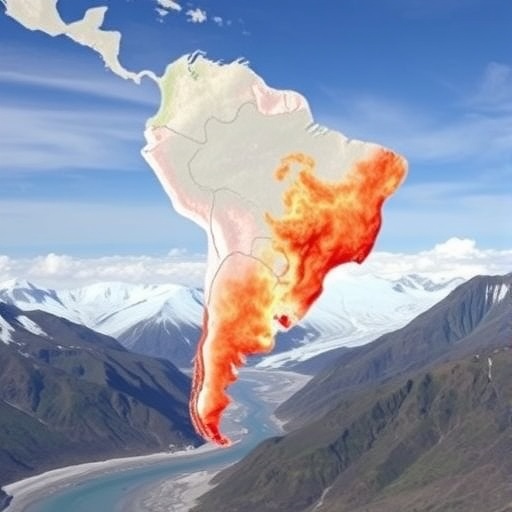
In a groundbreaking new study published in Nature Communications, researchers Ampuero, Stríkis, Meckler, and colleagues have unveiled compelling evidence of rapid warming in South America during the last deglaciation, a period roughly spanning from 20,000 to 10,000 years ago. This revelation not only reshapes our understanding of ancient climate dynamics in the Southern Hemisphere but also provides critical insights relevant to modern climate change scenarios. The study harnesses a suite of advanced geochemical proxies and high-resolution sediment analyses to reconstruct past temperature variations with unprecedented precision, shedding light on the complex interplay of atmospheric and oceanic processes that drove rapid temperature shifts during this critical juncture in Earth’s climate history.
The last deglaciation marks the transition from the Last Glacial Maximum (LGM), characterized by extensive ice sheets and colder global temperatures, to the relatively warmer Holocene epoch. While the general timeline of global warming during this period has been well documented, the rate and regional variability of temperature changes in South America remained less clear. This research addresses that gap by focusing on paleoclimatic archives from the Andes and adjacent lowlands, areas particularly sensitive to past climate fluctuations due to their unique topography and atmospheric circulation patterns. The team’s integration of isotopic measurements, sediment core analyses, and climate modeling has allowed them to track rapid temperature increases occurring in discrete pulses rather than gradual trends.
One of the study’s central findings is that the warming episodes in South America during the deglaciation were not synchronous with the Northern Hemisphere, suggesting a nuanced asynchronous behavior in global climate systems. This asynchrony challenges prevailing assumptions derived from mid-latitude and polar records predominantly from the Northern Hemisphere. The evidence points to a scenario where atmospheric teleconnections, influenced by shifts in the Intertropical Convergence Zone (ITCZ), played a vital role in redistributing heat between hemispheres. Changes in the ITCZ’s position and intensity appear to have triggered alterations in monsoonal patterns and precipitation regimes across tropical and subtropical South America, thereby accelerating warming trends.
Delving deeper into the proxies used, the research team employed oxygen isotope ratios (δ18O) from speleothems and lacustrine carbonate deposits, alongside organic biomarkers preserved in lake sediments. These proxies are invaluable for reconstructing past temperature and hydrological conditions. Their fine temporal resolution enabled the team to detect rapid warming events occurring over mere decades to centuries, contrasting starkly with previously assumed millennial-scale trends. This high-resolution data challenges the paradigm that post-glacial warming was a slow and steady process, underscoring the climate system’s capacity for abrupt state shifts driven by complex feedback mechanisms.
The study posits that these rapid warming events are linked to deglacial reductions in ice volume combined with rising greenhouse gas concentrations, which collectively enhanced atmospheric temperatures. However, the mechanisms responsible for regional heterogeneity in warming intensity remain a frontier of research. The authors hypothesize that the interplay between the South Atlantic Ocean’s temperature gradients and the Andes’ orographic effects created microclimates that either amplified or moderated warming signals locally. These insights highlight the intricacies of Earth’s cryosphere-atmosphere interactions, emphasizing that regional response to global forcings can diverge dramatically.
Crucially, the study carries significant implications for understanding future climate trajectories. The past rapid warming episodes provide analogs for the rate and spatial distribution of modern anthropogenic warming, especially in mountainous and tropical regions. Given that South America supports critical biodiversity hotspots and large human populations dependent on glacial-fed water resources, these findings raise concerns about the vulnerability of such systems to contemporary climate disruptions. They also stress the importance of refining climate models to incorporate regional heterogeneities and abrupt transitions observed in past climates to improve future predictions.
The methodologies applied in this study exemplify advancements in paleoclimatology. High-precision radiometric dating techniques, including uranium-thorium series and radiocarbon calibrations, ensured robust chronological frameworks. Simultaneously, the use of compound-specific isotope analyses allowed disentanglement of temperature signals from confounding hydrological changes. By merging empirical data with state-of-the-art climate model simulations, the research provides a comprehensive narrative that integrates proxy evidence with theoretical climate dynamics, fostering an interdisciplinary understanding crucial for reconstructing past climates.
This investigation also revisits the role of Southern Hemisphere westerly winds during glacial terminations. These winds, known to influence oceanic upwelling and atmospheric moisture transport, appear to have shifted latitudinally and intensified during warming intervals, enhancing the carbon cycle feedback through increased ocean-atmosphere exchange. Such shifts would have profound implications for regional precipitation and temperature patterns, echoing the complex feedback loops that amplify climate variability. The interplay between atmospheric circulation changes and deglacial warming elucidated in this work refines our grasp of the mechanisms driving rapid climate shifts in South America.
The detailed record of warming patterns obtained from Andean ice cores and sediment cores also reveals that local climate responses were amplified by feedback mechanisms related to vegetation changes and soil moisture dynamics. As temperatures rose, altered precipitation regimes induced shifts in ecosystem composition and land surface properties, which in turn influenced regional albedo and evapotranspiration rates. These biophysical feedbacks likely intensified warming pulses, creating nonlinear climate responses that challenge the linear projections often found in simplified models. The study’s recognition of these processes underscores the need to consider feedback loops when analyzing both past and future climate events.
Furthermore, the research highlights the influence of meltwater pulses originating from retreating glaciers on ocean circulation patterns in the South Atlantic, which may have contributed to abrupt changes in the Atlantic Meridional Overturning Circulation (AMOC). These oceanic perturbations would have cascaded into atmospheric circulation anomalies, further modulating temperature regimes. The integration of paleohydrological and oceanographic data thus provides a multidimensional perspective on how coupled ocean-atmosphere-cryosphere systems orchestrated climate variability during the last deglaciation.
The findings provoke new questions about thresholds and tipping points in paleoclimatic systems. The demonstrated rapid warming episodes suggest that even small incremental increases in external forcings can trigger disproportionately large climate responses once feedbacks are engaged. Such insights are vital for modern climate science, particularly in understanding the potential for abrupt, nonlinear climate transitions under ongoing anthropogenic pressures. By decoding the clues encoded in South America’s geological record, the study enhances our ability to forecast and mitigate the risks associated with rapid climatic changes.
Notably, this work emphasizes the importance of cross-continental and hemispheric comparisons in paleoclimatic studies. By juxtaposing South American data with Northern Hemisphere and Antarctic records, the researchers have contextualized regional warming events within the broader global climate narrative. This comparative approach reveals asynchronous yet interconnected patterns of deglacial warming, challenging simplistic notions of uniform climate shifts and advocating for more intricate, region-specific assessments of past climate dynamics.
In conclusion, the study by Ampuero et al. represents a significant stride in reconstructing past climate change with regional fidelity and temporal precision. Their identification of rapid warming intervals during the last deglaciation in South America not only enriches the scientific understanding of glacial-interglacial transitions but also provides vital lessons for the present and future. The intricate linkages among atmospheric circulation, oceanic processes, and terrestrial feedbacks revealed by this study underscore the intricacy of Earth’s climate system and the urgency of addressing rapid environmental changes from a holistic perspective. Future research inspired by this work will undoubtedly deepen insights into the mechanisms of abrupt climate change and help refine predictive climate models essential for safeguarding vulnerable ecosystems and societies.
—
Cite Scienmag News
Violet Maxwell. (June 20, 2026). South America’s Rapid Warming During Last Deglaciation. Scienmag. https://scienmag.com/south-americas-rapid-warming-during-last-deglaciation/
Violet Maxwell. "South America’s Rapid Warming During Last Deglaciation." Scienmag, 20 June 2026, https://scienmag.com/south-americas-rapid-warming-during-last-deglaciation/. Accessed 4 September 2026.
Violet Maxwell. "South America’s Rapid Warming During Last Deglaciation." Scienmag. June 20, 2026. https://scienmag.com/south-americas-rapid-warming-during-last-deglaciation/


