


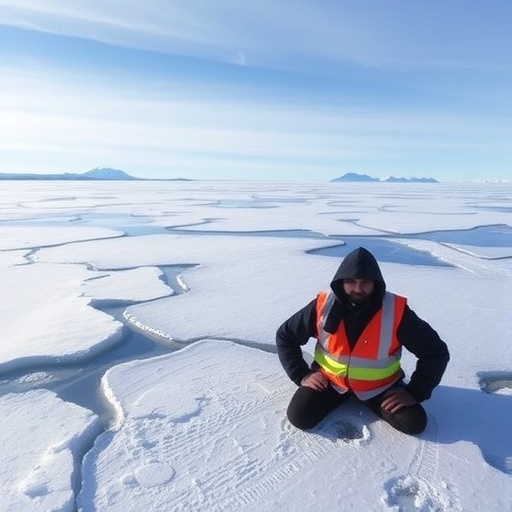
In a groundbreaking study that promises to reshape our understanding of Arctic marine ecosystems, researchers have uncovered evidence of unexpected biological productivity along the Barents Sea ice edge during the late Holocene. The investigation, led by A.J. Pieńkowski and colleagues, utilized advanced biomarker analysis to trace diatom enrichment—a key indicator of primary production—in sediment cores, revealing complex ecological dynamics that continue to defy conventional seasonal models of polar phytoplankton activity. This discovery has broad implications for climate science, marine biology, and our conceptual frameworks regarding ice-edge ecosystems in a warming Arctic.
The Barents Sea, located north of Norway and Russia, is a key region for studying the effects of climate change on Arctic environments due to its unique position between Atlantic and Arctic waters. Historically, sea ice has been understood to exert a controlling influence over the timing and intensity of phytoplankton blooms, with primary productivity peaking during the spring and early summer months as ice melts. However, the extreme late-Holocene interval analyzed in this study suggests that productivity along the ice edge may extend much later into the seasonal cycle than previously thought, indicating a previously underappreciated ecological niche.
Central to this research is the application of organic geochemical proxies, notably diatom-specific biomarkers such as highly branched isoprenoids (HBIs). These molecular fossils are derived from diatoms—microscopic photosynthetic algae—and provide a window into past productivity and environmental conditions. By examining sediment layers deposited over the last several thousand years, the team identified striking elevations in diatom biomarker concentrations during late-season periods, suggesting not only prolonged but intensified ice-edge productivity.
The implications of these findings are profound, signaling that the timing of phytoplankton blooms may have been more flexible and responsive to environmental variables over millennial timescales than contemporary observations suggest. This shifts paradigms about marine food web dynamics in polar regions, as late-season blooms could support secondary consumers such as zooplankton—and by extension, fish and marine mammals—during periods traditionally seen as low productivity. Such dynamics have likely played a crucial role in shaping Arctic biodiversity through time.
Moreover, the study highlights the interplay between sea ice extent, melt timing, and nutrient availability. While earlier models posited that retreating ice reduces habitat for ice-associated algae and thus limits productivity, these new data reveal a more nuanced picture where late-season melting creates persistent ice edges that serve as hotspots for diatom proliferation. Nutrient enrichment via upwelling and Atlantic water inflow likely contributed to sustaining this productivity, challenging assumptions about the oligotrophic nature of the late melt season.
In terms of methodology, the research exemplifies the cutting-edge integration of paleoceanography and organic geochemistry. Sediment cores were meticulously sampled and subjected to high-resolution biomarker profiling, allowing for temporal reconstructions at seasonal to decadal scales. The use of isotopic analyses further corroborated the timing of these bio-events, lending robustness to interpretations about late-season environmental conditions in the Barents Sea. This methodological sophistication underscores the potential for biomarker proxies to unlock hidden chapters of ecological history.
Notably, the timing of the extreme biomarker enrichments correlates with known climatic variability during the late Holocene, including phases of relative warming and cooling. This temporal correspondence suggests that even subtle shifts in temperature and sea ice dynamics may have orchestrated significant ecological reorganization in polar marine systems. Understanding these past responses is critical as anthropogenic warming accelerates, potentially recreating or amplifying such conditions in the near future.
From a broader perspective, the recognition of late-season ice-edge productivity has ramifications for global biogeochemical cycles. Phytoplankton are pivotal in sequestering atmospheric CO2, and extending the productive season could mean that polar oceans play a more dynamic role in the carbon cycle than appreciated. This discovery invites a reassessment of climate models that currently may underestimate the biological feedback potential of Arctic marine ecosystems during the waning ice season.
The study’s revelations also emphasize the resilience and adaptability of polar marine life. Despite harsh and fluctuating conditions, diatoms and associated microbial communities have exploited ephemeral niches, adjusting phenology and productivity patterns to optimize survival and growth. Such adaptive strategies may become increasingly important as climate perturbations continue to reshape polar habitats, with unknown consequences for ecosystem stability and services.
In practical terms, these findings could inform conservation and management strategies. As the Barents Sea and broader Arctic region become more accessible due to ice retreat, understanding seasonal productivity pulses is crucial for fisheries, indigenous communities, and environmental stewardship. Recognizing late-season productivity hotspots could guide sustainable use and protection of biologically rich zones that emerge under shifting climatic regimes.
Furthermore, this research opens new avenues for interdisciplinary collaboration, bridging paleoclimatology, marine ecology, and environmental chemistry. Future studies may leverage the biomarkers identified here to monitor contemporary changes in Arctic productivity and validate predictive models. Additionally, analogous approaches could elucidate productivity dynamics in other polar and subpolar regions, deepening our global perspective on climate-ecosystem interactions.
Given the rapidity of ongoing climatic change, the temporal insights provided by this late-Holocene study serve as a crucial baseline, contextualizing contemporary observations within a longer-term framework. This historical depth equips scientists and policymakers with a richer understanding of variability and resilience in polar systems, enhancing our capacity to anticipate and mitigate the impacts of a warming world.
In sum, the work by Pieńkowski, Belt, Husum, and their team has decisively expanded our comprehension of ice-edge ecosystems, revealing a vibrant and late-blooming diatom community thriving in conditions once thought marginal or unproductive. Their integration of molecular biomarkers and paleoenvironmental techniques creates a compelling narrative of Arctic productivity that challenges prevailing assumptions and invigorates future research paths. As the Arctic ice retreats, these insights become not only academically fascinating but vitally important for forecasting and managing the biological pulse of the planet’s coldest seas.
This landmark study stands as a testament to the power of interdisciplinary science to uncover hidden complexities within Earth’s most extreme environments, shining a light on the subtle yet dynamic rhythms of life beneath the ice. It invites a reconsideration of the Arctic not as a static frozen desert, but as a place of seasonal vibrancy and ecological innovation sustained by the delicate interplay of ice, ocean, and life.
Cite Scienmag News
Violet Maxwell. (June 20, 2026). Late-Season Ice-Edge Productivity Revealed in Barents Sea. Scienmag. https://scienmag.com/late-season-ice-edge-productivity-revealed-in-barents-sea/
Violet Maxwell. "Late-Season Ice-Edge Productivity Revealed in Barents Sea." Scienmag, 20 June 2026, https://scienmag.com/late-season-ice-edge-productivity-revealed-in-barents-sea/. Accessed 3 September 2026.
Violet Maxwell. "Late-Season Ice-Edge Productivity Revealed in Barents Sea." Scienmag. June 20, 2026. https://scienmag.com/late-season-ice-edge-productivity-revealed-in-barents-sea/


