


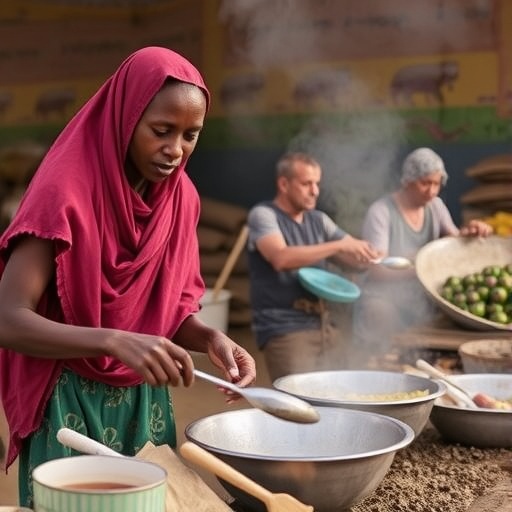
In recent years, the pressing issue of environmental sustainability has taken center stage across the globe, with particular emphasis on regions facing acute developmental and ecological challenges. Somalia, a nation historically beset by conflict and economic hardship, emerges as a potent case study in understanding how innovative approaches in energy use and financial inflows can synergistically influence ecological outcomes. New research by Hussein and Warsame, published in Scientific Reports in 2026, offers an illuminating analysis of how the adoption of clean cooking energy technologies, paired with the critical economic role of remittances, impacts Somalia’s ecological footprint in measurable ways.
Somalia’s environmental landscape is complex, marked by drought-prone land, limited infrastructure, and a reliance on biomass fuels such as charcoal and firewood for cooking and heating. These traditional practices have created intensive pressure on the country’s already fragile ecosystems, leading to increased deforestation, land degradation, and carbon emissions. The transition to clean cooking energy sources is thus not merely a technological upgrade; it represents a potential paradigm shift towards substantially reducing environmental harm. Hussein and Warsame’s study provides a detailed evaluation of how this transition, supported by economic inflows from abroad in the form of remittances, influences Somalia’s environmental sustainability trajectory.
Clean cooking energy technology largely encompasses alternatives such as liquefied petroleum gas (LPG), solar cookers, improved biomass stoves, and biogas systems. These technologies are designed to burn fuel more efficiently or switch to renewable energy sources, thereby reducing particulate matter emissions and carbon footprints. According to the research, the adoption of these technologies in Somali households correlates with a marked decrease in health hazards associated with indoor air pollution as well as a diminution in the rate of deforestation. The shift alleviates the ecological strain imposed by traditional fuel use, contributing significantly to sustainability goals.
Remittances, financial resources sent from the Somali diaspora to families in the home country, play a critical role in enabling the adoption of clean cooking technologies. Hussein and Warsame emphasize the economic empowerment remittances provide, facilitating investments in household technology that may otherwise be unattainable due to poverty. This link between remittance flows and environmental improvement is a novel concept, highlighting a socio-economic mechanism that can drive sustainable development in fragile states. The paper’s data-driven insights suggest that remittance-receiving households are substantially more likely to invest in clean energy solutions, thus mitigating their ecological footprint.
From a technical standpoint, understanding the ecological footprint encompasses measuring the aggregate environmental impacts of resource consumption and waste generation. Hussein and Warsame utilize a rigorous methodology incorporating both satellite data on environmental degradation and household-level survey data. This mixed-method approach enables a nuanced understanding of how macroeconomic factors, like remittances, intersect with micro-level behavioral changes relating to energy use. Their results demonstrate a statistically significant reduction in per capita ecological footprints within communities with higher access to clean cooking energy, amplified by remittance income.
One of the pivotal challenges outlined in the study is the availability and affordability of clean cooking technologies in Somalia. Market constraints, supply chain issues, and political instability present formidable barriers. Yet, the data reveal a growing acceptance and preference for cleaner energy amid urban and semi-urban populations. The research advocates for policy frameworks that bolster supply networks, subsidize initial costs, and encourage innovations tailored to local contexts. These technical and economic interventions could serve as blueprints for other nations grappling with similar environmental and social dynamics.
The implications of this research extend beyond Somalia’s borders, illuminating a model where socio-economic and technological factors combine to create pathways toward sustainability in developing regions. Hussein and Warsame argue for an integrated approach that treats environmental issues not in isolation but as interconnected with economic livelihoods and social structures. The nexus of remittances and clean energy adoption is a critical finding, emphasizing how diaspora networks act as agents of sustainable change, channeling not only money but also knowledge and technology.
Importantly, the study also engages with the gender dimension of clean cooking energy adoption. Women, who traditionally bear the brunt of household cooking duties, stand to benefit significantly from cleaner cooking options through reduced exposure to hazardous smoke and the alleviation of labor associated with fuel collection. Remittances contribute here as well by enabling women’s access to these technologies, thus improving health outcomes and catalyzing broader social empowerment. This multifaceted impact underscores the intersectionality of environmental and social sustainability.
In terms of ecological metrics, Hussein and Warsame’s quantitative assessment captures reductions across several dimensions—carbon emissions, land use change, and biodiversity loss. Cleaner cooking energy reduces carbon monoxide, methane, and particulate emissions, all major contributors to climate change and respiratory illnesses. Reduced reliance on charcoal extraction leads to forest conservation, mitigating soil erosion and preserving biodiversity hotspots. This suite of environmental benefits is critical in a region frequently vulnerable to climate-induced shocks.
The technical backbone of this research includes the use of geospatial analysis to monitor environmental degradation patterns over time, coupled with econometric modeling to parse out the specific impacts of remittances and energy adoption on ecological footprints. This fusion of environmental science and economic analysis is innovative and critical for policy makers to design targeted interventions. The data sets employed are unique, combining remote sensing with social surveys to provide a holistic picture rarely captured in similar studies.
The ripple effects of these findings also touch on Somalia’s energy policy landscape. The government, alongside international donors and NGOs, is increasingly oriented towards promoting renewable energy uptake and sustainable development under the country’s national strategy frameworks. Hussein and Warsame’s research offers empirical backing to these initiatives by quantifying the environmental returns on investment in clean cooking infrastructure and diaspora engagement. Their work strengthens the case for scaling such interventions in fragile socio-political environments.
Furthermore, the research addresses challenges in ensuring long-term sustainability and scalability of clean cooking energy interventions. While initial uptake driven by remittance income is promising, the study highlights potential risks including reliance on imported fuels like LPG and fluctuations in remittance flows due to global economic shifts. The authors suggest that a diversified energy strategy encompassing solar, biogas, and locally sourced renewable fuels could foster resilience and greater ecological benefits in the long run.
This study also contributes to the ongoing discourse on global climate justice by contextualizing Somalia’s environmental challenges within historical inequalities and economic constraints. The authors argue that international cooperation and climate financing mechanisms should recognize the role of diaspora remittances as an informal yet powerful climate action enabler. Harnessing this dynamic could complement formal climate aid and investment, thereby enabling countries like Somalia to leapfrog to cleaner energy futures.
Critically, this pioneering research underscores the necessity for interdisciplinary approaches to tackle environmental sustainability. Combining technological innovation, economic flows, social behavior, and environmental assessment produces a robust analytical framework. This holistic perspective is essential to unravel the complexities faced by developing nations, where environmental degradation is often intertwined with economic vulnerability and political instability.
In conclusion, Hussein and Warsame’s 2026 publication in Scientific Reports offers a compelling narrative on how clean cooking energy and remittances jointly influence Somalia’s ecological footprint, presenting a replicable model for sustainability in resource-constrained settings. Their work pushes forward the agenda on integrating socio-economic factors with environmental technology adoption, providing a roadmap for future research, policy development, and international cooperation. As nations worldwide strive toward the Sustainable Development Goals, insights from Somalia remind us that innovative pathways can emerge even in the most challenging contexts, driven by the interplay of technology, finance, and social capital.
Cite Scienmag News
Faith Mcneil. (June 20, 2026). Clean Cooking and Remittances Slash Somalia’s Ecological Footprints. Scienmag. https://scienmag.com/clean-cooking-and-remittances-slash-somalias-ecological-footprints/
Faith Mcneil. "Clean Cooking and Remittances Slash Somalia’s Ecological Footprints." Scienmag, 20 June 2026, https://scienmag.com/clean-cooking-and-remittances-slash-somalias-ecological-footprints/. Accessed 4 September 2026.
Faith Mcneil. "Clean Cooking and Remittances Slash Somalia’s Ecological Footprints." Scienmag. June 20, 2026. https://scienmag.com/clean-cooking-and-remittances-slash-somalias-ecological-footprints/


