


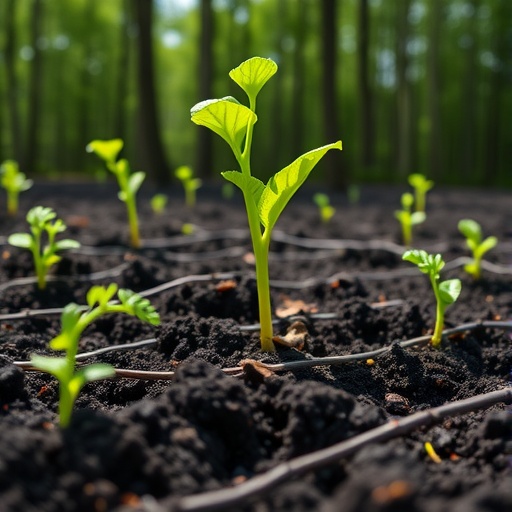
In the urgent search for innovative strategies to mitigate climate change, biochar—an organic carbon-rich charcoal-like material derived from biomass—has emerged as a compelling tool for enhancing soil carbon sequestration in agricultural landscapes. Despite longstanding recognition of biochar’s ability to improve soil properties and capture atmospheric carbon dioxide, the complex microbial processes mediating its long-term efficacy in stabilizing soil organic carbon (SOC) remain elusive. Recent groundbreaking meta-analytical research led by scientists at Northwest A&F University has provided unprecedented insight into these microbial mechanisms, offering a spatially-resolved, data-intensive assessment of biochar’s impact on carbon cycling dynamics across China’s diverse croplands.
This comprehensive study synthesizes data from 90 independent investigations, amassing 392 observations and over 2,600 datapoints related to soil organic carbon content and microbial community composition under biochar amendments. By leveraging advanced linear mixed-effects modeling combined with geographical data integration, the researchers achieved robust spatial predictions of SOC sequestration across heterogeneous agroecosystems. Their approach underscores how biochar interacts dynamically with soil microbiota, altering community structure and function in ways that critically govern net carbon retention and turnover.
Quantitatively, the study estimates a substantial national-scale cumulative increase in SOC stocks by approximately 128.9 teragrams of carbon (Tg C), equating to an average yearly sequestration of 0.42 megagrams of carbon per hectare. However, these gains exhibit pronounced spatial heterogeneity, with Northeast, Northwest, and Southwest China identified as hotspots of enhanced carbon accrual following biochar application. Such regional variation reflects underlying differences in soil characteristics, climatic conditions, and microbial ecologies, revealing the necessity for region-specific management regimes.
At the heart of this breakthrough is the revelation that microbial trophic strategies critically modulate biochar’s carbon sequestration potential. Initially, biochar amendments stimulate copiotrophic microorganisms adept at exploiting nutrient-rich conditions, driving rapid carbon accumulation through efficient utilization of labile organic substrates. Over time, however, the microbial community composition shifts towards oligotrophic taxa, which are adapted to nutrient-poor environments and specialize in breaking down more recalcitrant organic matter fractions. This successional transition results in diminished carbon use efficiency, reducing the net SOC sequestration capacity of treated soils.
The temporal dynamics and dosage dependence of microbial responses underscore the importance of finely-tuned biochar management protocols. Contrary to intuitive expectations, increasing biochar application rates beyond moderate levels does not proportionally amplify carbon storage benefits. Instead, excessive biochar inputs can trigger adverse shifts in microbial communities, accelerating decomposition processes that counteract carbon retention. The research therefore advocates for a balanced application strategy that maximizes initial carbon gains by fostering copiotrophic activity while restraining the eventual proliferation of oligotrophic degraders.
Furthermore, croplands in humid and acidic coastal zones, characterized by inherently weaker SOC responses to biochar, may derive added benefits from integrative soil amendments. Co-application of liming agents or targeted nutrient supplementation alongside biochar can modify soil chemical conditions, thereby promoting favorable microbial activity and enhancing overall sequestration efficacy. This highlights the necessity of adopting site-specific, multi-faceted soil management practices tailored to the unique edaphic and microbial contexts of different agroecosystems.
While illuminating, the study acknowledges several avenues for deeper inquiry to refine understanding and optimize biochar deployment. Existing projections primarily account for singular biochar applications and the uppermost 15 cm of soil, omitting potential cumulative effects of repeated amendments or carbon dynamics in subsoil horizons. Additionally, taxonomic resolution at the phylum level may mask finer-scale functional variation among microbial taxa, limiting the precision of ecological inferences. Future research integrating repeated application regimes, vertical soil profiling, and molecular techniques resolving microbial functions at strain or gene-level resolution promises to enrich mechanistic insights.
The meticulous synthesis conducted by this research team signifies a paradigm shift in conceptualizing soil carbon sequestration through biochar. It vividly illustrates that the efficacy of biochar is inherently intertwined with the hidden, complex ecology of soil microbial communities rather than constituting a simple additive carbon reservoir. Such knowledge empowers the design of precision soil amendments that harness microbial functionality to achieve longer-lasting carbon stabilization and improved agroecosystem health.
In the words of lead corresponding author Lei Deng from Northwest A&F University, “Our analysis reveals that the true potential of biochar for carbon sequestration is intrinsically linked to the hidden world of soil microbes. By understanding how these tiny organisms respond to biochar, we can design more effective, region-specific strategies to lock away carbon and build healthier agricultural soils for the future.” This perspective vividly underscores the promising convergence of biogeochemistry, microbial ecology, and agricultural engineering in combating global climate challenges.
This study not only advances scientific understanding but also has profound practical significance for sustainable agriculture and climate mitigation policy. The spatially-stratified findings enable policymakers and practitioners to prioritize biochar applications in high-return regions while adopting adaptive strategies in more refractory areas. Moreover, the elucidation of microbial successions offers a biological basis for optimizing amendment timing and dose, preventing counterproductive outcomes. Ultimately, integrating these biogeochemical insights into landscape-level management frameworks could unlock vast untapped potentials for mitigating atmospheric CO2 accumulation.
By bridging experimental data from diverse ecological contexts with rigorous statistical modeling and microbial ecological theory, this research sets a new standard for evaluating biochar’s environmental performance. It highlights the indispensable role of soil microorganisms as both mediators and indicators of sustainable soil carbon storage. As attention intensifies on nature-based solutions for climate resilience, harnessing the synergistic interplay between biochar and soil microbiomes emerges as a cornerstone of effective carbon farming.
Future investigations expanding on this foundation should prioritize high-resolution microbial functional profiling, examining synergistic amendment combinations, and assessing multi-year field trials encompassing deeper soil layers. Such multidimensional research will provide a more granular understanding of microbial carbon turnover mechanisms and their modulation by biochar characteristics under real-world conditions. Enhanced predictive models integrating these biological parameters will refine global carbon budgeting and bolster evidence-based land management decisions.
In summary, this meta-analytical work delivers compelling evidence that while biochar is a promising tool for augmenting soil carbon storage, its long-term efficacy depends fundamentally on complex, time-dependent microbial community dynamics. Intelligent, region-specific, and moderate biochar application schemes harnessing these microbial processes offer the best pathway to durable carbon sequestration and improved soil fertility. This microbial lens reshapes our approach to deploying biochar in climate-smart agriculture and underscores the profound interconnectedness of microbial ecology and global carbon management.
News Publication Date: June 16, 2026
Web References: https://doi.org/10.1007/s44246-026-00273-5
Cite Scienmag News
Alan Morgan. (June 17, 2026). Harnessing Microbes: Unlocking Sustainable Carbon Storage in Farmland with Biochar. Scienmag. https://scienmag.com/harnessing-microbes-unlocking-sustainable-carbon-storage-in-farmland-with-biochar/
Alan Morgan. "Harnessing Microbes: Unlocking Sustainable Carbon Storage in Farmland with Biochar." Scienmag, 17 June 2026, https://scienmag.com/harnessing-microbes-unlocking-sustainable-carbon-storage-in-farmland-with-biochar/. Accessed 4 September 2026.
Alan Morgan. "Harnessing Microbes: Unlocking Sustainable Carbon Storage in Farmland with Biochar." Scienmag. June 17, 2026. https://scienmag.com/harnessing-microbes-unlocking-sustainable-carbon-storage-in-farmland-with-biochar/


