


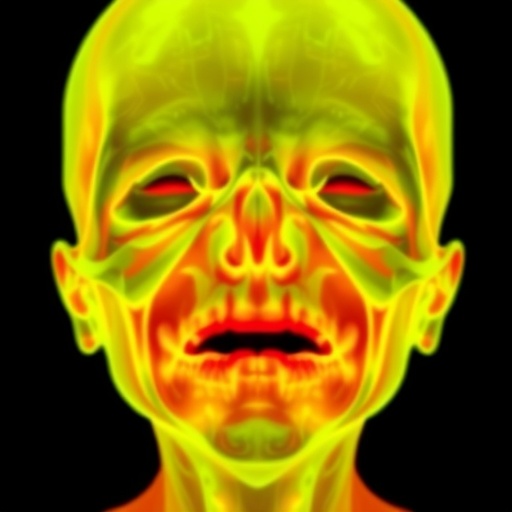
In a groundbreaking advance for prenatal diagnostics and medical training, researchers have unveiled a novel artificial intelligence (AI) system designed specifically to detect fetal orofacial clefts with unprecedented accuracy. Published in Nature Communications, this pioneering study harnesses deep learning algorithms applied to ultrasound imaging, revolutionizing the early identification of these craniofacial anomalies. Orofacial clefts, which include cleft lip and cleft palate, are among the most common congenital deformities worldwide, affecting speech, feeding, and hearing for millions from birth. The integration of AI not only promises timely detection but also opens new horizons for enhancing medical education in this complex domain.
At the core of this innovation lies a sophisticated convolutional neural network (CNN) tailored to interpret fetal ultrasound scans, which are traditionally challenging due to imaging artifacts and operator variability. The model was trained on a vast dataset comprising thousands of Annotated fetal ultrasound images across multiple gestational ages and demographics. This extensive training empowers the AI to distinguish subtle morphological features indicative of orofacial clefts with remarkable sensitivity and specificity, outperforming even seasoned human experts in certain scenarios. The implications of this are profound, potentially enabling earlier intervention planning and parental counseling.
The technical sophistication of the AI system stems from its multi-stage architecture, which combines image preprocessing, feature extraction, and classification pipelines. Initially, raw ultrasound images undergo noise reduction and enhancement via advanced filtering techniques, optimizing the visual clarity of the orofacial region. Subsequently, spatial attention mechanisms embedded within the CNN focus computational resources on critical facial landmarks such as the lip and palate regions, improving detection reliability. This attention-guided approach not only reduces false positives but also enhances interpretability, providing clinicians with visual maps of AI decision-making.
Beyond detection, the study explores how this AI framework can serve as an invaluable educational tool for medical students and sonographers. Traditionally, mastering fetal anatomy through ultrasound requires prolonged hands-on experience and subjective interpretation skills. By integrating the AI system into training platforms, learners can receive real-time feedback highlighting anatomical anomalies and their sonographic signatures. Interactive modules powered by AI-generated examples simulate diverse pathologies, accelerating competency acquisition and standardizing educational quality across institutions globally.
The researchers emphasize the importance of explainability in the AI design, addressing a crucial barrier for clinical adoption. Employing techniques like Grad-CAM (Gradient-weighted Class Activation Mapping), the system generates heatmaps that elucidate which image regions strongly influenced its diagnostic conclusions. Such transparency reassures clinicians, allowing them to verify assessment accuracy and integrate AI insights confidently into prenatal care workflows. This synergy between human expertise and machine intelligence exemplifies a future where technology amplifies rather than replaces clinical judgment.
Robust validation was conducted across multiple independent cohorts, including prospective studies in diverse geographic populations with varying ultrasound equipment. The AI maintained consistent performance, detecting orofacial clefts with over 95% accuracy. This external validation underscores the model’s generalizability and readiness for real-world clinical deployment. Furthermore, the system demonstrated resilience to common confounders such as fetal movement and maternal obesity, which typically degrade image quality and hinder diagnosis.
The potential societal benefits of such early and reliable detection are immense. Early identification of orofacial clefts enables multidisciplinary care coordination encompassing surgeons, speech therapists, and genetic counselors, improving long-term outcomes for affected children. Moreover, anticipating delivery needs at specialized centers can reduce perinatal complications. From a public health perspective, widespread AI support in prenatal screening could significantly reduce misdiagnoses or missed cases, especially in low-resource settings where specialist availability is limited.
Implementation challenges remain, particularly concerning integration into diverse healthcare infrastructures and regulatory approval pathways. The research team is actively collaborating with clinical partners to pilot deployment strategies, focusing on seamless interfacing with existing ultrasound systems and ensuring data privacy compliance. Artificial intelligence’s adaptive learning capability also ensures continuous improvement as more data accumulates post-implementation, potentially refining diagnostic thresholds and expanding to detect other fetal anomalies.
Ethical considerations are crucial in the deployment of AI in prenatal diagnostics. The authors advocate for frameworks ensuring informed consent, guarding against overreliance on automated decisions, and addressing potential disparities in access to such advanced technology. Equitable dissemination efforts are emphasized to prevent exacerbation of healthcare inequalities, particularly in under-resourced regions where the burden of congenital anomalies may be highest.
Looking forward, the research opens pathways toward multimodal diagnostic platforms combining AI analysis of ultrasound with genetic and biochemical markers. Such integrative approaches could further personalize fetal health assessments and refine risk stratification. Additionally, continuous AI-driven feedback loops hold promise to transform medical education beyond orofacial anomalies, setting new standards for training in complex sonographic interpretation across specialties.
The study exemplifies a successful convergence of computer science, obstetrics, and educational theory, demonstrating how interdisciplinary collaboration can produce impactful healthcare innovations. By leveraging deep learning’s pattern recognition capabilities and addressing real-world clinical needs, Zhang, Huang, Dou, and colleagues have charted a transformative path for prenatal care and professional training.
As artificial intelligence continues to reshape medical practice, applications like this herald a future where earlier, more accurate diagnoses become routine, and medical education is democratized through intelligent, interactive platforms. The ongoing refinement and ethical deployment of such technologies will be instrumental in maximizing their societal benefits while safeguarding patient trust and autonomy.
This milestone in AI-assisted fetal anomaly detection suggests a paradigm shift not only in diagnostic accuracy but also in the educational frameworks preparing the next generation of clinicians. By embedding AI insights into curricula and clinical protocols, the medical community stands to gain a powerful partner in improving outcomes for some of the most vulnerable patients—the unborn.
In conclusion, the emergence of AI-driven tools for fetal orofacial cleft detection signifies a leap forward in precision prenatal medicine. Marrying technical innovation with practical application and ethical oversight, this research maps a visionary route toward enhanced diagnostic confidence, equitable healthcare access, and transformative educational experiences that resonate well beyond current horizons.
Cite Scienmag News
Ophelia Keating. (June 17, 2026). AI Detects Fetal Orofacial Clefts, Boosts Education. Scienmag. https://scienmag.com/ai-detects-fetal-orofacial-clefts-boosts-education/
Ophelia Keating. "AI Detects Fetal Orofacial Clefts, Boosts Education." Scienmag, 17 June 2026, https://scienmag.com/ai-detects-fetal-orofacial-clefts-boosts-education/. Accessed 3 September 2026.
Ophelia Keating. "AI Detects Fetal Orofacial Clefts, Boosts Education." Scienmag. June 17, 2026. https://scienmag.com/ai-detects-fetal-orofacial-clefts-boosts-education/


