


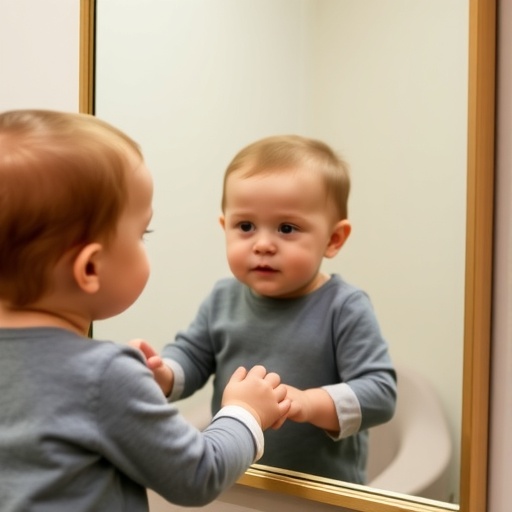
A groundbreaking study led by Dr. Carina de Klerk at the University of Essex has revealed compelling insights into early infancy social cognition, specifically addressing how exposure to one’s own reflection can influence neural mechanisms involved in facial mimicry. Facial mimicry—an unconscious, spontaneous process where individuals replicate others’ facial expressions—is a cornerstone of social bonding, emotional recognition, and empathy. Despite the psychological importance of mimicry, its developmental trajectory and underlying neural substrates in infancy have remained elusive until now.
The research focused on four-month-old infants, a critical period when sensorimotor development swiftly advances. Previous debates have cast two contrasting views: one school arguing that the ability to link observation with action is innate and observable from birth, and the other proposing that sensorimotor experience, accumulated through interaction with the environment—including the infant’s own body and reflection—gradually shapes this ability. Dr. de Klerk’s team sought to directly test the latter hypothesis by investigating if controlled exposure to mirrors, thereby allowing infants to see themselves, can modulate facial mimicry development.
To probe this, the study enrolled infants around the age of 120 days and divided them into two groups over a two-week experimental window. One group was given a toy embedded with a small mirror providing daily opportunities for self-observation. In contrast, the control group received the same toy but without the mirror, effectively controlling for general toy interaction effects. The design meticulously ensured that the only variable differing between groups was visual self-exposure, thus isolating the sensorimotor experiential component hypothesized to affect early social processing.
Neural and behavioral responses were assessed both before and after this intervention. Infants were shown videos of other babies making distinct facial expressions while the researchers collected neurophysiological data using electroencephalography (EEG), capturing sensorimotor cortex activity, and electromyography (EMG), measuring subtle facial muscle activation to detect mimicry on a micro-behavioral level. This multimodal measurement approach allowed the team to precisely map both brain activity and behavioral output in relation to facial expression observation.
The results unveiled a fascinating dissociation. Infants who had mirror exposure demonstrated a significant increase in sensorimotor cortex activation, especially localized to the right hemisphere region associated with facial representation. This suggests that seeing their own facial movements augmented the connectivity or sensitivity of neural circuits involved in mapping observed actions to motor outputs, a fundamental mechanism supporting social cognition. This neural potentiation illustrates how even simple sensorimotor experiences can scaffold brain systems critical for understanding others’ behavior.
However, intriguingly, this enhanced cortical activation did not correspond to a measurable increase in actual facial mimicry behaviors as assessed by EMG. The infants did not show greater overt facial copying of observed expressions after the mirror exposure period. This finding challenges simplistic assumptions that neural readiness or increased cortical activity immediately results in overt behavioral changes, highlighting that early behavioral expressions of mimicry might require longer periods of learning or maturation.
This dissociation sheds light on the complexity of early infant social learning. While foundational neural mechanisms become attuned through sensorimotor experience, the observable behavioral manifestations of social mimicry likely emerge later as neural changes consolidate and interact with broader developmental processes, including motor control refinement, attentional systems, and perhaps social motivation. The implication is that brain development and social experience operate on staggered timescales, with neural adaptations potentially preceding and enabling subsequent behavioral phenomena.
Beyond advancing theoretical understanding, the study carries profound implications for developmental psychology and neuroscience. It underscores the plasticity of the infant brain and highlights the importance of self-perception and sensorimotor feedback in shaping the social brain. This aligns with embodied cognition frameworks positing that experience with one’s own body informs the understanding of others through shared neural representations, a perspective gaining traction across multiple disciplines.
Moreover, the selective activation observed primarily in the right hemisphere’s facial representation area invites further investigations into hemispheric specialization in infancy. The right hemisphere’s dominance in social and emotional processing in adults suggests that this lateralization might be evident very early, modifiable by experiential factors like mirror exposure, and foundational for empathy and face perception networks.
In practical terms, the findings suggest that everyday activities, such as allowing infants to observe themselves in mirrors or reflective surfaces, could subtly enhance neural pathways underpinning social cognition. This opens avenues for early interventions, especially for populations at risk of social developmental disorders, where sensorimotor experiences might be leveraged to promote healthy social brain development.
Despite these advances, the study also illustrates the challenges inherent in linking brain activation patterns directly to complex behaviors in infants. Facial mimicry itself is intricate, encompassing subtle motor components and situational influences. Therefore, the absence of behavior change after just two weeks of mirror exposure may reflect the need for extended timeframes or additional sensory inputs—such as tactile or interactive social experiences—to translate neural plasticity into observable mimicry.
Future research directions should explore longitudinal designs that track infants over longer periods, integrating neuroimaging, behavioral assays, and perhaps genetic or environmental modulators to fully unravel how sensorimotor experiences sculpt the emergent social brain. Additionally, expanding the scope to different age ranges and diverse cultural settings could elucidate universal versus experience-dependent aspects of facial mimicry development.
Dr. Carina de Klerk emphasizes the significance of these findings by noting how early sensorimotor experiences, even as mundane as seeing one’s own reflection, contribute to shaping the neural architecture underlying social perception. This reveals a remarkable sensitivity of the infant brain to its environment and suggests that the roots of empathy and social understanding are laid down in the interplay between action and perception from an astonishingly young age.
In conclusion, this study marks a pivotal step in decoding the neural and experiential underpinnings of facial mimicry, a vital social skill nurturing empathy and communication. While the enhanced sensorimotor cortex activation following mirror exposure highlights the brain’s adaptability, translating this readiness into behavioral mimicry demands further developmental unfolding. Through this nuanced understanding, researchers edge closer to unraveling the complex tapestry weaving early experience, brain function, and social behavior in human infancy.
News Publication Date: 10-May-2026
Web References:
https://onlinelibrary.wiley.com/doi/10.1111/desc.70221
References:
De Klerk, C., et al. (2026). Two Weeks of Mirror Exposure Enhances Sensorimotor Cortex Activation but not Facial Mimicry in 4-Month-old Infants. Developmental Science, DOI: 10.1111/desc.70221
Cite Scienmag News
Courtney Benton. (June 17, 2026). Can Mirror Recognition Aid Babies in Imitating Others? Scienmag. https://scienmag.com/can-mirror-recognition-aid-babies-in-imitating-others/
Courtney Benton. "Can Mirror Recognition Aid Babies in Imitating Others?" Scienmag, 17 June 2026, https://scienmag.com/can-mirror-recognition-aid-babies-in-imitating-others/. Accessed 4 September 2026.
Courtney Benton. "Can Mirror Recognition Aid Babies in Imitating Others?" Scienmag. June 17, 2026. https://scienmag.com/can-mirror-recognition-aid-babies-in-imitating-others/


