


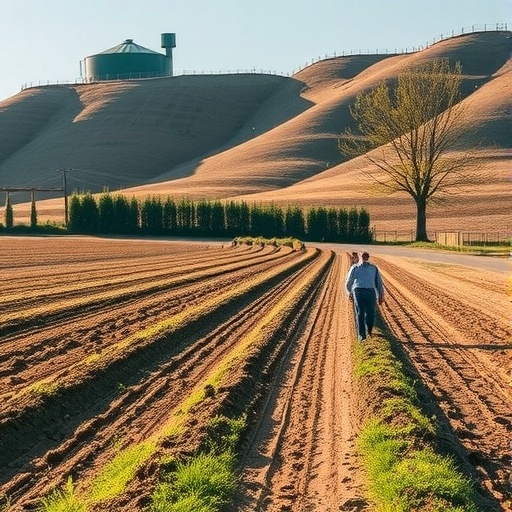
As global urbanization escalates, its impact on surrounding periurban croplands has become a focal point for understanding the future of agricultural productivity amidst shifting climate paradigms. A groundbreaking investigation by Liu, Duan, Min, and colleagues, published in Nature Food, elucidates how micro-scale interactions at the edges of cropland parcels profoundly influence the resilience and vulnerability of agricultural landscapes to extreme hydrological events, such as droughts. This research brings to light mechanisms that could redefine adaptive land management strategies crucial for sustaining food production in an era marked by increasing climate unpredictability.
Periurban croplands, situated at the interface between expanding urban areas and rural landscapes, are undergoing rapid fragmentation due to urban sprawl. This fragmentation increases the ratio of cropland edges—margins where agricultural fields meet non-cultivated or urban land. Such boundaries are hotspots of anthropogenic disturbance, altering microclimatic conditions and ecosystem dynamics. Liu et al. pinpointed these edge zones as critical nodes that amplify climatic stressors, especially during extremely dry events, making them crucial targets for intervention to safeguard productivity.
The study employs a high-resolution modeling framework combined with a robust vulnerability–resilience assessment, enabling researchers to quantify how changes in cropland edge structures modulate the response of crop yields to climate extremes. A key finding reveals a nearly one-to-one association between increases in edge ratios and heightened vulnerability: specifically, a single standard deviation increase in cropland edge ratio corresponded to a 0.981 standard deviation rise in log-transformed vulnerability to drought conditions. This quantitatively illustrates how expanding edge effects exacerbate susceptibility to dryness, thereby threatening the stability of food supplies.
Conversely, the presence and expansion of ecological buffer zones—areas of natural or semi-natural vegetation adjacent to croplands—demonstrably enhance resilience. These buffer zones act as environmental shock absorbers, mitigating microclimatic extremes and supporting beneficial ecological processes such as soil moisture retention and pollinator support. The study found that augmenting the ecological buffer zone ratio by one standard deviation led to a remarkable 3.165 standard deviation improvement in resilience, underscoring the buffer’s potent protective role against hydrological stress.
Such findings propelled the research team to explore adaptive strategies through counterfactual simulations. Two distinct pathways emerged: one focused on reducing cropland edge ratios by consolidating fragmented fields, thereby minimizing exposure to damaging edge effects; the other involved expanding ecological buffer zones to strengthen natural defenses and enhance landscape heterogeneity. These strategies were assessed under diverse future socio-economic and climate scenarios, integrating Shared Socioeconomic Pathways (SSP) and Representative Concentration Pathways (RCP) to model plausible trajectories to 2060.
Results from these scenario analyses highlight the efficacy of edge reduction strategies in consistently decreasing the extent of cropland edge exposure by around 36% across all SSP–RCP projections. Such a reduction would substantially limit the vulnerability kernel associated with fragmented cropland margins. In parallel, buffer zone expansion strategies projected a 12–15% increase in ecological buffer areas, offering a complementary pathway to bolster landscape-level resilience by fostering biodiversity, improving water retention, and stabilizing microclimates.
This dual-pathway adaptive framework provides a mechanistic understanding of how land management at the micro-scale can cascade into macro-scale improvements in agricultural resilience. It also aligns with global imperatives to enhance sustainability and food security under the looming threat of climate extremes. By strategically managing cropland perimeters—either by reshaping land parcels or enriching natural buffers—farmers and policymakers can unlock synergistic benefits that buffer crops against drought shocks.
Underlying these outcomes are intricate microclimatic interactions at cropland edges, where factors such as wind patterns, solar radiation flux, soil moisture gradients, and biotic interactions converge to influence crop stress responses. The intensified exposure to urban heat island effects and pollution at edges further compounds this vulnerability, making the management of periurban fields especially crucial. This nuanced ecological perspective calls for integrated land use planning that considers both spatial configuration and ecological functionality.
Moreover, the ecological buffer zones highlighted in the study are not simply physical space fillers; they function as dynamic ecological corridors that foster species movement, carbon sequestration, and nutrient cycling. Their ability to modulate hydrological cycles by intercepting runoff and enhancing infiltration underscores their multifaceted role in mediating landscape vulnerability. Such multifunctionality positions buffer zones as vital instruments for climate adaptation and biodiversity conservation simultaneously.
Importantly, the study’s reliance on a log-transformed vulnerability metric allows for more sensitive detection of nonlinear responses to drought stress, capturing subtle thresholds beyond which cropland productivity may decline precipitously. This quantitative rigor facilitates informed decision-making by revealing leverage points where incremental land management changes can yield outsized resilience dividends.
The multi-scenario approach adopted by Liu and colleagues also emphasizes the interplay between socio-economic development pathways and climate trajectories. It highlights that adaptive gains from edge management are achievable even under high-emission scenarios, suggesting that land management interventions could serve as robust components of climate resilience portfolios independent of global mitigation success.
By illuminating the critical role of micro-scale landscape configuration, this research offers a paradigm shift away from solely crop-centric adaptation strategies toward landscape-centric frameworks. This holistic vision integrates land tenure consolidation, periurban planning, and ecological conservation as interconnected levers shaping agricultural futures.
The implications extend beyond periurban zones. Rural agricultural landscapes, increasingly vulnerable to climate extremes worldwide, may equally benefit from targeted edge management and ecological buffering, tailored to local contexts. Consequently, these insights may catalyze a broader movement toward micro-scale ecological engineering as a foundation of climate-smart agriculture.
This investigation also underscores the value of high-resolution land use data and modeling tools in unraveling complex human–environment interactions at scales relevant to on-the-ground management. Such methodological advances are critical as agriculture faces converging challenges of climate disruption, urban growth, and ecosystem degradation.
Ultimately, the work by Liu et al. charts a scientifically rigorous and ecologically sound roadmap for enhancing cropland adaptability to extreme dryness—a core component of future-proofing global food systems. By harnessing the spatial configuration of croplands and embedding ecological buffers at critical edges, it is possible to attenuate climatic impacts and sustain productivity in an increasingly uncertain world.
As policymakers and farmers grapple with the challenges of a rapidly changing planet, this research provides clear, actionable pathways grounded in empirical evidence and advanced modeling. It invites a reconceptualization of agricultural land management, recognizing that resilience is as much about spatial dynamics and ecological integration as it is about crop genetics or irrigation technology.
In conclusion, the synergistic potential of reducing cropland edge ratios while expanding ecological buffer zones offers a compelling adaptive strategy. It not only mitigates direct climatic stress but also enhances the broader agroecosystem services essential for sustainable productivity. The insights from Liu and colleagues’ work thus represent a pivotal step forward in landscape-based adaptation science, informing future interventions that reconcile urban expansion with agricultural resilience.
Cite Scienmag News
Alan Morgan. (June 17, 2026). Cropland Edge Management Boosts Drought Resilience. Scienmag. https://scienmag.com/cropland-edge-management-boosts-drought-resilience/
Alan Morgan. "Cropland Edge Management Boosts Drought Resilience." Scienmag, 17 June 2026, https://scienmag.com/cropland-edge-management-boosts-drought-resilience/. Accessed 5 September 2026.
Alan Morgan. "Cropland Edge Management Boosts Drought Resilience." Scienmag. June 17, 2026. https://scienmag.com/cropland-edge-management-boosts-drought-resilience/


