


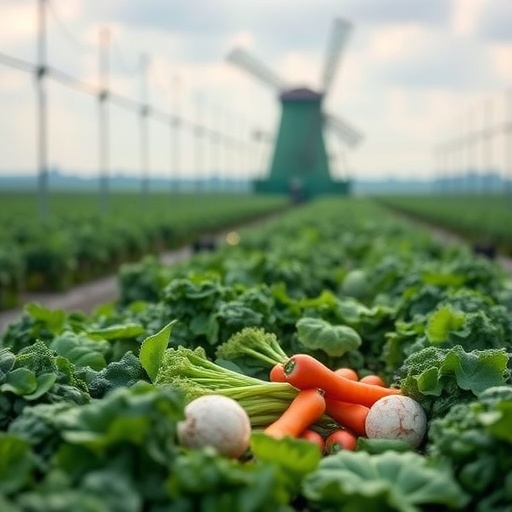
The Netherlands, often heralded as a global agricultural powerhouse, has for decades positioned itself as a key player in feeding the world through its robust export-oriented farming sector. This self-portrayal has been a cornerstone of the nation’s agricultural identity, with expansive trade networks dispersing Dutch-produced food worldwide. However, emerging research now casts doubt on this narrative, revealing that the country’s capacity for net agricultural exports is far more constrained than widely believed when considering ecological sustainability and domestic consumption needs.
Recent research published in Nature Food employs an agroecological food system model to assess the Netherlands’ real potential to export food without compromising local food security and environmental integrity. The study meticulously integrates land use, dietary patterns, and ecological conservation into its analyses, offering a multifaceted view that challenges the simplistic economic argument of the Netherlands as a net global feeder. The findings indicate a sobering reality: producing the food groups currently consumed domestically demands virtually all of the country’s agricultural land.
This revelation calls into question the long-held belief that the Netherlands can sustain its influential export role without significant trade-offs. The study emphasizes that if the country prioritizes not only feeding its own population but also ecosystem resilience and the emerging bioeconomy, the capacity to export surplus food diminishes drastically. Thus, the Netherlands’ ‘feeding the world’ storyline emerges as an economic construct that may overlook vital ecological and social considerations.
A key component of the study’s methodology lies in its agroecological modeling approach, which simulates food production under multiple scenarios of domestic dietary shifts and land allocation strategies. For instance, the model evaluates outcomes under current meat and dairy consumption levels as well as more plant-based dietary regimes advocated for health and environmental sustainability. Even when assuming significant reductions in animal product consumption, the findings suggest that land resources remain just barely sufficient to meet domestic needs, leaving little room for export.
This outcome draws attention to the complex interplay between diet, land use, and environmental stewardship. The researchers argue that improving agricultural sustainability in the Netherlands extends beyond tweaking production methods or intensifying output; it demands a holistic reevaluation of consumption patterns and rural land management. The push towards plant-forward diets aligns with global sustainability goals, yet even such shifts present challenging trade-offs when coupled with ecological restoration objectives.
Moreover, the study highlights the necessity of incorporating ecosystem strengthening into the nation’s food system paradigm. With mounting pressures from biodiversity loss, soil degradation, and climate change, prioritizing natural ecosystems becomes imperative. This ecological imperative constrains the agricultural land base further, limiting the scope for both intensive farming and export-oriented production.
In parallel, the urgency to foster a biobased economy, which relies on biological resources for sustainable industrial applications, places additional demands on land use. Balancing the needs of food production with space for bioeconomic innovation introduces yet another layer of complexity in national land management strategies. The study’s integrative model accounts for this by allocating land not just to food crops but also to biomass production for materials and energy, further squeezing available land for agricultural exports.
These intertwined challenges illuminate the limitations embedded in framing the Netherlands solely as a global food supplier. The economic narrative, while compelling from a trade balance perspective, risks overshadowing the ecological realities and socio-political choices that must inform future agricultural and land-use policies. The authors advocate for a paradigm shift that foregrounds ecological considerations alongside economic goals, urging stakeholders to embrace a more nuanced and sustainable vision.
Indeed, the Dutch case serves as a critical example for other regions with export-driven agricultural sectors. The multidisciplinary and spatially explicit methodology outlined in this research offers a replicable framework to evaluate food system sustainability across different geographies. By considering domestic consumption needs, ecological priorities, and emerging economic sectors in tandem, policymakers and scientists can better define realistic roles in global food supply networks.
Furthermore, this nuanced understanding invites broader public and stakeholder engagement on reimagining the agricultural sector’s trajectory. It encourages transparency about trade-offs involved in continuing export expansion versus reinforcing resilience and sustainability at home. The study also underlines the importance of aligning national policies with international commitments to climate action and biodiversity conservation, which are increasingly pertinent amid unfolding environmental crises.
Taken together, these insights drive home an essential message: food systems cannot be divorced from ecological contexts and emerging economic paradigms. As the Dutch study illustrates, striving to ‘feed the world’ is not simply a matter of maximizing output and exports; it requires balancing complex, sometimes competing demands on limited land and resources. This balance must be carefully navigated to secure long-term food security, environmental health, and economic viability.
In conclusion, while the agricultural sector remains a vital contributor to the Dutch economy and global food markets, its past characterization as a boundless net food exporter is ripe for reexamination. The study by van Selm and colleagues provides compelling evidence that responsible stewardship of agricultural land and ecosystems will inevitably reshape the Netherlands’ food production and export capacity. Embracing this new reality will be central to fostering resilient and sustainable food systems not just nationally, but globally.
As the world faces intensifying challenges from population growth, climate change, and biodiversity degradation, such integrated assessments underscore the need to ground policy and practice in ecological realities. The Dutch experience thus serves as a timely call for all agricultural regions to critically assess their food system narratives and prepare for a future where sustainability is not optional but essential.
Cite Scienmag News
Ophelia Keating. (June 15, 2026). Net-Export Limits Challenge Netherlands’ Global Food Role. Scienmag. https://scienmag.com/net-export-limits-challenge-netherlands-global-food-role/
Ophelia Keating. "Net-Export Limits Challenge Netherlands’ Global Food Role." Scienmag, 15 June 2026, https://scienmag.com/net-export-limits-challenge-netherlands-global-food-role/. Accessed 4 September 2026.
Ophelia Keating. "Net-Export Limits Challenge Netherlands’ Global Food Role." Scienmag. June 15, 2026. https://scienmag.com/net-export-limits-challenge-netherlands-global-food-role/


