


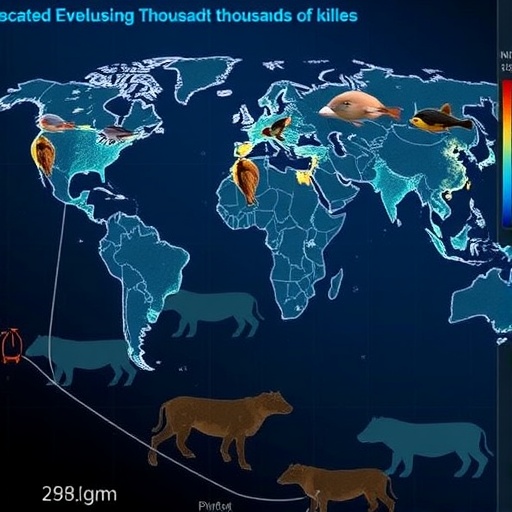
In a groundbreaking shift in our understanding of evolutionary biology, new research reveals that species separated by thousands of kilometers might still influence each other’s evolution through migratory predators. This novel insight challenges the long-held assumption that coevolution requires species to inhabit the same geographic area. Instead, migratory predators emerge as unexpected conduits for evolutionary change, connecting distinct ecosystems across continental divides and enabling what researchers term “allopatric coevolution.”
Researchers from the Hebrew University of Jerusalem, led by PhD student Akiva Topper alongside Dr. Yotam Ben-Oren and Dr. Oren Kolodny, have published their findings in the prestigious Proceedings of the National Academy of Sciences. Their work leverages computational modeling to simulate how migratory predators can facilitate mimicry between prey species that never physically encounter each other. This study opens up an uncharted avenue in evolutionary theory by suggesting that ecological processes traditionally considered local could in fact be influenced by global biological vectors.
Mimicry, a classic evolutionary example where species evolve similar warning signals—whether through coloration, behavior, or other sensory cues—to deter mutual predators, has conventionally been understood as a product of shared local environments. Species residing in overlapping habitats benefit when predators learn to avoid a common signal, minimizing the risk for each mimic species. However, the new study argues that predatory animals migrating between distinct geographic ranges can create similar selective pressures remotely, effectively transporting learned avoidance behaviors across continents.
At the heart of this phenomenon lies the interaction between defended prey species and their predators. Defended species possess traits such as venom or unpleasant tastes that discourage predation, and mimicry serves as a clever evolutionary strategy to amplify this deterrence. Using advanced simulation techniques, the researchers modeled populations separated by geography but linked through common predatory agents who periodically migrate between these populations. The results were striking—migratory predators indirectly encouraged the evolution of matching warning signals in isolated species, demonstrating an evolutionary bridge built by movement rather than proximity.
The implications extend far beyond mimicry. If migratory species can synchronize warning signals among geographically segregated prey, similar evolutionary interactions might govern a wide array of ecological relationships previously considered isolated. Predator-prey arms races between herbivores and plants, host-pathogen dynamics, and other coevolutionary processes might similarly be modulated by the movement of animals that connect distant ecosystems. This adds a fascinating layer of complexity to evolutionary biology, positioning migration as not only a driver of ecological connectivity but also as a potent evolutionary force.
Interestingly, the study identifies key parameters shaping this transcontinental coevolution. The strength of predation—the intensity of selective pressure experienced by prey—plays a crucial role. If predators aggressively cull individuals lacking effective warning signals, the evolutionary incentive to mimic across regions intensifies. Additionally, the timing of predator migration relative to the emergence of warning signals influences the extent to which mimicry can spread between isolated populations. These nuanced dependencies paint a complex but coherent picture of how migration and evolution intertwine.
Practical examples underscore the significance of these findings. Venomous snakes such as the Desert Horned Viper (Cerastes cerastes) in North Africa exhibit distinctive defensive behaviors and coloration that deter predators. Some harmless egg-eating snakes, which inhabit regions without these venomous species, have apparently evolved to mimic such displays—suggesting an evolutionary influence that transcends direct co-occurrence. Migratory birds of prey, monarch butterflies traveling vast distances between North America and Central Mexico, and even viruses vectored by migratory hosts may all act as migratory carriers of evolutionary knowledge, spreading learned avoidance across prey species or hosts spanning continents.
This research further prompts a reevaluation of how we interpret ecological data and evolutionary history. Traditionally, biologists viewed evolutionary change through the lens of local interactions captured in static geographic ranges. However, recognizing migratory predators as evolutionary messengers requires an integration of dynamic ecological processes with evolutionary models. It also inspires new empirical investigations to detect these subtle evolutionary signals in wild populations, potentially altering conservation strategies and enriching biodiversity understanding on a global scale.
Moreover, this conceptual leap could shed light on puzzling cases of mimicry and convergent evolution where geographic overlap is absent or minimal. By mapping migratory routes and assessing predator learning behaviors, scientists may uncover previously invisible links, illustrating how evolution propagates through complex meta-ecosystems. The study acts as a call to broaden the spatial and temporal scales at which evolutionary biology researches its fundamental questions.
Ultimately, migration emerges not merely as an ecological behavior but as a potent evolutionary force capable of shaping phenotypes across species separated by immense distances. This integrative perspective introduces a paradigm where distant ecosystems share evolutionary destinies, mediated through the journeys of migratory animals. By illuminating these hidden connections, the work of Topper, Ben-Oren, and Kolodny paves the way for transformative discoveries about the deep interrelatedness of life on Earth.
As we deepen our understanding of these processes, the notion of “evolutionary isolation” is redefined. The migratory highways linking ecosystems serve as conduits of selective pressures and learned behaviors, knitting a tapestry of coevolutionary interactions that span continents. Such insights remind us that the planet’s biological complexity cannot always be understood through a narrow, local lens—evolution is as migratory as some of its agents, a continuous and global narrative unfolding across vast scales of space and time.
Cite Scienmag News
Gavin Prescott. (June 15, 2026). Migrating Predators Could Connect Evolution Across Thousands of Kilometers. Scienmag. https://scienmag.com/migrating-predators-could-connect-evolution-across-thousands-of-kilometers/
Gavin Prescott. "Migrating Predators Could Connect Evolution Across Thousands of Kilometers." Scienmag, 15 June 2026, https://scienmag.com/migrating-predators-could-connect-evolution-across-thousands-of-kilometers/. Accessed 3 September 2026.
Gavin Prescott. "Migrating Predators Could Connect Evolution Across Thousands of Kilometers." Scienmag. June 15, 2026. https://scienmag.com/migrating-predators-could-connect-evolution-across-thousands-of-kilometers/


