


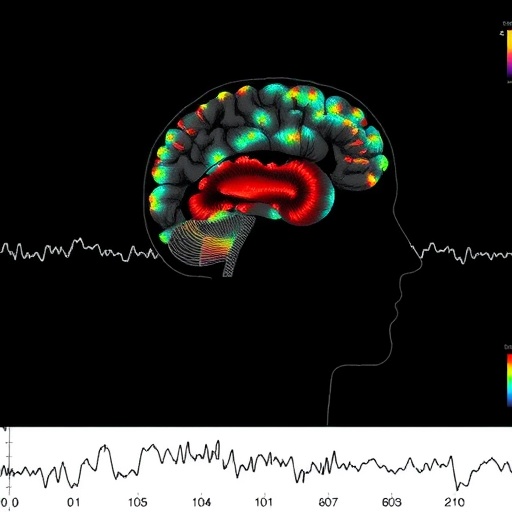
In a groundbreaking study poised to transform our understanding of neurodevelopmental disorders, researchers have uncovered a compelling link between excess beta-band oscillations in electroencephalography (EEG) and the clinical severity of Dup15q syndrome. This rare genetic condition, characterized by duplications on chromosome 15q11.2-q13.1, manifests with a broad spectrum of neurodevelopmental challenges, including cognitive impairment, seizures, and autistic features. The study, led by Hipp, Chamberlain, DiStefano, and colleagues, leverages advanced EEG analytics to decode the neural oscillatory signatures that may underpin the profound clinical symptoms observed in affected individuals.
At the core of this research lies the EEG beta frequency band, typically ranging from 13 to 30 Hz, a neural rhythm traditionally associated with motor control, attention, and sensory processing. While beta oscillations are a normal and essential component of brain function, their aberrant enhancement may signal pathological neural states. By meticulously analyzing EEG patterns across a cohort of individuals with Dup15q syndrome, the research team identified a striking elevation in beta-band oscillatory activity compared to neurotypical controls. Crucially, these heightened oscillations were not mere epiphenomena; their amplitude and distribution correlated robustly with standardized assessments of clinical severity, marking a significant stride in biomarker discovery for this enigmatic disorder.
The implications of detecting excess beta oscillations in Dup15q syndrome extend beyond diagnostic augmentation. Beta rhythms are traditionally linked to the intricate synchronization of cortical networks, facilitating information transfer and cognitive functions. Anomalous intensification in this band could reflect aberrant circuit dynamics, potentially tied to the genetic perturbations inherent to chromosome 15q duplications. This aberrancy might disrupt the delicate excitatory-inhibitory balance within neural microcircuits, thereby propagating symptomatic manifestations at a systems level. Such mechanistic insights open avenues for targeted neuromodulatory interventions aimed at restoring electrophysiological homeostasis.
Methodologically, the study employed high-density EEG recordings coupled with rigorous spectral decomposition approaches to delineate oscillatory components with precision. Participants underwent comprehensive neuropsychological evaluations, correlating EEG signatures with clinical metrics encompassing cognitive, behavioral, and motor domains. This multidimensional analysis allowed the research team to unravel nuanced relationships between beta-band power and specific functional deficits, illuminating the heterogeneity of symptom expression in Dup15q syndrome. Their statistical models accounted for confounding variables such as age, medication status, and seizure history, strengthening the validity of their findings.
One of the most captivating aspects of the research is the potential translational utility of beta oscillation monitoring as a biomarker for disease progression and treatment efficacy. In clinical settings, EEG offers a non-invasive, cost-effective window into cortical dynamics. Detecting electrophysiological markers that mirror symptom severity allows clinicians to track disease trajectories objectively, facilitating timely interventions. Moreover, the beta-band signature could serve as a surrogate endpoint in clinical trials of emerging therapeutics, including gene therapies and neuromodulation protocols, accelerating the development of personalized medicine for Dup15q syndrome patients.
The study also challenges prevailing paradigms about the neurophysiological underpinnings of neurodevelopmental disorders more broadly. By framing beta-band excess as a quantifiable and clinically relevant phenomenon, the findings contribute to a growing body of evidence implicating specific neural oscillatory patterns in neuropsychiatric conditions. This adds to our understanding of how genetic anomalies translate into circuit-level dysfunction, bridging gaps between molecular genetics, electrophysiology, and behavioral phenotypes.
Intriguingly, while beta oscillations are typically associated with motor and cognitive control networks, the researchers noted that excess beta power in Dup15q patients was pronounced in frontotemporal EEG leads, regions integral to executive function and social cognition. This regional specificity suggests that beta-band dysregulation in Dup15q syndrome may preferentially impact networks critical for complex cognitive operations and social behavior, providing a neural substrate for the widespread deficits observed clinically.
The study’s design underscores the importance of integrating technologically sophisticated neuroimaging modalities with rigorous clinical phenotyping. High-density EEG offers millisecond temporal precision, capturing transient oscillatory events that other neuroimaging tools, such as MRI, cannot resolve with comparable fidelity. Such temporal acuity is indispensable for parsing pathological neural rhythms, enabling the identification of oscillatory biomarkers like the excess beta-band activity reported here.
Looking beyond Dup15q syndrome, the implications of this research reverberate across the landscape of neurodevelopmental and neuropsychiatric disorders. Elevated beta oscillations have been reported variably in epilepsy, autism spectrum disorder, and schizophrenia, highlighting shared electrophysiological disruptions across diverse conditions. The specificity and sensitivity of beta-band alterations in Dup15q syndrome, however, may inform differential diagnoses and stratify patients according to neurophysiological profiles, paving the way for electrophysiology-driven nosology.
Future investigations are poised to explore the causal mechanisms driving beta-band excess in Dup15q syndrome. Potential etiologies include altered GABAergic interneuron function, excitatory synaptic overdrive, or maladaptive thalamocortical connectivity. Preclinical models, leveraging genetically engineered animals and in vitro preparations, offer promising routes to dissect circuit-level contributions. Concomitant empirical work in human subjects could employ longitudinal designs to evaluate how beta oscillations evolve over developmental timelines, revealing critical windows for therapeutic intervention.
The study also raises provocative questions about the interplay between beta oscillations and epileptiform activity frequently observed in Dup15q syndrome. Given the co-occurrence of seizures and augmented beta power, it remains to be determined whether heightened beta-band activity predisposes to epileptogenesis, reflects compensatory network adaptations, or coexists as an independent electrophysiological hallmark. Advanced signal processing techniques, including phase-amplitude coupling analysis, could elucidate the dynamics between beta oscillations and epileptic discharges.
Even more compelling is the potential for neuromodulatory strategies such as transcranial magnetic stimulation (TMS) or transcranial alternating current stimulation (tACS) to modulate pathological beta frequencies. By selectively attenuating excess beta power, these interventions might ameliorate core symptoms or reduce seizure susceptibility in Dup15q syndrome. Such approaches represent a thrilling frontier in personalized neurotherapeutics grounded in electrophysiological mechanisms.
In summary, the study by Hipp and colleagues represents a seminal contribution to the neurobiology of Dup15q syndrome, unveiling excess EEG beta-band oscillations as a quantifiable and clinically salient biomarker. Their work heralds a paradigm shift toward mechanistically informed diagnosis and treatment, grounded in the rich temporal dynamics of brain rhythms. As this line of inquiry matures, it promises to illuminate fundamental principles of brain dysfunction in genetic neurodevelopmental disorders and catalyze breakthroughs in precision medicine.
This research not only challenges neuroscientific dogmas but also embodies the convergence of genetic, electrophysiological, and clinical disciplines essential for tackling complex brain disorders. The elucidation of beta-band abnormalities in Dup15q syndrome opens horizons for innovative diagnostics and targeted interventions that hold the potential to dramatically improve patient outcomes and quality of life. By decoding the oscillatory language of the brain, scientists edge ever closer to unraveling the mysteries of human cognition and its discontents in disease.
Cite Scienmag News
Glenn Wilkins. (June 15, 2026). Elevated Beta EEG in Dup15q Signals Severity. Scienmag. https://scienmag.com/elevated-beta-eeg-in-dup15q-signals-severity/
Glenn Wilkins. "Elevated Beta EEG in Dup15q Signals Severity." Scienmag, 15 June 2026, https://scienmag.com/elevated-beta-eeg-in-dup15q-signals-severity/. Accessed 4 September 2026.
Glenn Wilkins. "Elevated Beta EEG in Dup15q Signals Severity." Scienmag. June 15, 2026. https://scienmag.com/elevated-beta-eeg-in-dup15q-signals-severity/


